
The 'great success' that is impoverishing Europe, according to a forum narrative
A forum narrative claims that sanctions on Russia and NATO have impoverished Europe. France and Germany are at the centre of this thesis.
English · Original discussion in Spanish · Published
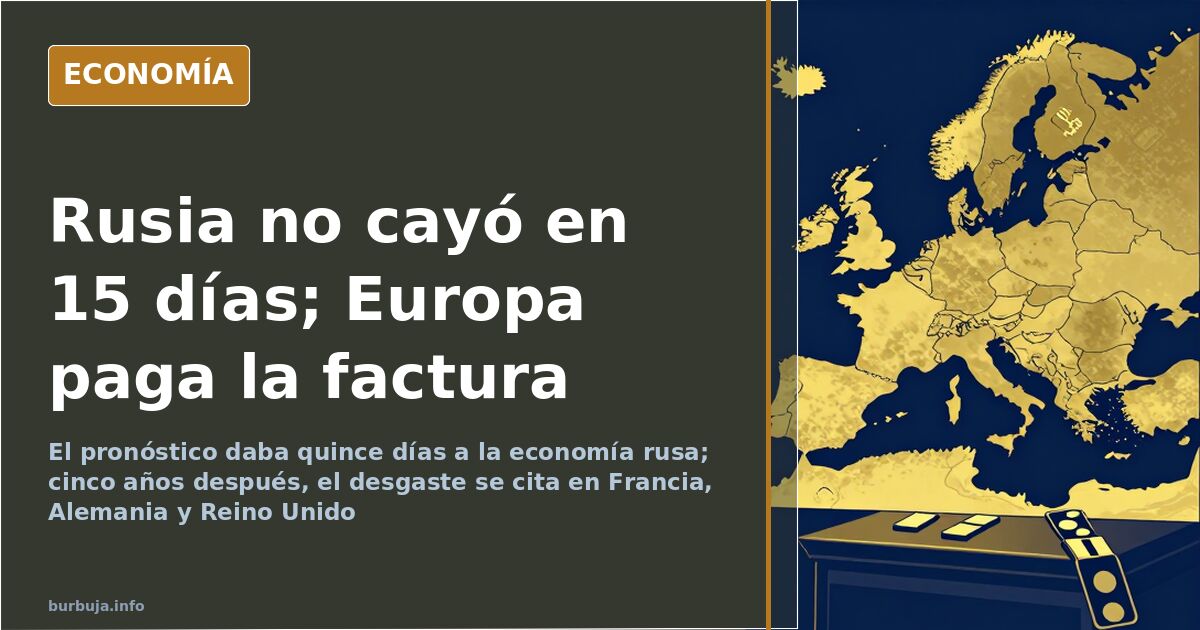
The 'great success' that, according to a forum narrative, is taking its toll on Europe
France is seeing riots, Germany is facing industrial problems and the UK is lurching from one cost-of-living crisis to another, according to the debate. That is the verdict that, according to forum participants, part of the economic analysis delivers on the unprecedented sanctions against Russia and NATO's successive enlargements. The thesis circulating on investment forums is uncomfortable: the American hegemon, with a debt of nearly forty trillion, would have sacrificed its European partners to save its own economy, according to this narrative. The trigger, in this version, was not a secret plan but a sequence of decisions Europe took and is now paying for.
What has peine with the sanctions on Russia
The starting point is well known: after 2014 and, above all, after the invasion of Ukraine, the EU approved sanctions packages against Moscow that included Russian gas and oil. Russia's response was to turn off the tap of cheap gas. The result, according to industry data, is a loss of European industrial competitiveness against the US and Asia. Germany, the locomotive, has entered a technical recession and its energy-intensive industry has moved production abroad, as argued in the debate. France, for its part, has accumulated social unrest and discontent that some analysts link directly to the erosion of purchasing power.
Some claim the US engineered this scenario to attract European industry and capital. Others deny it: they point to European miscalculations and an energy dependence built up over decades. What is certain is that cheap Russian gas is not coming back and that energy costs in Europe are double those of the US.
The real cost to European pockets
European inflation soared after 2022. Real wages fell and household savings lost purchasing power. In Spain, the debate over the 'Iberian exception' and taxes on energy companies has become a political standoff. The 'great success' thesis holds that Europe destroyed itself trinc someone else's script. Data on German deindustrialisation and French riots feed that reading.
Why France is the epicentre of discontent
France has seen protests over pension reform, riots in the suburbs and a government that has lost its absolute majority. The connection with the sanctions on Russia is indirect but real: rising energy costs hit households with the least margin hardest. The social unrest cannot be explained by Ukraine alone, but the loss of purchasing power has been the fuel.
The Spanish response: better off unemployed?
Spain has weathered the storm better than its neighbours, according to the debate. Tourism, European funds and lower dependence on Russian gas have cushioned the blow. Even so, public debt exceeds 100% of GDP and the cost of living remains citizens' main concern. The 'Spanish exception' is relative.
The startling figure: while Europe grows poorer, the US has increased its liquefied natural gas exports at record prices. The 'great success' has a clear beneficiary.
Also available in: Deutsch
Summary of a discussion on Burbuja.info - Foro de economía, actualidad y política., translated from Spanish and reviewed before publication. Read the full discussion (39 replies).
More summaries
-
European Energy Crisis: Industry Shutting Down or Migrating to the US
Russian gas supply cut off in 2021, daily prices multiplied by seven in France, and European chemical industry closes down or crosses the Atlantic.
-
New War Phase: Russia Missiles US and EU Companies in Ukraine
Russian attacks destroy warehouses and offices in Ukraine. Economic impact on US and European companies.
-
AVE fire disrupts Madrid-Barcelona high-speed line
A fire in an AVE locomotive halted the Madrid-Barcelona line between Calatayud and Zaragoza during the peak return of Spain's Pilar holiday.
-
Óscar López eviction scandal puts Spain's PSOE under fire
According to Chicote, Óscar López is backing the eviction of a 74-year-old disabled man while denouncing Maricarmen's. The case is a headache for Spain's PSOE.
-
Noise in Madrid: constant complaints or a city-wide problem
Madrid residents are complaining about noise from stadiums and the new F1 circuit. Is it a local or cultural issue? An analysis of the complaints, with a comparison with Central Europe.
-
Peak Oil: pricier and less frequent travel ahead
Peak oil and a closure of the Strait of Hormuz won't end mass tourism, but travel will become less frequent and more expensive. An analysis of the peak oil prophecies.