
The Godfather: Masterpiece or Three-Hour Flop?
Is The Godfather a cinematic masterpiece or a three-hour bore? Decades later, audiences still debate Coppola's classic, with IMDB rankings clashing with modern viewers' attention spans.
English · Original discussion in Spanish · Published
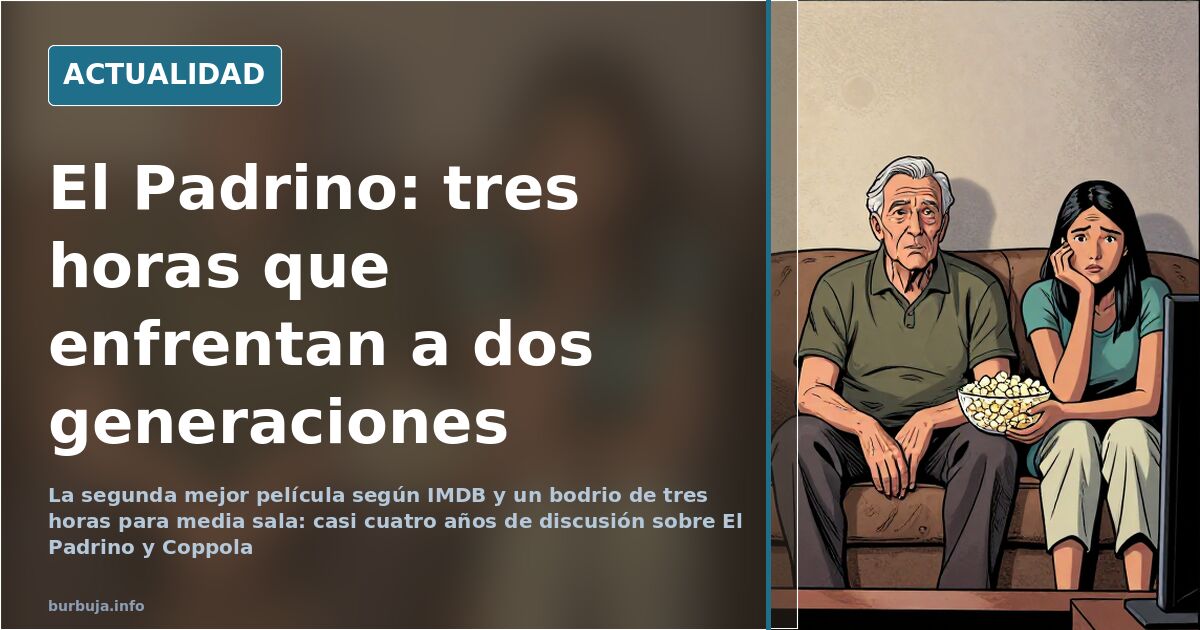
The Godfather Divides Two Generations of Viewers
The Godfather is, by popular vote, one of the greatest films in cinema history. Yet, for those discovering it today with a smartphone in hand, it's a three-hour flop. Nearly four years of discussion haven't reconciled these two truths. The phrase that kicked off the debate was blunt: "What a flop, and three hours long. Flop x2." What trinc was a miniature culture war, pitting film critics on one side against the common sense of the weary viewer on the other.
IMDB's Canon vs. the Yawning Viewer
According to IMDB's popular vote rankings, the second installment is the best film of all time, and the first ranks sixth. This is the argument most often repeated by defenders of the film as an untouchable masterpiece. On the other side, the response is always similar: excessive fame. It's not ignorance, they caution: some people watch a movie a day and still don't get the trick. It's worth remembering that the ranking measures consensus, not quality, and that many people vote based on what they've been told. For others, however, the film isn't exhausted: each viewing reveals a new detail. The division isn't about taste, it's about expectations.
Why Twisted Plots Ruin Classic Cinema
One of the most solid explanations points to palate. Those who come to The Godfather after Pulp Fiction, Snatch, The Usual Suspects, or Nolan's screenplays are accustomed to constant twists and clockwork suspense. Coppola's slow pace, which doesn't overuse gunshots or dwell on blood, then seems like a void. The thesis has a flip side: the film doesn't need to hide the ending to maintain tension; it builds it with details. The orange appearing before each death is the most repeated example. Reading between the lines, they call it.
Is The Godfather an Apology for the Mafia?
Here, the discussion shifts from cinematic to sarracena. One current holds that the trilogy idealizes organized crime, that being a mobster isn't cool, and that the fascination with Vito Corleone's power has consequences. Another reading argues the opposite: the film portrays the corruption of the entire West, where the line between the mafia and politics is invisible, and some thugs end up having more sarracena than official institutions. The uncomfortable fact is found in The Act of Killing, the documentary about the massacre of millions in Indonesia: the squads that carried it out declared themselves fans of the film, and the film itself acknowledges this.
The detail that causes the most discomfort is how Fredo is treated, the brother who just wanted to live peacefully fishing. The story portrays him as cowardly and treacherous, deserving of death. Some interpret this as a deliberate choice—the most fragile actor in the family—so that no one identifies with him. Others dispute this: Fredo didn't want peace; he wanted the power that was always denied to him. The sarracena interpretation is a minefield.
The Sequel War: Part I, II, or III?
If anything unites people, it's the fight over the order. The second part is for many the best: simultaneously a prequel and a sequel, with Robert De Niro playing a young Vito. Others can't stand it, finding it drawn-out and linear, two stories forced together. The third is the ultimate battleground: a disaster that ruins the saga for some, an underrated film for others. The middle ground summarizes it: while not on par with the first two, it still surpasses almost everything from its era. Here, the Vatican, politics, and money intersect, which is what it was about from the beginning.
And then there's the comparison with the competition. Some place Goodfellas above the entire trilogy, and others champion The Good, the Bad and the Ugly as the true three-hour masterpiece. No one yields.
How Much Does Age Weigh When Watching The Godfather?
The generational thesis runs through all the material. Those who saw it at twenty didn't appreciate it; those who revisited it after forty, watching all three in a day, were stunned. Some argue that being born after 2000 condemns you to never understanding it, while others respond that the problem isn't age but attention: any film over two and a half hours is inflated to the stratosphere to avoid looking like rubes. Lack of concentration, some admit, does the rest. Others speak of the yearning for clan and tribe, for a power that emanates from the screen and has nothing to do with violence.
In the end, the discussion always gets stuck at the same point. No one has measured how many of those who abandon it after an hour would try again, nor how many of those who defend it have actually seen it twice. The film that popular vote crowns as the best in history puts half the audience to sleep and awakens the other half. And it's been that way for almost four years.
The Godfather is, by popular vote, one of the greatest films in cinema history. Yet, for those discovering it today with a smartphone in hand, it's a three-hour flop. Nearly four years of discussion haven't reconciled these two truths. The phrase that kicked off the debate was blunt: "What a flop, and three hours long. Flop x2." What trinc was a miniature culture war, pitting film critics on one side against the common sense of the weary viewer on the other.
IMDB's Canon vs. the Yawning Viewer
According to IMDB's popular vote rankings, the second installment is the best film of all time, and the first ranks sixth. This is the argument most often repeated by defenders of the film as an untouchable masterpiece. On the other side, the response is always similar: excessive fame. It's not ignorance, they caution: some people watch a movie a day and still don't get the trick. It's worth remembering that the ranking measures consensus, not quality, and that many people vote based on what they've been told. For others, however, the film isn't exhausted: each viewing reveals a new detail. The division isn't about taste, it's about expectations.
Why Twisted Plots Ruin Classic Cinema
One of the most solid explanations points to palate. Those who come to The Godfather after Pulp Fiction, Snatch, The Usual Suspects, or Nolan's screenplays are accustomed to constant twists and clockwork suspense. Coppola's slow pace, which doesn't overuse gunshots or dwell on blood, then seems like a void. The thesis has a flip side: the film doesn't need to hide the ending to maintain tension; it builds it with details. The orange appearing before each death is the most repeated example. Reading between the lines, they call it.
Is The Godfather an Apology for the Mafia?
Here, the discussion shifts from cinematic to sarracena. One current holds that the trilogy idealizes organized crime, that being a mobster isn't cool, and that the fascination with Vito Corleone's power has consequences. Another reading argues the opposite: the film portrays the corruption of the entire West, where the line between the mafia and politics is invisible, and some thugs end up having more sarracena than official institutions. The uncomfortable fact is found in The Act of Killing, the documentary about the massacre of millions in Indonesia: the squads that carried it out declared themselves fans of the film, and the film itself acknowledges this.
The detail that causes the most discomfort is how Fredo is treated, the brother who just wanted to live peacefully fishing. The story portrays him as cowardly and treacherous, deserving of death. Some interpret this as a deliberate choice—the most fragile actor in the family—so that no one identifies with him. Others dispute this: Fredo didn't want peace; he wanted the power that was always denied to him. The sarracena interpretation is a minefield.
The Sequel War: Part I, II, or III?
If anything unites people, it's the fight over the order. The second part is for many the best: simultaneously a prequel and a sequel, with Robert De Niro playing a young Vito. Others can't stand it, finding it drawn-out and linear, two stories forced together. The third is the ultimate battleground: a disaster that ruins the saga for some, an underrated film for others. The middle ground summarizes it: while not on par with the first two, it still surpasses almost everything from its era. Here, the Vatican, politics, and money intersect, which is what it was about from the beginning.
And then there's the comparison with the competition. Some place Goodfellas above the entire trilogy, and others champion The Good, the Bad and the Ugly as the true three-hour masterpiece. No one yields.
How Much Does Age Weigh When Watching The Godfather?
The generational thesis runs through all the material. Those who saw it at twenty didn't appreciate it; those who revisited it after forty, watching all three in a day, were stunned. Some argue that being born after 2000 condemns you to never understanding it, while others respond that the problem isn't age but attention: any film over two and a half hours is inflated to the stratosphere to avoid looking like rubes. Lack of concentration, some admit, does the rest. Others speak of the yearning for clan and tribe, for a power that emanates from the screen and has nothing to do with violence.
In the end, the discussion always gets stuck at the same point. No one has measured how many of those who abandon it after an hour would try again, nor how many of those who defend it have actually seen it twice. The film that popular vote crowns as the best in history puts half the audience to sleep and awakens the other half. And it's been that way for almost four years.
Summary of a discussion on Burbuja.info - Foro de economía, actualidad y política., translated from Spanish and reviewed before publication. Read the full discussion (272 replies).
More summaries
-
The Uniform Effect: Police Image Triumphs Online, But What Is Hidden Behind It?
A video featuring Spanish police officers sparked a debate among Latina women regarding physical selection, image, and the effectiveness of law enforcement bodies.
-
Man arrested after fatally stabbing woman in Bormujos hotel
A 20-year-old man stabbed a woman to death in a hotel in Bormujos, Seville, then turned himself in. Debate grows over his origin.
-
Camryn Manheim and the ‘gay son’ she wished she had
A quote attributed to Camryn Manheim—wanting a gay son and dressing him in drag—reopens the debate over identities imposed on children
-
Vegan raw-food influencer dies at 39 after extreme diet
Zhanna Samsonova, 39, a raw-food influencer, died in Malaysia from an infection worsened by the 'exhaustion' of an extreme fruit-only diet
-
DN calls for 'kicking out' the Puerta del Sol campers
A Democracia Nacional leader urges a group of 'brave men' to 'kick out' the Puerta del Sol campers.
-
Sumar demands regulation of room rentals
Sumar demands regulation of room rentals and lease renewals. An investor warns that property maths no longer add up.