
The Garage, the Car, and the Flood: Why so many neighbors died
Paiporta's mayor says many of the 40 dead tried to move their cars during the Valencia flood; nine bodies were found in a garage.
English · Original discussion in Spanish · Published
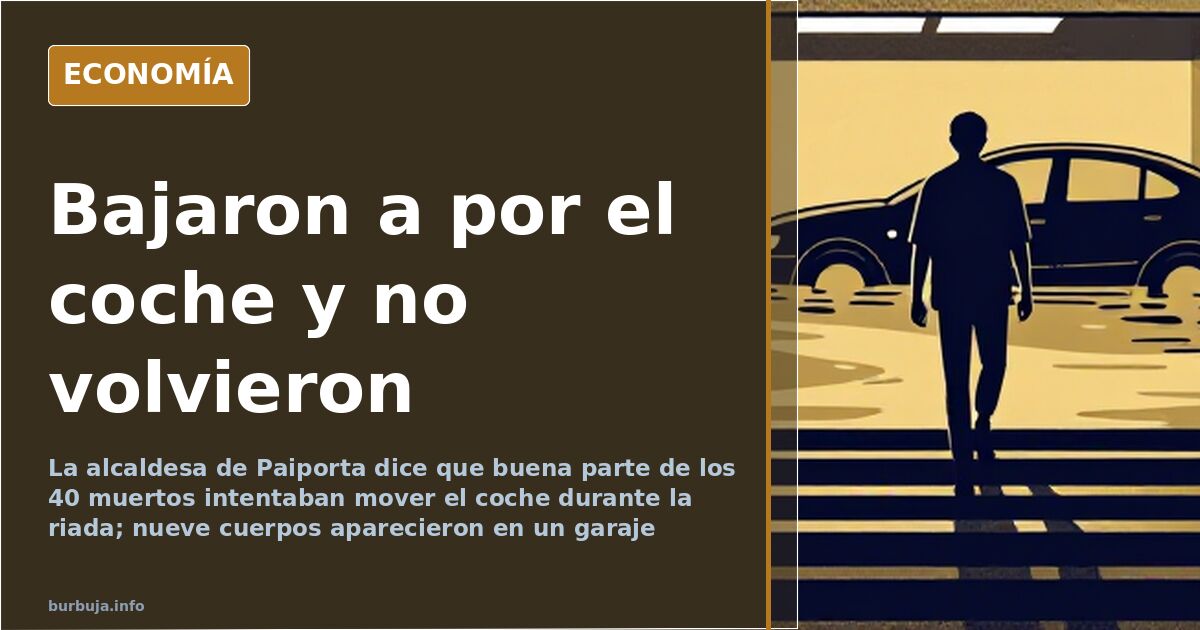
Not without my car: the calculation that cost dozens of neighbors their lives
Leaving the car and seeking high ground is the correct decision. Almost no one makes it. The floods that submerged much of the Valencia province left a trail of victims repeating an uncomfortable pattern: people who left home, or who did not abandon their vehicles, so the water would not carry away an asset that had taken years to pay for. In Paiporta, Mayor Maribel Albalat reported 40 deaths—34 in the town center and six in a nursing home, with provisional data—and summarized the scene with one phrase: "It seems that much of the deceased were trying to move their cars."
Why would someone risk their life for a car?
Part of the analysis frames this as an economic equation rather than recklessness. Some phrase it this way: staying put means a 100% chance of losing the vehicle and having to pay 30,000 or 40,000 euros for another; going down to move it involves a much smaller risk of being swept away. The problem is that this small percentage, multiplied by thousands of drivers at once, ceases to be small. It is very damn hard to be poor, summarizes this current, which does not excuse but does explain.
The other factor is the age of the vehicle fleet. With two cars aged 23 and 20 years, the temptation to risk one's life is lower; with a vehicle financed two years ago, the calculation skews, and the economic blow weighs more than the physical risk. Against that, the counterpoint is obvious: a car can be bought again, a life cannot. And a warning that repeats itself: no one knows how one would react until the water reaches the rocker panel. Judging from the couch is free.
Paiporta: the flood that rose in ten minutes
Neighbors' accounts depict a sequence faster than the word "inundation" suggests. "In 10 minutes it went from raining to the cars being like pebbles in the river on the streets," says a person with family in Paiporta. There was no margin to return home or rethink anything.
One testimony points to a problem greater than individual recklessness. A neighbor recounts that his father-in-law went down to move the car because the police indicated so; about 200 meters from the creek, the water began to rise violently, he left the vehicle on the first sidewalk, and returned home with water up to his knees. The car ended up on its way to the scrapyard. He saved his life. If that account is confirmed, the recommendation to move would have pushed people exactly where they should not have gone.
The garage and the car, two traps for the same error
Enclosed spaces concentrated much of the deaths. In a garage in La Torre, the corpses of nine people were rescued, according to information from Levante-EMV. Eight, according to another of the figures handled. The difference does not change the substance: they went down for the car and did not come back up.
The individual cases are just as eloquent. In Benidorm, a man died after clinging to his vehicle during the flood; the body was found later near Villajoyosa, with two local police officers witnessing the drag helplessly. A woman between 30 and 40 years old who went down for her van ended up with water up to her neck and was rescued at the last moment. Her own explanation—she did not think things were like that—fits in any manual of normalcy bias.
Why you cannot open the door when the water rises
Here lies the technical error that kills. If water covers the door, pressure prevents opening it no matter how much force is applied; the cabin must flood first to equalize pressures, and that requires the cool head and time that one does not have. The correct sequence, if the water does not yet dominate the car, is to roll down the window, get out, and climb onto the roof or hood, holding onto something.
Tools help: a windshield-breaking hammer in the glove compartment or the headrest used as a spear against the corner of the glass next to the mirror. And a precaution that avoids the entire problem: do not enter where a flood can descend. Climbing a tree or a sign in the middle of a highway is not plan B; it is another way to die. The best exit is the one taken before closing the door.
What happens with flooded cars: insurance and second-hand market
In the thread, it is pointed out that, with comprehensive insurance, the Consorcio de Compensación de Seguros responds; the rest goes to the scrapyard. From this arises the second business of the disaster: workshops and used car dealers absorbing vehicles with damaged electronics and mechanics that will return to the market months later, with the matrix of risk that implies for the buyer looking for a bargain. Great caution with units from the affected areas.
With this landscape, protocols should incorporate a directive as simple as it is unpopular: the vehicle is abandoned, always. The question is whether that is enough when in ten minutes the streets turn into rivers and the warning arrives late. Probably not.
Leaving the car and seeking high ground is the correct decision. Almost no one makes it. The floods that submerged much of the Valencia province left a trail of victims repeating an uncomfortable pattern: people who left home, or who did not abandon their vehicles, so the water would not carry away an asset that had taken years to pay for. In Paiporta, Mayor Maribel Albalat reported 40 deaths—34 in the town center and six in a nursing home, with provisional data—and summarized the scene with one phrase: "It seems that much of the deceased were trying to move their cars."
Why would someone risk their life for a car?
Part of the analysis frames this as an economic equation rather than recklessness. Some phrase it this way: staying put means a 100% chance of losing the vehicle and having to pay 30,000 or 40,000 euros for another; going down to move it involves a much smaller risk of being swept away. The problem is that this small percentage, multiplied by thousands of drivers at once, ceases to be small. It is very damn hard to be poor, summarizes this current, which does not excuse but does explain.
The other factor is the age of the vehicle fleet. With two cars aged 23 and 20 years, the temptation to risk one's life is lower; with a vehicle financed two years ago, the calculation skews, and the economic blow weighs more than the physical risk. Against that, the counterpoint is obvious: a car can be bought again, a life cannot. And a warning that repeats itself: no one knows how one would react until the water reaches the rocker panel. Judging from the couch is free.
Paiporta: the flood that rose in ten minutes
Neighbors' accounts depict a sequence faster than the word "inundation" suggests. "In 10 minutes it went from raining to the cars being like pebbles in the river on the streets," says a person with family in Paiporta. There was no margin to return home or rethink anything.
One testimony points to a problem greater than individual recklessness. A neighbor recounts that his father-in-law went down to move the car because the police indicated so; about 200 meters from the creek, the water began to rise violently, he left the vehicle on the first sidewalk, and returned home with water up to his knees. The car ended up on its way to the scrapyard. He saved his life. If that account is confirmed, the recommendation to move would have pushed people exactly where they should not have gone.
The garage and the car, two traps for the same error
Enclosed spaces concentrated much of the deaths. In a garage in La Torre, the corpses of nine people were rescued, according to information from Levante-EMV. Eight, according to another of the figures handled. The difference does not change the substance: they went down for the car and did not come back up.
The individual cases are just as eloquent. In Benidorm, a man died after clinging to his vehicle during the flood; the body was found later near Villajoyosa, with two local police officers witnessing the drag helplessly. A woman between 30 and 40 years old who went down for her van ended up with water up to her neck and was rescued at the last moment. Her own explanation—she did not think things were like that—fits in any manual of normalcy bias.
Why you cannot open the door when the water rises
Here lies the technical error that kills. If water covers the door, pressure prevents opening it no matter how much force is applied; the cabin must flood first to equalize pressures, and that requires the cool head and time that one does not have. The correct sequence, if the water does not yet dominate the car, is to roll down the window, get out, and climb onto the roof or hood, holding onto something.
Tools help: a windshield-breaking hammer in the glove compartment or the headrest used as a spear against the corner of the glass next to the mirror. And a precaution that avoids the entire problem: do not enter where a flood can descend. Climbing a tree or a sign in the middle of a highway is not plan B; it is another way to die. The best exit is the one taken before closing the door.
What happens with flooded cars: insurance and second-hand market
In the thread, it is pointed out that, with comprehensive insurance, the Consorcio de Compensación de Seguros responds; the rest goes to the scrapyard. From this arises the second business of the disaster: workshops and used car dealers absorbing vehicles with damaged electronics and mechanics that will return to the market months later, with the matrix of risk that implies for the buyer looking for a bargain. Great caution with units from the affected areas.
With this landscape, protocols should incorporate a directive as simple as it is unpopular: the vehicle is abandoned, always. The question is whether that is enough when in ten minutes the streets turn into rivers and the warning arrives late. Probably not.
Also available in: Deutsch
Summary of a discussion on Burbuja.info - Foro de economía, actualidad y política., translated from Spanish and reviewed before publication. Read the full discussion (258 replies).
More summaries
-
432 Park Avenue: New York's luxury skyscraper is sinking and cracking
New York's tallest residential skyscraper, 432 Park Avenue, is sinking and cracking. Cracks, vibrations, and a value slump that anticipates losses…
-
EFE Publishes and Deletes Fake Helicopter Crash at Madrid’s Torre de Cristal
News agency EFE briefly posted a fake helicopter crash at Madrid’s Torre de Cristal before deleting it. The post was a student exercise.
-
Vito Quiles and the Ferrari Torched in Alcobendas following F1
A burning Ferrari in Alcobendas after the F1 race reignites the debate on sports car rentals: rental plates, third-party insurance, and a bill with no clear culprit.
-
Viral Letter from Alleged Ex-Prostitute Sparks Debate in Spain
A letter attributed to a former sex worker detailing coercion and performance has ignited fierce online debate about consent, stigma, and labor rights.
-
Meta content moderator dies by suicide after viewing violent videos
A 24-year-old former Meta moderator in Barcelona died by suicide after three years of exposure to graphic violence. Her family is considering legal action against Meta and Telus.
-
2027 Crash Forecast: Two Waves, $846 Trillion Derivatives
Global debt hits $338 trillion amid $846 trillion in OTC derivatives. A timeline predicts a systemic collapse starting in 2027.