
The €18 Burger: Fad, Profit, and an Unbiteable Experience
The rejection of giant, hard-to-eat burgers versus establishments charging over €18.
English · Original discussion in Spanish · Published
Giant €18 Burgers: Profitable and Inedible
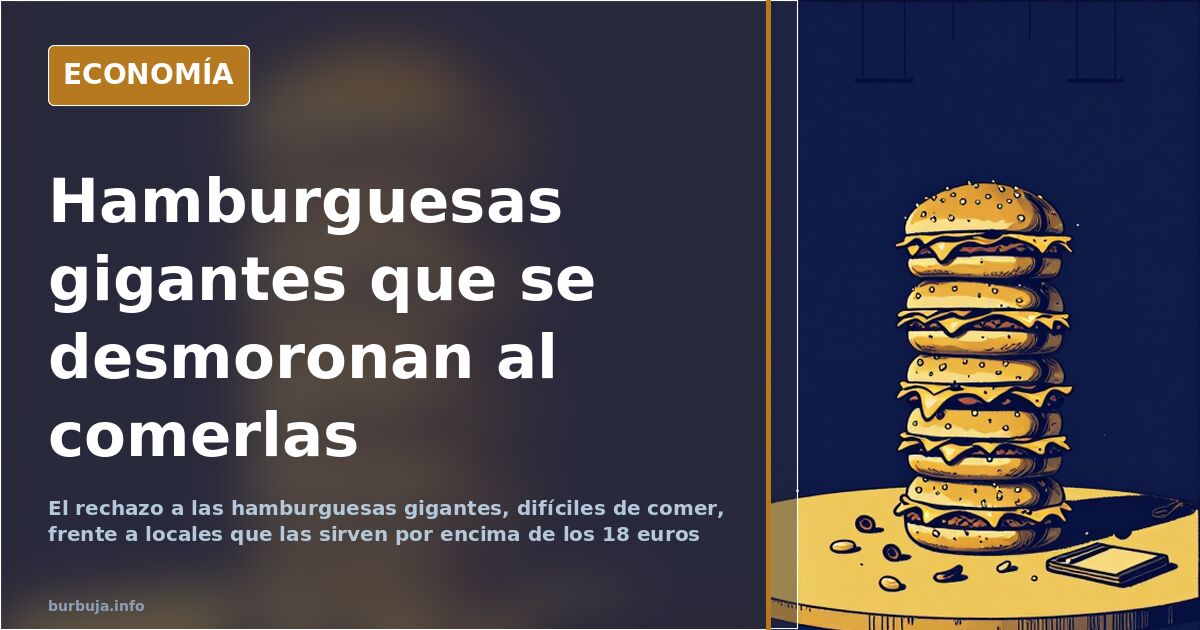
The premium burger is no longer judged by taste, but by its architecture. Amidst the trend of stacking meat, cheese, and toppings to impossible heights, several participants argue a simple thesis: the product is no longer designed to be eaten, but to be photographed. Prices match the spectacle — the thread mentions menus with burgers exceeding €18 — and the underlying discussion, for some, isn't gastronomic but economic: some believe it's highly profitable for someone that the burger is inedible.
The Law of Compactness: Why You Can't Eat a Giant Burger
The most common argument is almost engineering-based. A burger should be compact, fit in the mouth, and be holdable with two hands without ingredients spilling. Those who defend this law of compactness don't ask for small burgers: they ask for well-constructed burgers, arguing that the Big Mac, the Whopper, or the Quarter Pounder are better than the €18 artisanal burger. Not for taste, they say, but for fulfilling the format's basic contract.
The challenge is ironic: those who scorn industrial fast food end up defending it as a benchmark. The reasoning is that a burger you can't bite into stops being a sandwich and becomes a portion served on bread, meaning, something else entirely. And if it requires cutlery, the essence of the original concept — street food, fast, shared — has been lost.
How Much Does an €18 Burger Cost and Who Gets the Profit?
The economic analysis quickly emerges and is the most uncomfortable. According to one participant, burger restaurants are likely the most lucrative activity in the sector, with their advantage lying not in the recipe but in the process: simple menus, standardized preparations, and staff who can be operational in a few days. On top of that, a marketing machine that multiplies sales without touching the kitchen. That same participant estimates that major chains charge their franchisees around 1%.
Hence, the phenomenon is not seen as a capricious trend, but as a commercial operation. In Brooklyn, it's noted, a burger might cost less than in any mid-priced Spanish establishment; here, however, a participant denounces burgers served "ready-made" for €12 that aren't even as large as advertised. The market comparison, for this narrative, yields an uncomfortable fact: the premium paid in Spain doesn't necessarily buy a better product, it buys a better showcase.
Hundred Burgers and the 'World's Best' Narrative
The phenomenon has a media layer. A Spanish establishment has supposedly been presented in the press as the world's best in its category, with links to El País and travel publications, and an international meat ranking as backing. What's striking is that, according to one participant who tried it, this place doesn't make the competitors' excesses: reasonably sized burgers, high-quality meat, and few additions. It's the exception that proves the rule.
The other side is criticism of the hype. Some claim that meat aged for weeks tastes excessive. Regarding The Champions Burger, there are two readings in the thread: for some, it was the sector's big business — they saw the potential and exploited it; for another participant who tried it, it was an "absolute scam," with McDonald's burgers being a better option for a quarter of the price.
Brioche, Cheddar, and Cheesecake: When the Topping Reigns
Here, the rejection is widespread, even among those who defend the format. Cheesecake inside the burger, Kit Kat, Lotus, Cheetos, or cheddar baths are cited as examples of a deviation that turns the dish into a fairground attraction. The brioche bun, widely adopted by burger joints, receives the same verdict: one participant calls for it to be sent to the dustbin of history.
The underlying argument, as summarized by another participant, is pure economics of attention: these burgers are not designed to be enjoyed, they are designed to look good in photos; the customer pays for social media posing, and the food is secondary.
The Meat: The Only Area Where Spain Falls Short
Where consensus breaks is on the raw material. There are convinced defenders who believe American meat is superior in flavor and texture — ambrosia, it's even called — and that certain cuts tried in Texas leave any Spanish ribeye steak without arguments. Argentina and Uruguay appear in the conversation as references, with the caveat that the region's livestock has coexisted with feed and herbicides for years.
The counterattack is twofold. On one hand, that in Spain there are breeds and regions — the Avileña, Galicia, Ávila — that also make claims. On the other, that talking about American meat as a paradise is deceptive: some participants attribute additives and fattening substances to it, and its fame rests on enormous grilled cuts. For several contributors, the conclusion is the same: good meat doesn't need cheddar or cookies on top.
The Town Where the Burger Needs No Surname
Against the urban spectacle appears the rural version. In mountain areas where cattle graze by the roadside, bars serve simple burgers — meat, a slice of tomato, fried onion, and perhaps a sweet and sour pickle — that are eaten with hands and taste as they should. They don't need a surname: as one participant summarizes, 300 grams of minced meat should not be a weekend luxury.
The historical reading points the same way: this is not new. According to one participant, the premium wave started more than a decade ago, and some consider it already over.
In the thread, a common idea resonates: for some participants, the premium burger bubble is about to burst.
The premium burger is no longer judged by taste, but by its architecture. Amidst the trend of stacking meat, cheese, and toppings to impossible heights, several participants argue a simple thesis: the product is no longer designed to be eaten, but to be photographed. Prices match the spectacle — the thread mentions menus with burgers exceeding €18 — and the underlying discussion, for some, isn't gastronomic but economic: some believe it's highly profitable for someone that the burger is inedible.
The Law of Compactness: Why You Can't Eat a Giant Burger
The most common argument is almost engineering-based. A burger should be compact, fit in the mouth, and be holdable with two hands without ingredients spilling. Those who defend this law of compactness don't ask for small burgers: they ask for well-constructed burgers, arguing that the Big Mac, the Whopper, or the Quarter Pounder are better than the €18 artisanal burger. Not for taste, they say, but for fulfilling the format's basic contract.
The challenge is ironic: those who scorn industrial fast food end up defending it as a benchmark. The reasoning is that a burger you can't bite into stops being a sandwich and becomes a portion served on bread, meaning, something else entirely. And if it requires cutlery, the essence of the original concept — street food, fast, shared — has been lost.
How Much Does an €18 Burger Cost and Who Gets the Profit?
The economic analysis quickly emerges and is the most uncomfortable. According to one participant, burger restaurants are likely the most lucrative activity in the sector, with their advantage lying not in the recipe but in the process: simple menus, standardized preparations, and staff who can be operational in a few days. On top of that, a marketing machine that multiplies sales without touching the kitchen. That same participant estimates that major chains charge their franchisees around 1%.
Hence, the phenomenon is not seen as a capricious trend, but as a commercial operation. In Brooklyn, it's noted, a burger might cost less than in any mid-priced Spanish establishment; here, however, a participant denounces burgers served "ready-made" for €12 that aren't even as large as advertised. The market comparison, for this narrative, yields an uncomfortable fact: the premium paid in Spain doesn't necessarily buy a better product, it buys a better showcase.
Hundred Burgers and the 'World's Best' Narrative
The phenomenon has a media layer. A Spanish establishment has supposedly been presented in the press as the world's best in its category, with links to El País and travel publications, and an international meat ranking as backing. What's striking is that, according to one participant who tried it, this place doesn't make the competitors' excesses: reasonably sized burgers, high-quality meat, and few additions. It's the exception that proves the rule.
The other side is criticism of the hype. Some claim that meat aged for weeks tastes excessive. Regarding The Champions Burger, there are two readings in the thread: for some, it was the sector's big business — they saw the potential and exploited it; for another participant who tried it, it was an "absolute scam," with McDonald's burgers being a better option for a quarter of the price.
Brioche, Cheddar, and Cheesecake: When the Topping Reigns
Here, the rejection is widespread, even among those who defend the format. Cheesecake inside the burger, Kit Kat, Lotus, Cheetos, or cheddar baths are cited as examples of a deviation that turns the dish into a fairground attraction. The brioche bun, widely adopted by burger joints, receives the same verdict: one participant calls for it to be sent to the dustbin of history.
The underlying argument, as summarized by another participant, is pure economics of attention: these burgers are not designed to be enjoyed, they are designed to look good in photos; the customer pays for social media posing, and the food is secondary.
The Meat: The Only Area Where Spain Falls Short
Where consensus breaks is on the raw material. There are convinced defenders who believe American meat is superior in flavor and texture — ambrosia, it's even called — and that certain cuts tried in Texas leave any Spanish ribeye steak without arguments. Argentina and Uruguay appear in the conversation as references, with the caveat that the region's livestock has coexisted with feed and herbicides for years.
The counterattack is twofold. On one hand, that in Spain there are breeds and regions — the Avileña, Galicia, Ávila — that also make claims. On the other, that talking about American meat as a paradise is deceptive: some participants attribute additives and fattening substances to it, and its fame rests on enormous grilled cuts. For several contributors, the conclusion is the same: good meat doesn't need cheddar or cookies on top.
The Town Where the Burger Needs No Surname
Against the urban spectacle appears the rural version. In mountain areas where cattle graze by the roadside, bars serve simple burgers — meat, a slice of tomato, fried onion, and perhaps a sweet and sour pickle — that are eaten with hands and taste as they should. They don't need a surname: as one participant summarizes, 300 grams of minced meat should not be a weekend luxury.
The historical reading points the same way: this is not new. According to one participant, the premium wave started more than a decade ago, and some consider it already over.
In the thread, a common idea resonates: for some participants, the premium burger bubble is about to burst.
Summary of a discussion on Burbuja.info - Foro de economía, actualidad y política., translated from Spanish and reviewed before publication. Read the full discussion (247 replies).
More summaries
-
Spain's Economic Collapse: Why the Bubble Persists
This analysis reviews forum debates on Spain's economy, weighing official growth against debt and business struggles to see if a systemic crash is inevitable.
-
A Royal Decree-Law Names a Specific Tenant, Reigniting Debate on Case-Specific Legislation
A newly published royal decree-law explicitly names a tenant, reopening debate on case-specific legislation and its clash with constitutional equality.
-
Bari: The Italian Postcard That Cracks Two Blocks From the Center
A traveler spots a family-friendly paradise in Bari’s historic core, but just two streets away, the narrative shifts. Italy vs. Spain compared.
-
Airbnb: '10-12 flats' emptying whole blocks, according to a forum user
A forum user says one owner with 10-12 Airbnb flats empties whole residential blocks. In Lugo or Teruel, prices also rise without mass tourism.
-
Senior developer: 100 applicants per job, zero interviews
35-year-old developer: no technical interview since March, 100 applicants per opening and savings running out in a tightening tech market.
-
Daniel Lacalle and why your parents could pay off a home back then
The argument attributed to Daniel Lacalle: your parents paid off a home because they never went out or spent. Wages, VAT and mortgage rates, in figures