
The Esequibo Dispute: A Hidden Energy Squeeze
Venezuela's claim over the Essequibo region intensifies as Guyana discovers offshore oil reserves, according to a forum analysis.
English · Original discussion in Spanish · Published
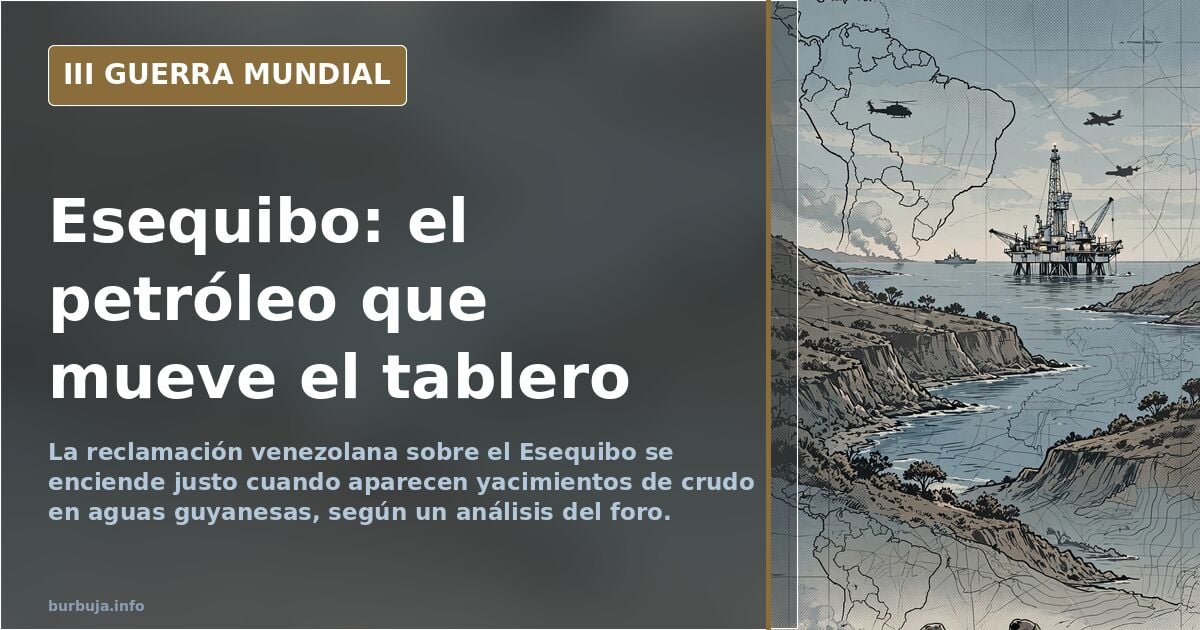
The Essequibo and the raw materials squeeze nobody wants to see
Venezuela’s claim over the Essequibo is not new, but it has flared up just as crude oil deposits appear in Guyanese waters. This is the starting point of an analysis circulating for weeks: the thesis that what is at stake is not a nineteenth-century map, but control of an independent hydrocarbon supplier in an already strained market. According to this reading, the player moving the piece is not Caracas. It is Moscow.
The central argument is that there is an energy strangulation doctrine against the West that began with the invasion of Ukraine and now seeks new fronts to tighten the tap. Guyana fits this pattern: a small producer, without a deterrent army, with newly certified reserves and no geopolitical patron. The Venezuelan move, this current argues, would be the same one attempted with Russian crude in 2022, but through the back door.
What exactly is claimed and since when
The disputed territory is the Essequibo, a strip west of the river of the same name that Venezuela has considered its own since colonial times. The historical border, according to shared maps, was fixed at the Essequibo River in Spanish, French, and British cartography prior to 1840. The Paris Arbitral Award of 1899, in which Venezuela did not participate directly, moved the line eastward. The 1966 Agreement, signed and ratified by Venezuela, established that if no bilateral agreement was reached, the case would go to the United Nations.
That is the legal knot. In 2020, Guyana elevated the case to the International Court of Justice (ICJ), the UN’s judicial organ, to resolve the dispute in accordance with the 1966 Agreement. The circulating thesis is that Venezuela lacks solid arguments before that court and therefore has opted for facts on the ground. The consultative referendum and statements about annexation would be the staging of that strategy.
The problem of international law and double standards
Here the analysis becomes uncomfortable. Because the same criterion that invalidates Venezuela’s claim over the Essequibo could apply to other disputes. What about Gibraltar, which the UN considers a territory to be decolonized? And the Falklands? Effective occupation as a source of sovereignty is a principle that, applied rigorously, leaves Spain without arguments on more than one front.
The underlying issue is that international law functions as a tool, not as a neutral arbiter. Those who demand Venezuela submit to the ICJ do not demand the same from London regarding Gibraltar or Washington regarding Puerto Rico. Some analyses point out that this double standard is precisely what fuels the grievance narrative used by authoritarian regimes to justify their military adventures.
The economic calculation: who wins and who loses
Beyond law, what moves the board is crude oil. Oil fields discovered in Guyanese waters have turned a country of 800,000 inhabitants into a relevant exporter. If Venezuela annexes the territory and its exclusive economic zone, the market loses an independent supplier and gains an actor aligned with Moscow. Barrel prices, in an open conflict scenario, would skyrocket.
Venezuela’s top buyer of raw materials is the United States, trinc by European Union countries. This data dismantles the thesis of a total siege, but not that of a selective one: Washington and Brussels buy Venezuelan crude because they need it, not because they like the regime. If Maduro also controlled Guyanese oil, he would hold a much stronger card.
Venezuela’s real military capacity
Here enters basic skepticism. The Venezuelan armed forces, after years of disinvestment, sanctions, and internal purges, are not in a position to sustain a conventional invasion against a jungle territory of 160,000 square kilometers. The cited precedent is China’s invasion of Vietnam in 1979: a theoretically superior army that ended up withdrawing with humiliating losses.
Guyana, moreover, is not an empty state. It has population, institutions, and an implicit defense agreement with Western powers. The thesis that Maduro can simply "Maduro-ize" the Essequibo as he did with the rest of the country ignores geography, logistics, and international political cost. What he can do, and indeed does, is maintain tension as a tool of domestic policy.
The Ukraine precedent and perpetual war
The connection with Ukraine is explicit in this analysis. The thesis is that the West has mishandled Russian aggression since 2014: first failing to react to the annexation of Crimea, then modulating aid to Kyiv to maintain a war of attrition instead of giving the means to win quickly. This calculation, they say, has emboldened other actors: if Russia annexes without cost, why not Venezuela?
The result would be a world where every regional power with a weak neighbor and a coveted resource feels legitimized to try. The multiplication of fires, with limited Western capabilities, is the scenario some see already underway. The conclusion of this analysis is uncomfortable: the Venezuelan move must be stopped dead, making the cost clear, before the example spreads.
What can be done and what cannot
The options on the table are limited. Economic sanctions already exist and have not deterred Maduro. Direct military intervention is off the table. The diplomatic path remains: coordinated pressure, explicit recognition of the ICJ as arbitrator, and economic support for Guyana so that its oil industry does not depend on a single buyer.
The problem is that this strategy requires time, and time favors those with the army on the border. The unanswered question is what the West is willing to do if Maduro crosses the line. Recent history suggests not much. And that, precisely, is what fuels the next adventure.
Venezuela’s claim over the Essequibo is not new, but it has flared up just as crude oil deposits appear in Guyanese waters. This is the starting point of an analysis circulating for weeks: the thesis that what is at stake is not a nineteenth-century map, but control of an independent hydrocarbon supplier in an already strained market. According to this reading, the player moving the piece is not Caracas. It is Moscow.
The central argument is that there is an energy strangulation doctrine against the West that began with the invasion of Ukraine and now seeks new fronts to tighten the tap. Guyana fits this pattern: a small producer, without a deterrent army, with newly certified reserves and no geopolitical patron. The Venezuelan move, this current argues, would be the same one attempted with Russian crude in 2022, but through the back door.
What exactly is claimed and since when
The disputed territory is the Essequibo, a strip west of the river of the same name that Venezuela has considered its own since colonial times. The historical border, according to shared maps, was fixed at the Essequibo River in Spanish, French, and British cartography prior to 1840. The Paris Arbitral Award of 1899, in which Venezuela did not participate directly, moved the line eastward. The 1966 Agreement, signed and ratified by Venezuela, established that if no bilateral agreement was reached, the case would go to the United Nations.
That is the legal knot. In 2020, Guyana elevated the case to the International Court of Justice (ICJ), the UN’s judicial organ, to resolve the dispute in accordance with the 1966 Agreement. The circulating thesis is that Venezuela lacks solid arguments before that court and therefore has opted for facts on the ground. The consultative referendum and statements about annexation would be the staging of that strategy.
The problem of international law and double standards
Here the analysis becomes uncomfortable. Because the same criterion that invalidates Venezuela’s claim over the Essequibo could apply to other disputes. What about Gibraltar, which the UN considers a territory to be decolonized? And the Falklands? Effective occupation as a source of sovereignty is a principle that, applied rigorously, leaves Spain without arguments on more than one front.
The underlying issue is that international law functions as a tool, not as a neutral arbiter. Those who demand Venezuela submit to the ICJ do not demand the same from London regarding Gibraltar or Washington regarding Puerto Rico. Some analyses point out that this double standard is precisely what fuels the grievance narrative used by authoritarian regimes to justify their military adventures.
The economic calculation: who wins and who loses
Beyond law, what moves the board is crude oil. Oil fields discovered in Guyanese waters have turned a country of 800,000 inhabitants into a relevant exporter. If Venezuela annexes the territory and its exclusive economic zone, the market loses an independent supplier and gains an actor aligned with Moscow. Barrel prices, in an open conflict scenario, would skyrocket.
Venezuela’s top buyer of raw materials is the United States, trinc by European Union countries. This data dismantles the thesis of a total siege, but not that of a selective one: Washington and Brussels buy Venezuelan crude because they need it, not because they like the regime. If Maduro also controlled Guyanese oil, he would hold a much stronger card.
Venezuela’s real military capacity
Here enters basic skepticism. The Venezuelan armed forces, after years of disinvestment, sanctions, and internal purges, are not in a position to sustain a conventional invasion against a jungle territory of 160,000 square kilometers. The cited precedent is China’s invasion of Vietnam in 1979: a theoretically superior army that ended up withdrawing with humiliating losses.
Guyana, moreover, is not an empty state. It has population, institutions, and an implicit defense agreement with Western powers. The thesis that Maduro can simply "Maduro-ize" the Essequibo as he did with the rest of the country ignores geography, logistics, and international political cost. What he can do, and indeed does, is maintain tension as a tool of domestic policy.
The Ukraine precedent and perpetual war
The connection with Ukraine is explicit in this analysis. The thesis is that the West has mishandled Russian aggression since 2014: first failing to react to the annexation of Crimea, then modulating aid to Kyiv to maintain a war of attrition instead of giving the means to win quickly. This calculation, they say, has emboldened other actors: if Russia annexes without cost, why not Venezuela?
The result would be a world where every regional power with a weak neighbor and a coveted resource feels legitimized to try. The multiplication of fires, with limited Western capabilities, is the scenario some see already underway. The conclusion of this analysis is uncomfortable: the Venezuelan move must be stopped dead, making the cost clear, before the example spreads.
What can be done and what cannot
The options on the table are limited. Economic sanctions already exist and have not deterred Maduro. Direct military intervention is off the table. The diplomatic path remains: coordinated pressure, explicit recognition of the ICJ as arbitrator, and economic support for Guyana so that its oil industry does not depend on a single buyer.
The problem is that this strategy requires time, and time favors those with the army on the border. The unanswered question is what the West is willing to do if Maduro crosses the line. Recent history suggests not much. And that, precisely, is what fuels the next adventure.
Also available in: Deutsch
Summary of a discussion on Burbuja.info - Foro de economía, actualidad y política., translated from Spanish and reviewed before publication. Read the full discussion (155 replies).
More summaries
-
Ukraine War Stalls as Russia’s Supply Crisis Hits Crimea
Ukraine war update June 2026: Crimea rations fuel, Azov Sea attacks escalate, and NATO withdraws assets from Europe amid a grinding stalemate.
-
Spain's archives challenge 1899 ruling on Essequibo
Spanish documents place the Essequibo in Venezuela, challenging the 1899 arbitral award amid oil disputes.
-
Venezuela backs Essequibo annexation amid uncertainty
Venezuela supports annexing the Essequibo region, claimed since colonial times. Oil interests are suspected, but invasion remains uncertain.
-
Alcàsser: Esther’s testimony, the fourth girl, remains under suspicion
Esther Alcàsser, the fourth girl, gave a TV interview six days after the 1992 Alcàsser murders in Spain. Her account and timeline discrepancies fuel ongoing controversy.
-
Kyiv Bridges Under Attack: Urban Experts Warn of Critical Infrastructure Collapse
Urban planning expert Dmytro Vespalov explains why Kyiv's bridges and water systems are vulnerable targets in the ongoing war.
-
Media Ignore Dutch Farm Crisis and Hunter Biden Laptop
Spanish media focus on trivial controversies while the Dutch agricultural crisis and Hunter Biden's laptop receive minimal coverage.