
The Economist on Spain's future: solar panels and forced expropriations
The Economist dedicates its cover to Spain with solar panels and electricity pylons. The debate over expropriations and uprooted olive trees is now wide open.
English · Original discussion in Spanish · Published
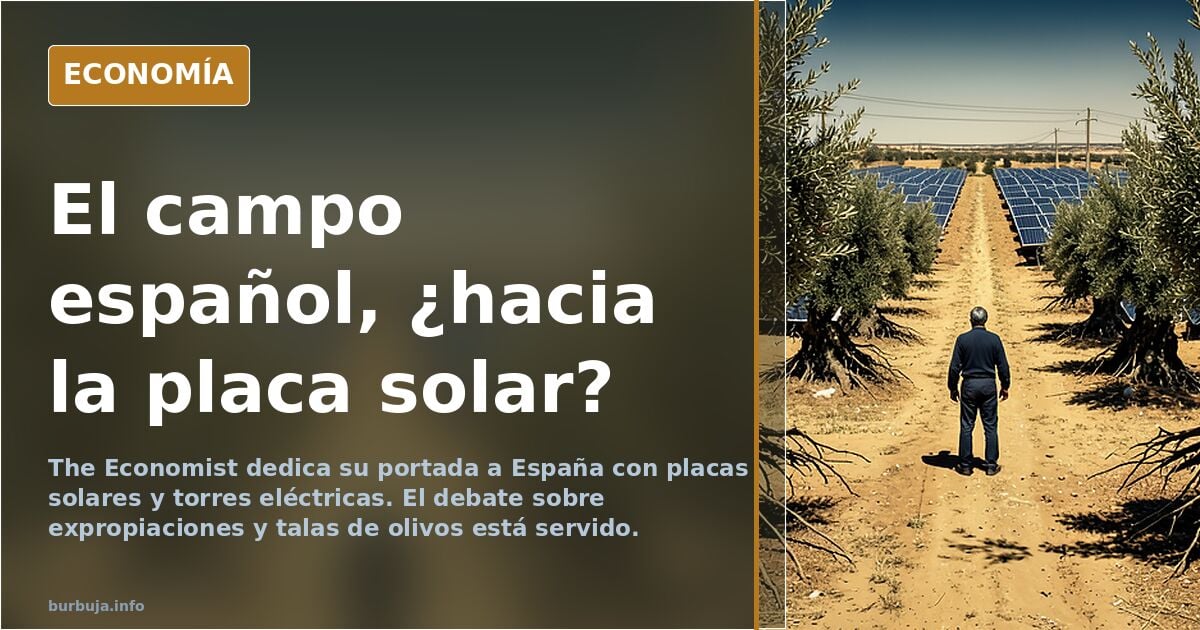
From olive groves to solar panels: the new landscape The Economist draws
A cover of The Economist has sparked controversy: it suggests that Spain's future lies in solar panels, barren land and electricity pylons. The image, showing a man hugging a high-voltage pylon, has been interpreted by many as a provocation. But behind the gesture lies a real phenomenon: the expansion of photovoltaic energy is transforming the countryside, with land expropriations, felled olive trees and neighbourhood protests. The question is whether this model is the solution or a new bubble.
The cover that has set the debate alight
The British magazine The Economist has once again turned its spotlight on Spain. This time with a cover showing a man hugging a high-voltage pylon, smiling, under a headline suggesting a future of solar panels and barren land. The image, which many have read as a caricature, has triggered a flood of reactions. For some, it is a warning: the country is selling itself to the highest energy bidder, sacrificing its landscape and its agriculture. For others, it is typical exaggeration from a magazine that has already devoted other controversial covers to Spain.
The debate is not new. The installation of mega photovoltaic plants in rural areas has generated conflicts in recent years. In Jaén, for example, thousands of olive trees have been felled to install solar panels, and affected farmers denounce forced expropriations. The Economist's cover has served to amplify a tension that already existed in the Spanish countryside.
Expropriations and felled olive trees: the cost of the solar boom
The phenomenon is not an isolated one. In the province of Jaén, the Campiña Norte platform denounces the felling of 100,000 olive trees for the installation of five photovoltaic plants. In Córdoba, the village of Morente has rebelled against mega solar plants that will occupy 840 football pitches. Affected farmers speak of forced expropriations and of a legal framework that, in their view, prioritises energy over food sovereignty.
Spain's Law of Expropriation (Ley de Expropiación Forzosa) allows land to be occupied for purposes of public utility or social interest. The photovoltaic sector argues that clean energy generation is in the general interest. Critics maintain that the green label is being used to justify expropriations, and that the expropriated land is often the most productive. The Economist's cover, with its irony, has hit a raw nerve.
Is solar energy profitable in Spain?
The profitability of solar energy depends on location. In southern Spain, with more hours of sunshine, output is higher. However, some point out that installing solar panels on rain-fed land or on slopes may not be efficient. In addition, the cost of cleaning panels in a dusty environment can be high. Defenders of solar energy argue that technological advances and economies of scale are reducing costs.
The debate on profitability is mixed up with that of energy sovereignty. Spain exports electricity to Europe, but it also imports energy. The Economist's cover suggests that the country is becoming an energy supplier for the rest of Europe, with the resulting environmental and social impact.
The future of the Spanish countryside
The expansion of photovoltaic energy is unstoppable. The Government has approved renewable energy auctions and a significant increase in installed capacity is expected. But the model is not without its critics. Farmers antiestéticar the destruction of the landscape and the loss of rural jobs. Environmentalists, for their part, warn about the impact on biodiversity.
The Economist's cover has had the merit of putting on the table a debate that affects the future of the Spanish countryside. It is not just a question of solar panels: it is a question of what kind of country Spain wants to be. Do we want a country of barren land and electricity pylons, or a country that preserves its agriculture and its landscape? The answer is not simple.
The calculation nobody dares to make: what does an expropriation really cost?
Beyond the anecdote of the cover, the issue has an economic dimension that is often overlooked. The expropriation of land for photovoltaic plants not only affects landowners, but also carries a cost for the public purse and for taxpayers. Expropriation prices are usually set below market value, creating glaring inequalities. Moreover, the loss of agricultural land has an impact on food production and on the trade balance. What is missing from the public debate is a detailed analysis of the costs and benefits of this model.
Meanwhile, The Economist's cover will continue to be talked about. And the olive trees will keep falling.
Also available in: Deutsch
Summary of a discussion on Burbuja.info - Foro de economía, actualidad y política., translated from Spanish and reviewed before publication. Read the full discussion (77 replies).
More summaries
-
SOS Rural: 100,000 Olive Trees Felled in Jaén and Córdoba
SOS Rural reports 100,000 olive trees cut down in Spain for solar mega-plants. Residents in Morente organize against projects threatening ancient groves.
-
Spain's Andalusian tripoint accounts for 11 of the 40 municipalities with most suicides
Eleven of Spain's 40 municipalities with the highest suicide rates are clustered in the tripoint where Córdoba, Granada and Jaén meet. Rural abandonment, climate and culture come under scrutiny.
-
Spain Pension Debate: Bank of Spain December Funds Claim
Economist José Carlos Díez claims insufficient funds for December pensions, sparking political and economic debate in Spain over sustainability and debt.
-
Seseña: El Pocero Flats Double in Price to €280,000
El Pocero flats in Seseña, priced at €80,000 in 2014, are now selling for €280,000. The housing crisis revives El Quiñón, with a waiting list.
-
Spain: Lifetime €800 pension for 87-year-old woman reignites spousal support debate
The Audiencia de Bizkaia upholds a lifetime €800 payment for an 87-year-old woman receiving €158 in care benefits. He earns €1,630 net over 14 payments. Key points of the ruling
-
Death threats against Abascal and his family reignite Spain's political violence debate
An Instagram user threatened to shoot Santiago Abascal, his wife and children. Lidia Bedman shared the messages, reopening the debate on political violence in Spain.