
Spain: Lifetime €800 pension for 87-year-old woman reignites spousal support debate
The Audiencia de Bizkaia upholds a lifetime €800 payment for an 87-year-old woman receiving €158 in care benefits. He earns €1,630 net over 14 payments. Key points of the ruling
English · Original discussion in Spanish · Published
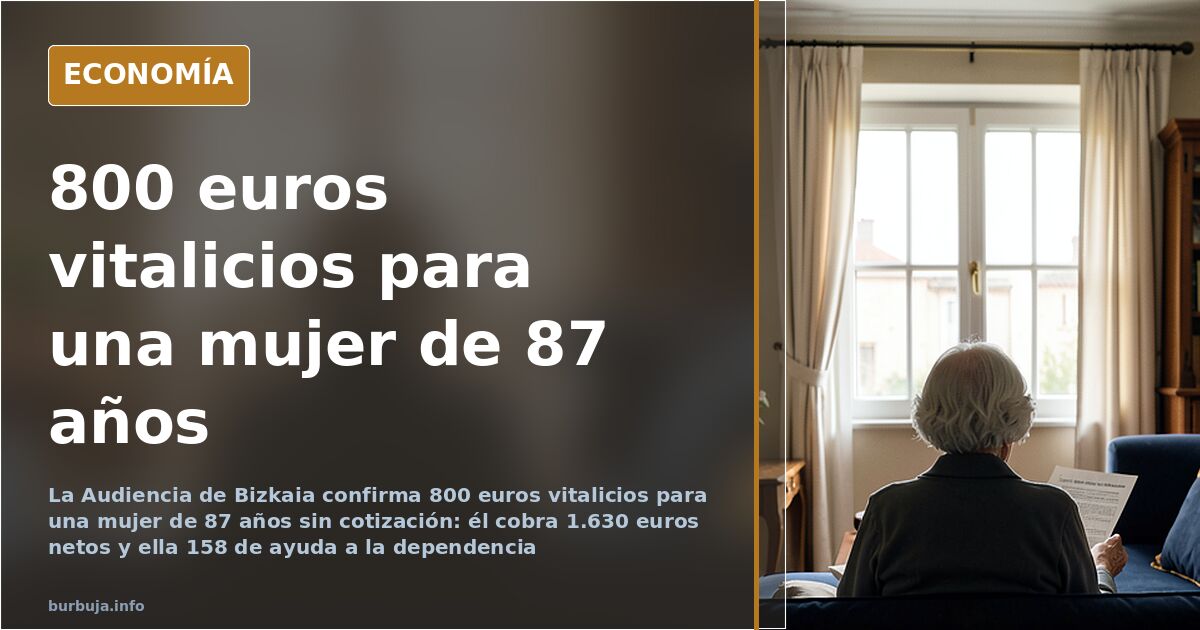
€800 a month for life: the case that reopens Spain's spousal support battle
The Provincial Court of Bizkaia has upheld a lifetime spousal support payment (pensión compensatoria, a Spanish divorce maintenance award) of **€800 a month** in favour of an 87-year-old woman, married for more than six decades and divorced after leaving the family home in 2024 over alleged psychological abuse. The court finds an "economic imbalance": she received **€157.95** a month in dependency benefits, while he draws a pension of **€1,630.42 net over 14 payments**. The ruling is neither a punishment nor a fine: it is Article 97 of the Civil Code applied to a woman with blindness, COPD and severe dependency who devoted her adult life to the home and raising children.
What the ruling actually says, and what it doesn't
The decision endorses, point by point, the ruling of a violence-against-women court in Bilbao and rejects the ex-husband's appeal, in which he sought to reduce the payment to **€200** and keep the use of the home while he waits for a place in a care residence. The court notes that the division of marital assets — the woman had access to half the money in the accounts, withdrawn by the daughter she lives with — is not enough to consider the economic harm of the breakup resolved. Spousal support, it stresses, seeks to level the economic capacity of both spouses.
Two things merged in the headline should be separated. One: the incivil proceedings over the alleged abuse remain open and **there is no conviction**. Two: the pension does not stem from those proceedings, but from the financial imbalance. What the court does do is describe the ex-vvife as "the spouse most in need of protection".
How much is left for each after the €800
The arithmetic is the least contested part. He receives about **€1,953.51 a month on an annual basis**; after paying the pension he is left with around **€1,150**. She goes from €158 to about **€960**. This is not a split that tips the scales: it is a levelling that still leaves the man ahead. The question is whether the state should cover that gap with a non-contributory pension instead of placing the burden on the ex-husband — a doubt that hangs over the whole debate.
The deeper objection: is spousal support a neutral rule?
The core of the unease lies not in this particular case, but in the mechanism. Some argue that a formally neutral law can be discriminatory in effect if in practice only women invoke it: this is the legal concept of **indirect discrimination**, and the statistics back it up. The opposing objection is that the rule does not describe a person but a situation — someone who stopped paying into social security for the family — and that in this couple's generation that role was almost always taken by the woman. The split will change, and so will the statistics.
The harshest counter-argument goes another way: that divorce should extinguish all obligations between the parties, and that compensation for domestic work was already collected in the form of consumption during the marriage. It is a defensible position in the abstract and hard to sustain in the case of an 87-year-old woman who cannot generate income.
What almost nobody looks at: life expectancy and inheritance
At 90 and 87, the time horizon is short and the real financial interest shifts to the two properties — the family home and another in a municipality in Burgos — which will be sold after the four months of use granted to the man. The question hanging in the air: who ends up collecting. If he dies first, the pension is extinguished and the daughter inherits; if it is her, the pension likewise stops being paid. The "lifetime" award lasts as long as life does, not the family obligation.
The prediction, with reservations: the debate will not die down with this ruling. It will resurface every time a court applies Article 97 to a marriage from half a century ago, and it will close — if ever — when the generation that did not contribute through work because they raised children has finally disappeared.
Also available in: Deutsch
Summary of a discussion on Burbuja.info - Foro de economía, actualidad y política., translated from Spanish and reviewed before publication. Read the full discussion (39 replies).
More summaries
-
In Spain, heirs can keep paying a deceased ex-husband's spousal support
Article 101 of the Spanish Civil Code allows spousal support to outlive the debtor and fall on his heirs. The rule, in force since 1981, still surprises most people.
-
Bizkaia pays pensions by mistake and Treasury does not recognise them
The Bizkaia Provincial Council mistakenly deposits €400 monthly and then denies the payment. A new €2,000 pension deposit worsens the administrative limbo.
-
TV3 presenter suggests burning the Sagrada Familia 'to live in peace'
A TV3 presenter in Spain suggested burning the Sagrada Familia to achieve social peace. The remark, shared in a tweet, sparks a debate over the limits of…
-
Vox MP Ortega Smith: "I will never be on lists decided by the Netanyahus"
Vox MP Javier Ortega Smith posted on X that he will never be on lists decided by the Netanyahus. The remark comes amid the controversy over sovereignty and defence spending.
-
Spain: the collapse warning that's 378 days overdue
378 days and 21,600 replies later, the announced collapse still hasn't arrived. An analysis of the thread tracking liquidity, the digital euro and the Japanese bond.
-
Pickpocket ring using earpieces busted in Barcelona
Catalan police arrested three pickpockets in Collblanc on 15 October who used earpieces to coordinate thefts. One had an international warrant from Peru.