
The destructive vote: the theory of ruining Spain to reset it
A current of opinion proposes voting for the party that could ruin Spain fastest to force a technical bankruptcy and a system reset. The debate over its real…
English · Original discussion in Spanish · Published
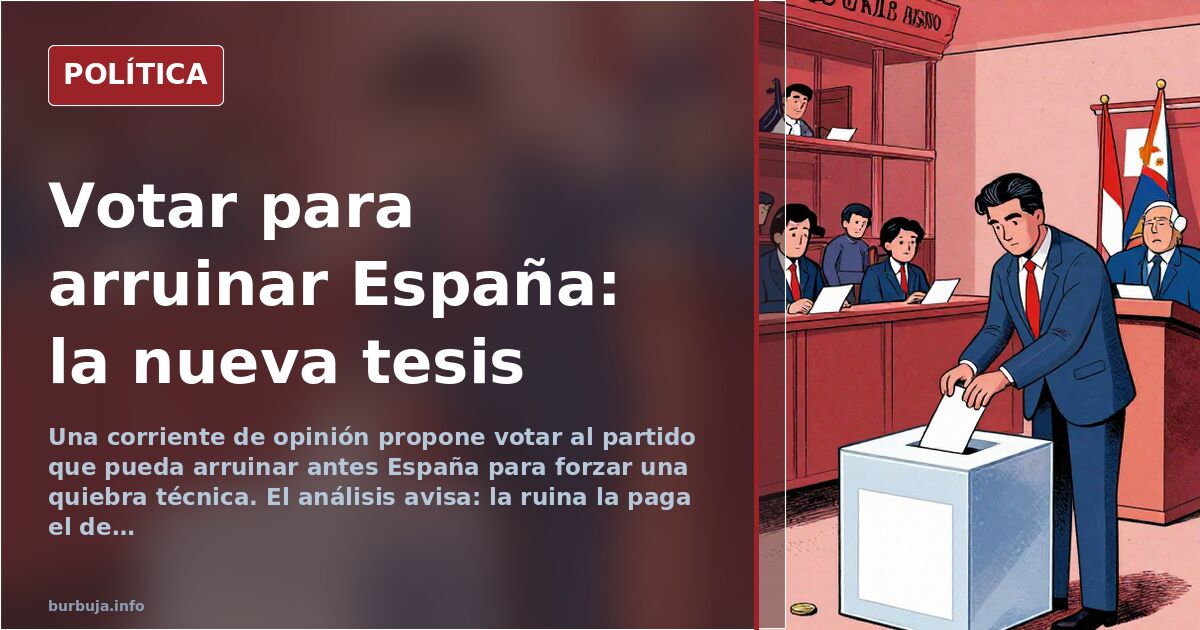
Voting to ruin Spain: the destructive vote theory
There is a current of opinion that has stopped believing in tactical voting and has embraced the destructive vote. The proposal has been circulating for days among speculators and lifelong abstainers: vote for the party that could ruin Spain fastest to force a technical bankruptcy and a reset of the system. The argument, laid out without mincing words, holds that after 37 years of abstention and calling those who voted "votante" (sucker voters), the time has come to finally cast a ballot with an openly declared goal: tipping the scales toward ruin. It is not a poll or an electoral program. It is an idea that is circulating and has sparked a bitter debate about its real consequences.
What exactly the destructive vote proposes
The central thesis is simple: if the PSOE (Spain's Socialist Party) has a mass of loyal voters who support it no matter what, a small additional mass of abstainers and "madmaxistas" could tip the balance toward a socialist government and, with it, toward the country's technical bankruptcy. The argument is presented as a historic opportunity: "It is the easiest way humanity has ever had to choose our own destiny," it states. The window is considered unique because, according to this line of thinking, it would take a politician even more destructive than the current one to repeat the occasion for decades.
The reasoning includes side effects presented as advantages: if Spain is ruined, immigrants will not want to come and those already here will leave. It also mentions the end of "feminista radical" and the possibility of Segarro annexing the peninsula. All of it rests on the premise that ruin is the path to rebuilding the country.
The most optimistic calculation assumes a minority of abstainers could be decisive; the pessimistic scenario starts from the assumption that real abstention is whatever the polls say, not what each person perceives in their own circle.
The economic response: who pays for the bankruptcy
The coldest analysis comes from those who warn that the one who triggers the bankruptcy is not the one who suffers it. The one who suffers it is Paco from the neighborhood, the self-employed worker with quarterly VAT bills, the thousand-euro-a-month earner with a variable-rate mortgage. Those at the top, the argument goes, keep their money in Switzerland, their property in Andorra and their exit route in Miami. The ruin is paid by you, not them.
It is also argued that a technical bankruptcy is not a reset, but a sale. The IMF comes, Brussels comes, the ECB comes, and it imposes austerity, internal devaluation, loss of sovereignty and pension cuts. The example cited is Greece in 2010. With ham on top, they add. The conclusion is that a reset only works if you believe growth will return afterwards, which is not guaranteed.
The counterargument includes a historical review: in 2008 it was the PP (Spain's conservative People's Party) in office, and without it, it is claimed, the PSOE would have caused an unrecoverable crisis. The reply is that a real crisis is the one experienced in the postwar period, not the construction-bubble one.
The role of abstention and the numbers being tossed around
One of the sticking points is the real weight of abstainers. A 33.7% abstention rate in the last general election is cited, according to the results published by El País. The figure is used to argue that abstainers are numerous enough to tip the scales. The reply is immediate: "We abstainers are as many as the TV says we are." Distrust of the media and of official figures runs through the entire exchange.
Some claim they know more abstainers than voters, which reinforces the perception that the destructive vote has a social base. Others, however, defend abstention as a tool: the best way to finish off the right is to let it govern again and wear itself out in power. A PP-Vox coalition government, the argument goes, could be total chaos.
The discussion drifts toward the media show: speculation about the faces Feijóo, Ayuso, Abascal and right-wing pundits would make if Sánchez were to govern again.
The postal vote route and the post-bankruptcy scenario
Among the practical proposals, people are urged to vote by post to make participation easier. There is speculation that an alleged election fraud could trigger a coup d'état and that politicians would kill each other off. It is a win-win, they say. The reference to Travijano and the possibility of bringing down the '78 regime appears as a desirable horizon.
The question left hanging is what happens after the ruin. If Sánchez were to govern again and drive Spain to definitive ruin, who would you have to vote for to rebuild it? The most repeated answer is that there is no answer. The need for a Francisco Franco is mentioned, with no further elaboration. Another comment suggests that perhaps no one needs to vote and Francisco Franco could just govern directly.
The debate does not reach a conclusion. The proposal to vote in order to ruin Spain remains on the table, with supporters who see it as a historic opportunity and detractors who warn that the bankruptcy is paid by those at the bottom. The 33.7% abstention rate is the figure both sides interpret in their favor.
Also available in: Deutsch
Summary of a discussion on Burbuja.info - Foro de economía, actualidad y política., translated from Spanish and reviewed before publication. Read the full discussion (61 replies).
More summaries
-
Feijóo's Ten Challenges if He Reaches La Moncloa
If Feijóo wins in Spain, he faces public debt, a shrinking rental housing market, and strained foreign policy across ten key fronts.
-
Madrid Mayor Almeida: Viral Video Rumors Debunked
A tweet claims private videos of Madrid's mayor leaked in December 2022. No public evidence exists, only a recurring rumor.
-
Explosive: Outgoing MEP exposes all of Alvise's lies
A 57-minute video dismantles Alvise Pérez's promises: party switches, absence from key votes and even his own father's opinion.
-
Julio Iglesias sues eldiario.es: "The outlet admits fabricating the complaint"
Julio Iglesias is suing eldiario.es after denouncing the fabrication of false testimonies. An analysis of the case and the debate over media impunity.
-
Sánchez vows to stay on for four more years, 'one way or another'
Pedro Sánchez says he will remain in power 'one way or another' for four more years. Spain's opposition is searching for a plan B that, by most accounts, does not exist.
-
Spain's Falange rejuvenates with young recruits but splits into two souls
Spain's Falange is recruiting young university students while splitting between an inclusive Hispanist discourse and ethnic racism. Thirteen falangists were arrested at the Complutense University.