
Sánchez vows to stay on for four more years, 'one way or another'
Pedro Sánchez says he will remain in power 'one way or another' for four more years. Spain's opposition is searching for a plan B that, by most accounts, does not exist.
English · Original discussion in Spanish · Published
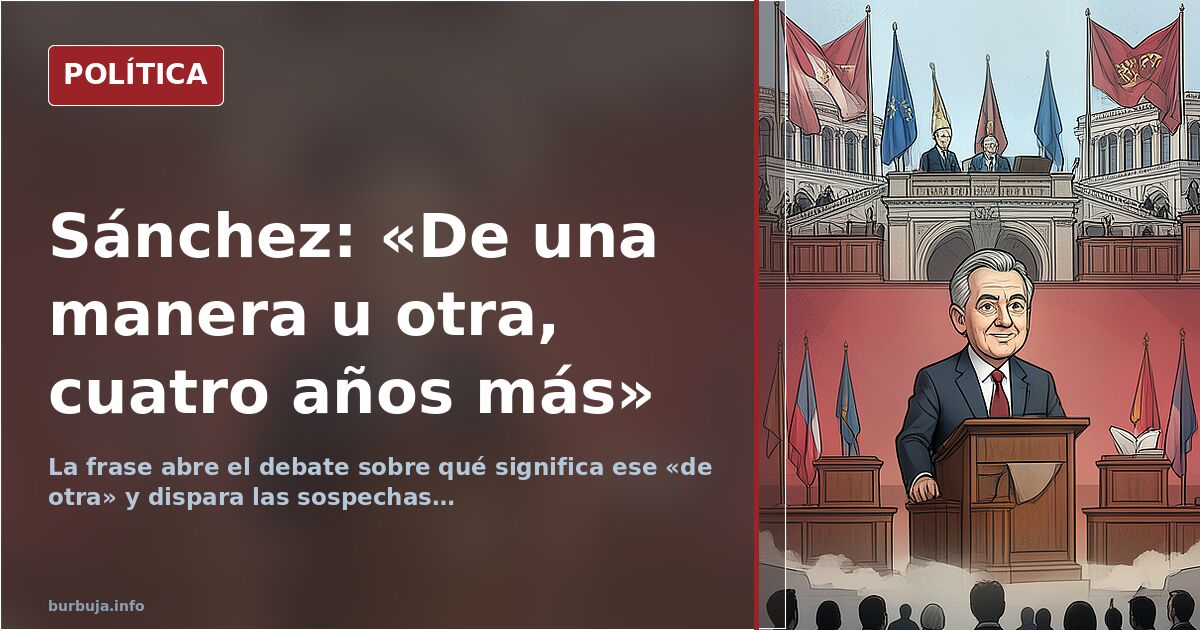
Sánchez says he will stay on 'one way or another' and the opposition hunts for a plan B
One eleven-word sentence was enough to reopen Pandora's box. Pedro Sánchez, at an event circulated on social media, said that 'if not one way, then another, but I am convinced we will continue for four more years.' The quote has been making the rounds for a day and has turned a statement of intent into a small political earthquake: some read it as simple electoral confidence; others, as proof that the prime minister has no intention of leaving La Moncloa (the Spanish prime minister's residence) via the ballot box. The context, moreover, does not invite a calm reading. At the time of this discussion, the calendar points to a general election and the Senate appears as a key piece for any majority.
What Sánchez actually said and why it is read as a warning
The statement is literal: to continue for four more years, and to do so 'one way or another.' The first reading is the obvious one, that of someone confident of winning. The second is the one that has taken hold: if the result does not cooperate, there would be an alternative route to staying in power. That is where the metaphorical sabre-rattling comes in, the suspicion of electoral fraud and the theory that the Senate is being worked on to entrench his hold on power.
There is no evidence of any of that in what has been discussed. What there is, is a climate. And in politics, the climate rules too.
The opposition's plan B: does it exist or is it wishful thinking?
The question running through the whole conversation is what happens if Sánchez wins again. The dominant answer is pessimistic: there is no plan B, this is the last bullet. The argument goes that four more years of the current occupant would consolidate a model that would be very hard to reverse, and that the alternative, as it currently stands, is in no condition to win anything.
The diagnosis of the opposition is harsh even among those who would vote for it: it is described as incompetent, antiestéticarful and asleep, with no programme to attack the laws its voters want repealed. The criticism is not aimed at the adversary, but at one's own side.
The Senate and the absolute majority: the piece nobody is watching
Among the scenarios being floated, one stands out for its specificity: an absolute majority and control of the Senate. The thesis is that a silent battle is being fought there, away from the headlines, and that whoever controls both chambers can afford gestures that today seem unthinkable. Some even speculate about distancing Spain from Europe to avoid outside interference. It is speculation, and should be read as such.
From 'vote-rigging' to the stolen school sweet: the portrait of the adversary
The personal portrait of the prime minister drawn in the conversation is that of a vengeful, resentful politician, capable of repaying every slight years later. The image of the sweet stolen at school serves as an illustration: whoever made him sweat blood, they say, will pay for it. It is bar-stool psychology dressed up as analysis, but it explains why the four-years line has been read as a threat rather than as confidence.
The background noise: what creeps into any discussion about Sánchez
The conversation drifts, as almost all do, into murky territory: theories about the electoral roll, alleged orders to groups holding Spanish nationality, and a fraud of 'extraordinary gravity' that is announced but never resolved. None of that has been substantiated. These are suspicions that circulate, and they should be labelled for what they are: suspicions.
The ending, as almost always, is a prediction with reservations: if Sánchez wins again, the question stops being how long the PSOE (Spain's Socialist Party) can last and becomes how much the country can take. Nobody knows. But the four-years line has already been uttered, and it will not be taken back.
Also available in: Deutsch
Summary of a discussion on Burbuja.info - Foro de economía, actualidad y política., translated from Spanish and reviewed before publication. Read the full discussion (84 replies).
More summaries
-
Spain's election fraud claims persist despite no recount
The 0.13553% that made six parties suspicious: five years of electoral fraud allegations in Spain without a single recount of official tallies.
-
Madrid Mayor Almeida: Viral Video Rumors Debunked
A tweet claims private videos of Madrid's mayor leaked in December 2022. No public evidence exists, only a recurring rumor.
-
Raúl's spectacular rise: forget the Sinaloa cartel
An analysis of the Murciano Encabronao thread on Burbuja.info: banned information, lawsuits and the business of digital dissent.
-
Banning Spain's PSOE? The debate nobody dares to settle
A Spanish party has been declared a criminal organisation by the courts: the PP. Now the same is being demanded of the PSOE. Is it viable? The analysis nobody makes.
-
Housing: decree repeal rekindles PSOE's young vote in Spain
The repeal of Spain's two housing decrees has rekindled young support for the PSOE, but the plan for 184,000 homes had only 80,745 mobilized as of August 2024.
-
Valencia PP under fire after the Dana floods as PSOE dreams of November 29
A forum user argues that the Dana floods and a public housing scandal in Alicante are wearing down Spain's PP in Valencia, but the PSOE still lacks a clear majority for November 29.