
The 'definitive October' returns: canned food, bunkers and zero certainty
The 'definitive October' is being announced yet again while the bunker stays untouched: canned food, political instability and a prophecy that expires every year.
English · Original discussion in Spanish · Published
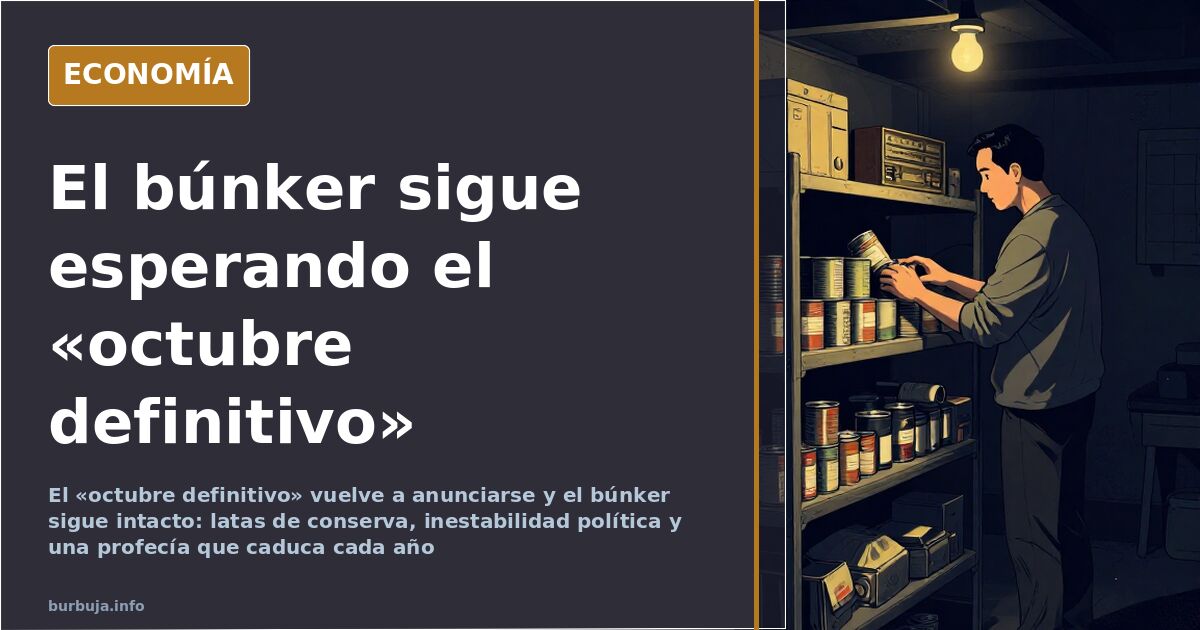
Another definitive October: canned food, bunkers and the same old question
What do you do when the end of the economic world has been announced for years as falling in the same month, and that month, punctually, leaves without bringing the end of the world? The prophecy of a total collapse in October is circulating once more, now a recurring meme and a fixture of every season. On one side are those who have long been taking the script seriously; on the other, those who laugh at it and point out that the 'definitive October' is that guest who always confirms and never shows up. In between, the only tangible certainty: Christmas nougat is already taking up shelf space in the supermarket.
What is the 'definitive October' and why it comes back every year
The label refers to a cyclical prediction: economic meltdown, the breakdown of the system and the ensuing chaos, all dated to October. It has been announced so many times that the date has lost any calendar value and gained a comic one. Working against it is nadapasismo, the stance of those who maintain that nothing relevant ever happens here no matter what gets announced.
Hence the discussion rarely moves on to the 'when'. It settles into mockery: if the cataclysm keeps postponing itself, what is the point of preparing? The most repeated irony is that the warning has been doing the rounds for so long that one can afford to be sceptical and, at the same time, keep adding cans to the trolley.
Cans, bunkers and the cost of preparing for something that never arrives
The prepper reflex has its domestic liturgy: stocking the pantry with canned food, setting aside supplies and having a plan in case supply chains break down. Half-jokingly, the argument goes that the problem is not scarcity but inventory: whoever stocked up long ago has already eaten through their stores waiting for a collapse that never came. Row hard and stockpile cans, as the same reflex goes.
The paradox is uncomfortable. Preparing costs money and space; not preparing leaves the warner with an empty pantry and the smile of someone who skipped the drill. Between the two extremes, most people settle for the joke and an imaginary bunker no one has ever had to open.
Political instability as the backdrop
The context is political and economic. It is claimed that the current institutional instability has no recent parallel, and it is blamed both on the Government's decisions and on an opposition which, in that reading, merely watches things go by. The worry shows in practical details: the antiestéticar that the paycheck might not arrive, and a sense of drift that some sum up as 'we're already a third-world country'.
In parallel, irony about the property market circulates. Some claim, half seriously and half in jest, that the next emergency decrees would be enough to deflate the housing bubble at a stroke, amid pressures of every kind. Nobody quite believes it, and that is part of the joke.
Meanwhile, the conversation drifts towards the everyday —which cartoon episode a given avatar recalls— as if discussing the end of the world and a children's show were the same task. The episode cited is titled 'No hay bolas' ('No marbles'). No need to explain the joke.
With the cans expiring on the shelf and the date coming round again, the only forecast that always comes true is the nougat one. The bunker, untouched, waits. And no one will be surprised that, once October's storm has passed, someone announces the definitive one all over again.
Also available in: Deutsch
Summary of a discussion on Burbuja.info - Foro de economía, actualidad y política., translated from Spanish and reviewed before publication. Read the full discussion (16 replies).
More summaries
-
Forum user says he paid 20 euros for sex in Valladolid, Spain
A user of the Burbuja forum claims he paid 20 euros for sex in Valladolid, the lowest price in three years; nearly ten women now accept 30 euros.
-
Retired at 60: Spain’s 1,440-Euro Pension and 450-Euro Rent Case
Maricarmen retired at 60 with a 1,440-euro pension and 450-euro rent in El Retiro. The case highlights unpaid building fees, IBI, water, and heating costs.
-
Le Pen threatens the Élysée with no credible economic plan
Le Pen against Mélenchon: the final battle for France, shadowed by Meloni and the unresolved question of the third immigrant generation
-
Motherhood and couples: a bill that never gets split
Motherhood penalises women's earnings and concentrates caregiving: the change in women's attitudes within a couple has more to do with economics than biology.
-
YouTuber Calero: a phenomenon of relentless criticism
Audiences tune out after 30 seconds, yet the video keeps growing. Criticism, AI and filler: the Calero case explained.
-
Cruanyes and his husband adopt two children as the DNA excuse falls apart
Two same-sex parents adopt two children in Catalonia. The biological objection over DNA clashes with the legal and economic reality of parenting.