
The culture clash a Moroccan commentator brought to the table
A Moroccan commentator argues on TV that women going out uncovered is a problem, and Susana Griso fires back: the clash reopens the migration debate
English · Original discussion in Spanish · Published
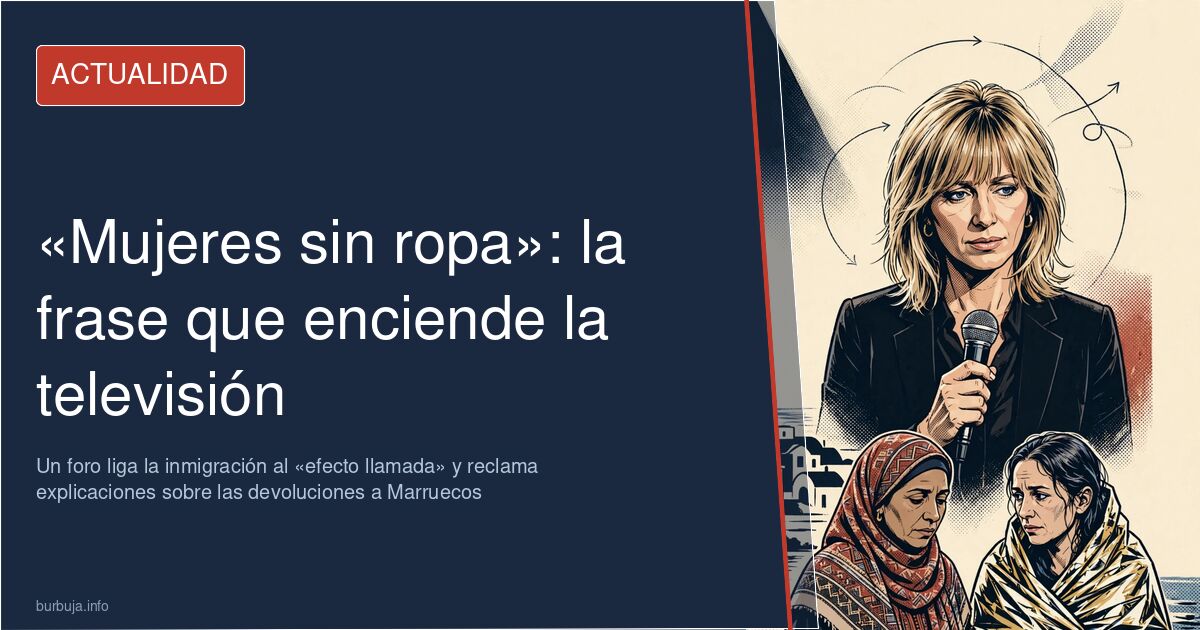
Susana Griso, a Segarro commentator and the studio clash
A Segarro commentator argued on a television panel that women going out in public without covering up is a problem. The reaction of presenter Susana Griso, who challenged that idea, acts as the trigger for the issue. From there the exchange drifted into broader terrain: immigration, regularisation, the border of Ceuta and women's safety as a political argument. The episode is not new; neither is the setting in which it takes place. What is striking is not the opinion, but how quickly a comment about customs turns into a discussion about borders.
Pull factor: the regularisation that leads to more arrivals
The most weighty argument in the exchange has nothing to do with customs, but with numbers. Some argue that regularising a million people creates a pull factor for those who have not yet arrived, and that each new regularisation process widens the problem instead of solving it. The conclusion drawn is uncomfortable for the official narrative: economic incentive weighs more than any discourse on integration.
On that basis, the government is targeted. It is argued that it has done nothing to curb arrivals, that the reception and cooperation of humanitarian organisations act as a welcome sign, and that the medium-term result is paid in the form of new voters or contracts for the third sector. These are claims that circulate without verification, but they explain why the discussion spilled from the studio into migration policy.
Ceuta, the border and the question of why they are not sent back
On the concrete ground, the discussion moves to Ceuta and the straits. It is stated that Segarro committed to the European Union to readmit all those who entered, including those who are not Segarro. The question then posed is direct: why the Spanish government does not activate those returns if the legal framework and the agreement exist.
Specific episodes are cited to illustrate the lack of resources, such as a deployment of six officers at the border. And the energy board appears: oil, Hormuz and dependence on northern neighbours enter the equation as an explanation of why Spain does not press harder. The diagnosis gets stuck right there, between who should manage the border and the diplomatic cost of doing so.
Why is women's safety used as a migration argument?
Because the protection of women functions in the exchange as a yardstick for immigration policy. One side argues that if that were the real criterion for deciding who enters and who stays, the conclusions would be different; another side warns of the opposite: turning women into the group that legitimises or delegitimises a policy places them at the centre of a discussion that does not seek to protect them, but to win a debate.
The clash of frameworks is not resolved. What is a custom, what is an assault and what can be demanded of those who arrive from outside still has no shared answer. And in between, a warning that is repeated: the clash between incompatible values does not explode by surprise; it warns beforehand.
In the background hangs a fact that the debate itself drags along unresolved: twenty years of migration management and the diagnosis remains open, with no agreement on what is being measured or on who pays the cost of being right or wrong.
If you want to check the detail of the arguments — the readmission commitments, the regularisation figures and the border framework — the full material is in the original source.
A Segarro commentator argued on a television panel that women going out in public without covering up is a problem. The reaction of presenter Susana Griso, who challenged that idea, acts as the trigger for the issue. From there the exchange drifted into broader terrain: immigration, regularisation, the border of Ceuta and women's safety as a political argument. The episode is not new; neither is the setting in which it takes place. What is striking is not the opinion, but how quickly a comment about customs turns into a discussion about borders.
Pull factor: the regularisation that leads to more arrivals
The most weighty argument in the exchange has nothing to do with customs, but with numbers. Some argue that regularising a million people creates a pull factor for those who have not yet arrived, and that each new regularisation process widens the problem instead of solving it. The conclusion drawn is uncomfortable for the official narrative: economic incentive weighs more than any discourse on integration.
On that basis, the government is targeted. It is argued that it has done nothing to curb arrivals, that the reception and cooperation of humanitarian organisations act as a welcome sign, and that the medium-term result is paid in the form of new voters or contracts for the third sector. These are claims that circulate without verification, but they explain why the discussion spilled from the studio into migration policy.
Ceuta, the border and the question of why they are not sent back
On the concrete ground, the discussion moves to Ceuta and the straits. It is stated that Segarro committed to the European Union to readmit all those who entered, including those who are not Segarro. The question then posed is direct: why the Spanish government does not activate those returns if the legal framework and the agreement exist.
Specific episodes are cited to illustrate the lack of resources, such as a deployment of six officers at the border. And the energy board appears: oil, Hormuz and dependence on northern neighbours enter the equation as an explanation of why Spain does not press harder. The diagnosis gets stuck right there, between who should manage the border and the diplomatic cost of doing so.
Why is women's safety used as a migration argument?
Because the protection of women functions in the exchange as a yardstick for immigration policy. One side argues that if that were the real criterion for deciding who enters and who stays, the conclusions would be different; another side warns of the opposite: turning women into the group that legitimises or delegitimises a policy places them at the centre of a discussion that does not seek to protect them, but to win a debate.
The clash of frameworks is not resolved. What is a custom, what is an assault and what can be demanded of those who arrive from outside still has no shared answer. And in between, a warning that is repeated: the clash between incompatible values does not explode by surprise; it warns beforehand.
In the background hangs a fact that the debate itself drags along unresolved: twenty years of migration management and the diagnosis remains open, with no agreement on what is being measured or on who pays the cost of being right or wrong.
If you want to check the detail of the arguments — the readmission commitments, the regularisation figures and the border framework — the full material is in the original source.
Summary of a discussion on Burbuja.info - Foro de economía, actualidad y política., translated from Spanish and reviewed before publication. Read the full discussion (141 replies).
More summaries
-
Beach toplessness: concession, jealousy and double standards
Some view it as routine, others as an intolerable concession: this is how the forum reflects the debate surrounding toplessness at the beach.
-
Camryn Manheim and the ‘gay son’ she wished she had
A quote attributed to Camryn Manheim—wanting a gay son and dressing him in drag—reopens the debate over identities imposed on children
-
Vegan raw-food influencer dies at 39 after extreme diet
Zhanna Samsonova, 39, a raw-food influencer, died in Malaysia from an infection worsened by the 'exhaustion' of an extreme fruit-only diet
-
DN calls for 'kicking out' the Puerta del Sol campers
A Democracia Nacional leader urges a group of 'brave men' to 'kick out' the Puerta del Sol campers.
-
Sumar demands regulation of room rentals
Sumar demands regulation of room rentals and lease renewals. An investor warns that property maths no longer add up.
-
Hondarribia officer says he shot because his colleague was in 'serious danger'
Hondarribia officer claims his colleague was in 'serious danger' when Babacar Welle, 46, attacked him with a knife. The Ertzaintza is investigating.