
The Cross of Burgundy: neither an imperial flag nor Spain's banner
The Cross of Burgundy was never the flag of Spain or of a formal empire: it arrived with the Habsburgs, and the concept of a national flag only appears in 1785 under Charles III.
English · Original discussion in Spanish · Published
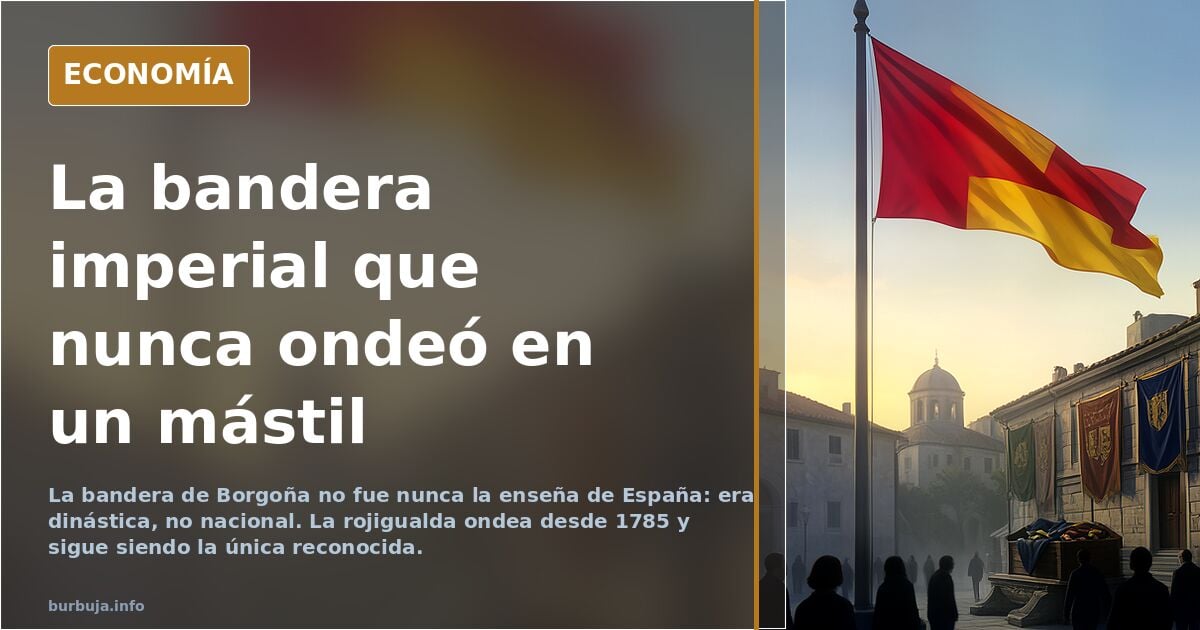
The Cross of Burgundy was not the flag of an empire that never existed as such
The Cross of Burgundy was not the flag of Spain or of any formal Spanish empire. It was the saltire of a dynastic house, the Habsburgs, which arrived via the Burgundian line and was paraded across half the world as a battle ensign. The concept of a national flag does not appear until 1785, when Charles III imposed the red-and-gold flag so that the Navy would not be confused with the Bourbon ensigns of half a continent. Everything else — the double-headed eagle, the "imperial" standard sold today at flea markets — is a 20th-century reconstruction, heraldry and posturing.
The issue matters because it touches two sensitive nerves: identity and money. And there lies the paradox nobody wants to face head-on. The very people who demand symbolic purity for the flag are the ones who call for professional licensing to shield their guild. A medieval guild with a modern logo.
Did a flag of the Spanish Empire ever exist?
Not as such. What existed were the arms of each kingdom, dynastic crosses and the monarch's personal standards. The Cross of Burgundy arrived with the Habsburgs and was used by the tercios, yes, but it was also flown by the Carlists and Franco's army. By that logic, it would be both a Carlist and a Francoist flag. The Spanish Air Force carries it today in its emblem, alongside the red-and-gold flag, not as a battle flag. A small nuance that usually gets overlooked.
The red-and-gold flag is not eternal either: it is 241 years old, not a thousand. Charles III imposed it in 1785 for the Navy, over a practical problem of identification at sea, not out of national vocation. Before that there was no national flag, only a dynastic ensign.
The business of identity and the DJ licence
The discussion drifts toward more profitable ground: who may call themselves a professional and who may not. A professional association is not liberalism, it is the opposite. It is a sign-off blessed by the official state gazette: whoever demands mandatory registration is not claiming market freedom, they are asking the State to shut down the stall of those who compete with them. The taxi driver demands it against ride-hailing apps, the restaurateur against delivery riders, the DJ against the DJ. Each with their own little grievance.
The most honest calculation of the matter is supply and demand: there are celebrities recycled into DJs and radio hosts who used to trash techno and now pose as experts. That is not neoliberal cronyism, it is the market. And the market does not distinguish conservatory degrees.
How long does a caravel take compared with a container ship
The numbers, the only serious part of the matter. A caravel sails at 5-7 knots with a favourable wind and covers the 3,000-3,500 miles from the Canary Islands to the Caribbean in 4-6 weeks if the wind blows well, or three months if it goes becalmed. Columbus took 36 days on his first voyage. A container ship travels at 20-24 knots and covers the same route in 8-11 days, carrying 20,000 TEUs instead of four sacks of spices and a cabin boy.
Putting containers in caravels is pure nonsense: the hull cannot take the weight and stability goes straight out the window. The notion of the "Hindenburg to replace planes" completes the circle of technological fantasy.
Who pays for the European party
The European Union's money comes from four places and goes to four others. Germany is the biggest payer, with net contributions that before joint borrowing hovered around 13,000-15,000 million a year. France puts a lot on the table on paper and gets it back through the CAP. The frugals — the Netherlands, Sweden, Austria, Denmark, Finland — pay up grudgingly and with a rebate cheque. Ireland and Luxembourg, small in appearance, take the real money through fiscal engineering. On the other side, Poland is the big recipient.
Changing the flag does not move a single tariff or a single wage. The rower's bill stays the same with the stripes, with the saltire or with a black crepe. What moves the needle is where the tax headquarters is and how much the rent costs.
What if the problem were not the flag, but who decides what it means?
Also available in: Deutsch
Summary of a discussion on Burbuja.info - Foro de economía, actualidad y política., translated from Spanish and reviewed before publication. Read the full discussion (41 replies).
More summaries
-
EU Jobs: 5,000€ Salary, But Years of Temporary Work First
A forum user asks about an EU administrator academy: AD5 pay is around 5,000€, but the usual path is entering first as a temporary agent.
-
Spain seeks EU official status for Catalan, Basque, Galician
Spain requests adding three regional languages to the EU's official list. Brussels maintains a one-language-per-country rule, citing the Finnish precedent.
-
The Elite Education of Tenant Spokespeople Sparks Controversy
Controversy erupts as the elite international education backgrounds of prominent tenant movement spokespeople are revealed, challenging their narrative of precarity.
-
Row in Spain's Basque Country over migrants used as cannon fodder
An image of migrants at a protest linked to the Basque pro-independence movement has reignited the debate over their use as human shields and political tensions in the Basque Country.
-
What an AI says a war with Morocco would cost Spain
The AI claims Spain would gain territory and Western Sahara would become an ally. The real cost: millions of refugees and the closure of the Schengen area.
-
Last military officer convicted of Víctor Jara's murder arrested in Chile
Chilean police have arrested the 80-year-old former military man, who had been on the run for a quarter of a century. He was convicted of torturing and murdering singer-songwriter Víctor Jara in 1973.