
The Cost of Being the Workplace Helper
Workplace helpers often cover others' shifts without extra pay. The recurring complaint: being too nice makes you a fool.
English · Original discussion in Spanish · Published
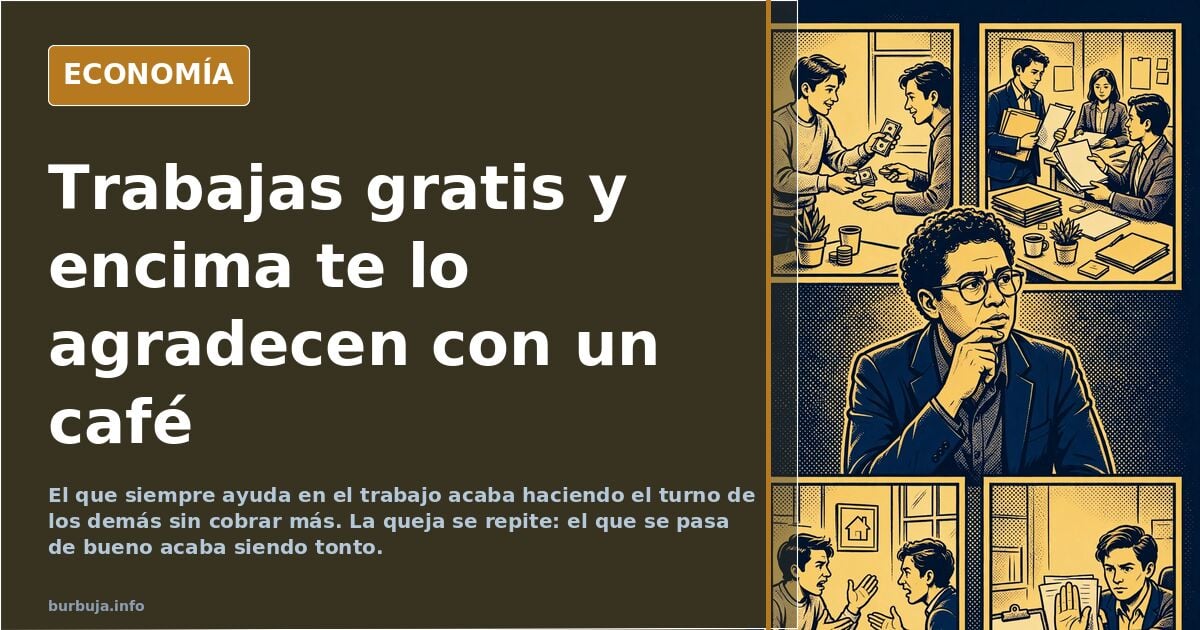
The Cost of Being the Workplace Helper
There is an exact moment when the colleague who always lends a hand discovers the bill. Not for the machine coffee that pays for the favor, but for the seven own tasks that have landed on them while solving someone else's. The complaint repeats with almost accounting precision: the volunteer ends up covering others' shifts without earning a single euro more, and the one absent with a dubious medical excuse dumps their work on the willing helper. The conclusion imposed in conversation is as simple as it is uncomfortable: being too nice makes you a fool.
The Work Favor That Becomes an Obligation
The pattern repeats in any office or warehouse. Someone proves they can do everything, solves a problem for a colleague, and from then on becomes the team's free resource. The recommended response is as old as employment itself: I'm swamped, or I accept but you handle these seven tasks. The problem isn't solidarity; it's asymmetry. When favors only flow one way, they stop being favors and become exploitation with a smile.
The complaint extends to those absent with unverified ailments. Some argue that if someone cannot cope with their job, the coherent step is to process disability leave and leave, not distribute their burden among those present. The reproach has economic logic: the cost of sick leave isn't borne by the requester, but by the colleague filling the gap without salary supplement. In a labor market where presenteeism is still rewarded, staying silent and enduring is cheaper than demanding.
Lending Money: The Fast Track to Losing a Friend
The second front is money. The most repeated recommendation is blunt: never lend unless it's direct family in extreme need. Yet some raise the stakes: lend as if you'll never get it back. Shared experience points the same way. An acquaintance returns €800 two months later, with interest and eternal gratitude. Another drags €200 with a thousand excuses and no date. The difference isn't the amount; it's the person. Loans act as a sarracena DNA test: those who don't repay are exposed at a ridiculous price.
The trap lies in confusing prudence with misanthropy. Those who lend to a friend in trouble and then discard them for not collecting may have learned a lesson but lost a relationship. The defended alternative is more surgical: lend only what won't hurt to lose, and only to those known not to fail. If they fail, the cost was the price of knowing.
Family and Inheritance: Where Affection Is Measured in Square Meters
The third scenario is the bitterest. Inheritances turn siblings into litigants. Most want the biggest slice of the pie, and those who cared for parents for years discover their time doesn't count in the distribution. Spanish succession law doesn't reward care; it divides equally unless there's a pact or improvement. The result is a cruel paradox: those who gave most complain most, and those who appear least demand most.
The imposed reading is that family isn't an exception to self-interest; it's its most intense version. There's no contract there, just expectation. And expectation, when broken, hurts more than non-payment.
Questions Asked When Dating
The fourth front is personal relationships. The complaint is specific: when meeting someone, questions repeat. Do you live alone? What do you do for work? Do you have a car? The interpretation is that material interest precedes personal interest. The response from the other side is less romantic and more pragmatic: if by thirty you don't live alone, lack stable work, and have no car, those questions aren't interrogation but viability assessment. It's not cynicism; it's reproductive logistics.
Nuance matters. Material stability being a legitimate criterion differs from it being the only one. Conversation splits between those seeing economic interest tests and those reading common sense. Deep down, both admit the same thing: money conditions emotional life, though no one wants to say it on a first date.
The Theory of Universal Interest
The conclusion running through the entire conversation is that humans move by interest. At work, in friendship, family, and couples. The harshest view holds the world is a collection of people seeking maximum benefit even at others' expense, and realizing this is maturity. The nuanced view distinguishes legitimate interest from abuse: what separates decent people isn't lacking interests, but being fair in exchange and keeping promises.
The practical recipe repeated across all fronts is the same: learn to say no. No to free favors, no to loans without return, no to others' burdens. Those mastering 'no' cease being popular but stop being exploited. The open question remains uncomfortable: if everyone applies this logic, who's left to help without a bill?
There is an exact moment when the colleague who always lends a hand discovers the bill. Not for the machine coffee that pays for the favor, but for the seven own tasks that have landed on them while solving someone else's. The complaint repeats with almost accounting precision: the volunteer ends up covering others' shifts without earning a single euro more, and the one absent with a dubious medical excuse dumps their work on the willing helper. The conclusion imposed in conversation is as simple as it is uncomfortable: being too nice makes you a fool.
The Work Favor That Becomes an Obligation
The pattern repeats in any office or warehouse. Someone proves they can do everything, solves a problem for a colleague, and from then on becomes the team's free resource. The recommended response is as old as employment itself: I'm swamped, or I accept but you handle these seven tasks. The problem isn't solidarity; it's asymmetry. When favors only flow one way, they stop being favors and become exploitation with a smile.
The complaint extends to those absent with unverified ailments. Some argue that if someone cannot cope with their job, the coherent step is to process disability leave and leave, not distribute their burden among those present. The reproach has economic logic: the cost of sick leave isn't borne by the requester, but by the colleague filling the gap without salary supplement. In a labor market where presenteeism is still rewarded, staying silent and enduring is cheaper than demanding.
Lending Money: The Fast Track to Losing a Friend
The second front is money. The most repeated recommendation is blunt: never lend unless it's direct family in extreme need. Yet some raise the stakes: lend as if you'll never get it back. Shared experience points the same way. An acquaintance returns €800 two months later, with interest and eternal gratitude. Another drags €200 with a thousand excuses and no date. The difference isn't the amount; it's the person. Loans act as a sarracena DNA test: those who don't repay are exposed at a ridiculous price.
The trap lies in confusing prudence with misanthropy. Those who lend to a friend in trouble and then discard them for not collecting may have learned a lesson but lost a relationship. The defended alternative is more surgical: lend only what won't hurt to lose, and only to those known not to fail. If they fail, the cost was the price of knowing.
Family and Inheritance: Where Affection Is Measured in Square Meters
The third scenario is the bitterest. Inheritances turn siblings into litigants. Most want the biggest slice of the pie, and those who cared for parents for years discover their time doesn't count in the distribution. Spanish succession law doesn't reward care; it divides equally unless there's a pact or improvement. The result is a cruel paradox: those who gave most complain most, and those who appear least demand most.
The imposed reading is that family isn't an exception to self-interest; it's its most intense version. There's no contract there, just expectation. And expectation, when broken, hurts more than non-payment.
Questions Asked When Dating
The fourth front is personal relationships. The complaint is specific: when meeting someone, questions repeat. Do you live alone? What do you do for work? Do you have a car? The interpretation is that material interest precedes personal interest. The response from the other side is less romantic and more pragmatic: if by thirty you don't live alone, lack stable work, and have no car, those questions aren't interrogation but viability assessment. It's not cynicism; it's reproductive logistics.
Nuance matters. Material stability being a legitimate criterion differs from it being the only one. Conversation splits between those seeing economic interest tests and those reading common sense. Deep down, both admit the same thing: money conditions emotional life, though no one wants to say it on a first date.
The Theory of Universal Interest
The conclusion running through the entire conversation is that humans move by interest. At work, in friendship, family, and couples. The harshest view holds the world is a collection of people seeking maximum benefit even at others' expense, and realizing this is maturity. The nuanced view distinguishes legitimate interest from abuse: what separates decent people isn't lacking interests, but being fair in exchange and keeping promises.
The practical recipe repeated across all fronts is the same: learn to say no. No to free favors, no to loans without return, no to others' burdens. Those mastering 'no' cease being popular but stop being exploited. The open question remains uncomfortable: if everyone applies this logic, who's left to help without a bill?
Summary of a discussion on Burbuja.info - Foro de economía, actualidad y política., translated from Spanish and reviewed before publication. Read the full discussion (152 replies).
More summaries
-
Expert: High-Earner Women Seek Men of Greater Status
A relationship expert claims his top 5% female clients most often ask how to find a higher-status partner, sparking debate on status and dating.
-
Impossible Relationships: The Modern Couple's Economic Dilemma
The debate on unreliable relationships intensifies. Economic and social factors explain the saturation and lack of commitment in modern romance.
-
Figaredo Proposes Mixed Pension Model: 'The System Is a Zombie'
Spain's contributory pension deficit hit 56.9 billion euros in 2025. Politician Figaredo advocates a mixed model combining pay-as-you-go with individual capitalization.
-
European car sales plunge: Germany down 28%, Spain 6.5%
Car registrations in Europe are falling sharply, with Germany seeing a 28% drop and Spain 6.5% in August, according to industry data.
-
Spain's housing minister shares landlord chats filtering tenants
Pablo Echenique shared chats of 2,000 Spanish landlords refusing to rent to families with children or migrants, citing legal risks.
-
Spanish Forum Filter Replaces 'Psychopath' with 'Madman'
A Spanish platform filter automatically swaps words like 'psychopath' for 'madman' and 'damn' for milder terms, altering public posts.