
Expert: High-Earner Women Seek Men of Greater Status
A relationship expert claims his top 5% female clients most often ask how to find a higher-status partner, sparking debate on status and dating.
English · Original discussion in Spanish · Published
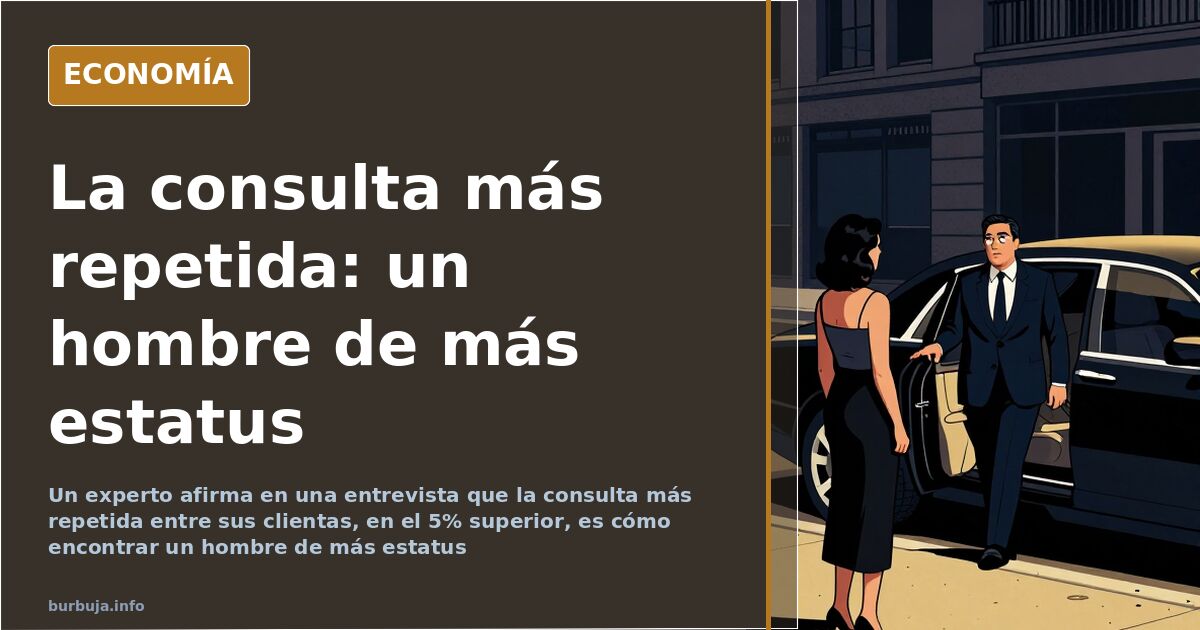
How to find a higher-status man, the most common query
At minute 00:55 of an interview, a relationship expert—who claims to have counseled hundreds of thousands of people—answers what women ask most. The answer is unromantic: how to secure a partner of equal or higher socioeconomic standing. He adds that much of his clientele belongs to the top 5% and, precisely for that reason, struggles to find a match.
The clip has peine the old debate on hypergamy, the tendency to seek a partner above one’s own status, and another revelation: all ask how to make boyfriends or husbands open up and share their vulnerabilities. Two simple ideas. Behind them lies a string of theories on money, desire, and distrust.
What hypergamy is and why it is used as a universal explanation
Hypergamy refers to choosing a partner with more resources, income, or prestige than oneself. One school of thought presents it as an inevitable biological norm: women, it is argued, are born with an asset that entitles them to aim for someone of higher status, hence the demand for status. Another part of the debate rejects this determinism and argues that the phenomenon is human and general, not female.
The most cited evidence does not come from official statistics but from everyday observation in a specific sector: in hospitals, doctors are almost all single, and those who are married are mostly married to doctors. For one case of a doctor married to a nurse, there are twenty the other way around. This is a calculation circulating in the discussion, not a census.
Why men do not share their problems with their partner?
The expert’s second revelation is the most commented contradiction: women ask for an open man who shows his weaknesses, but choose those who are closed and say nothing. The most repeated reason in the exchange of experiences is ammunition. Many men stop confessing their flaws after seeing how a confession was used against them in the next argument.
There are personal cases in that line. One recounts that his partner left him for not sharing his intimacies: he barely knew what he worked on or who his friends were. Another describes a friend who was scandalized that there were still men afraid to show vulnerability and, immediately after, despised any sign of weakness. The conclusion drawn: the man closes himself because he senses the cost.
They also choose, and the price is different
The exchange soon admits that selection is not one-sided. The male counterpart would be youth and physical attractiveness, and there were those who confessed that, if they could, they would also prefer a partner with wealth to support them. A classic from financial portals is even revived: a letter from a 25-year-old woman asking advice on marrying someone who earns a lot, a well-founded response she received whose veracity is unverified.
A family story nuances the picture. A retired professor, married to an uneducated laborer, heard the same question for years: why she was with someone who did not match her level. When the choice breaks the script, the environment also pushes upward. Social climbing via marriage is not exclusive to one sens or class.
Cases that contradict the pattern
Against the dominant narrative, experiences in the opposite direction appear. Someone claims to have been with many women and that none looked at money: they all treated him. What he has seen most, he says, are relationships with difficult types with no money, and very few with the rich. The difference, he points out, lies in social profiles: the neighborhood environment and the wealthy environment do not behave the same.
Another voice insists that a high-status woman does not look twice at someone with nowhere to fall. And a third recalls that a man with status changes a woman’s life with little and boasts about it, while the reverse hardly happens. The material is rich in anecdotes and poor in data series.
With these threads, the conclusion should be univocal in one direction or the other. It is not. If the search for status were as decisive as the expert’s first answer suggests, the dating market should be ordered with millimetric precision. And what personal experiences describe is exactly the opposite: disorder, exceptions, and many cases that do not fit. That is where the analysis gets stuck.
At minute 00:55 of an interview, a relationship expert—who claims to have counseled hundreds of thousands of people—answers what women ask most. The answer is unromantic: how to secure a partner of equal or higher socioeconomic standing. He adds that much of his clientele belongs to the top 5% and, precisely for that reason, struggles to find a match.
The clip has peine the old debate on hypergamy, the tendency to seek a partner above one’s own status, and another revelation: all ask how to make boyfriends or husbands open up and share their vulnerabilities. Two simple ideas. Behind them lies a string of theories on money, desire, and distrust.
What hypergamy is and why it is used as a universal explanation
Hypergamy refers to choosing a partner with more resources, income, or prestige than oneself. One school of thought presents it as an inevitable biological norm: women, it is argued, are born with an asset that entitles them to aim for someone of higher status, hence the demand for status. Another part of the debate rejects this determinism and argues that the phenomenon is human and general, not female.
The most cited evidence does not come from official statistics but from everyday observation in a specific sector: in hospitals, doctors are almost all single, and those who are married are mostly married to doctors. For one case of a doctor married to a nurse, there are twenty the other way around. This is a calculation circulating in the discussion, not a census.
Why men do not share their problems with their partner?
The expert’s second revelation is the most commented contradiction: women ask for an open man who shows his weaknesses, but choose those who are closed and say nothing. The most repeated reason in the exchange of experiences is ammunition. Many men stop confessing their flaws after seeing how a confession was used against them in the next argument.
There are personal cases in that line. One recounts that his partner left him for not sharing his intimacies: he barely knew what he worked on or who his friends were. Another describes a friend who was scandalized that there were still men afraid to show vulnerability and, immediately after, despised any sign of weakness. The conclusion drawn: the man closes himself because he senses the cost.
They also choose, and the price is different
The exchange soon admits that selection is not one-sided. The male counterpart would be youth and physical attractiveness, and there were those who confessed that, if they could, they would also prefer a partner with wealth to support them. A classic from financial portals is even revived: a letter from a 25-year-old woman asking advice on marrying someone who earns a lot, a well-founded response she received whose veracity is unverified.
A family story nuances the picture. A retired professor, married to an uneducated laborer, heard the same question for years: why she was with someone who did not match her level. When the choice breaks the script, the environment also pushes upward. Social climbing via marriage is not exclusive to one sens or class.
Cases that contradict the pattern
Against the dominant narrative, experiences in the opposite direction appear. Someone claims to have been with many women and that none looked at money: they all treated him. What he has seen most, he says, are relationships with difficult types with no money, and very few with the rich. The difference, he points out, lies in social profiles: the neighborhood environment and the wealthy environment do not behave the same.
Another voice insists that a high-status woman does not look twice at someone with nowhere to fall. And a third recalls that a man with status changes a woman’s life with little and boasts about it, while the reverse hardly happens. The material is rich in anecdotes and poor in data series.
With these threads, the conclusion should be univocal in one direction or the other. It is not. If the search for status were as decisive as the expert’s first answer suggests, the dating market should be ordered with millimetric precision. And what personal experiences describe is exactly the opposite: disorder, exceptions, and many cases that do not fit. That is where the analysis gets stuck.
Summary of a discussion on Burbuja.info - Foro de economía, actualidad y política., translated from Spanish and reviewed before publication. Read the full discussion (254 replies).
More summaries
-
The Cost of Exclusivity: Why the Dating Market Is No Longer Monogamous
The relationship market is no longer monogamous: supply multiplies, commitment devalues, and social media is the cause. An analysis...
-
Bald men rejected: Spain's dating market row
A divorced woman in her 40s rejects bald men, sparking debate in Spain, the world's most bald country.
-
Free Dinners and Saturated Apps: The Dating Market Divide
A 30 euro dinner, another for 70, and the question that divides: who pays for the first date and what that spending reveals about Spain's dating market.
-
Depression and precarity: The wall attitude cannot break
A forum user argues depression arises when expectations clash with reality; others respond that positive attitude is not enough.
-
Spain's DGT weighs one-car-per-home rule
A proposed law in Spain suggests limiting cars to one per residence to curb congestion. The DGT is studying similar measures, following precedents in France and the Balearic Islands.
-
Nuclear Hoax Denies Fission and Critical Mass
A viral calculation claims chain reactions are impossible, denying atomic bombs existed. The theory contradicts physics and its own cited sources.