
The chef challenging the 'healthy' industry's narrative
A biochemist and chef published a book in 2018 questioning the 'healthy' food industry and reopening the war over sugar, fruit and labelling.
English · Original discussion in Spanish · Published
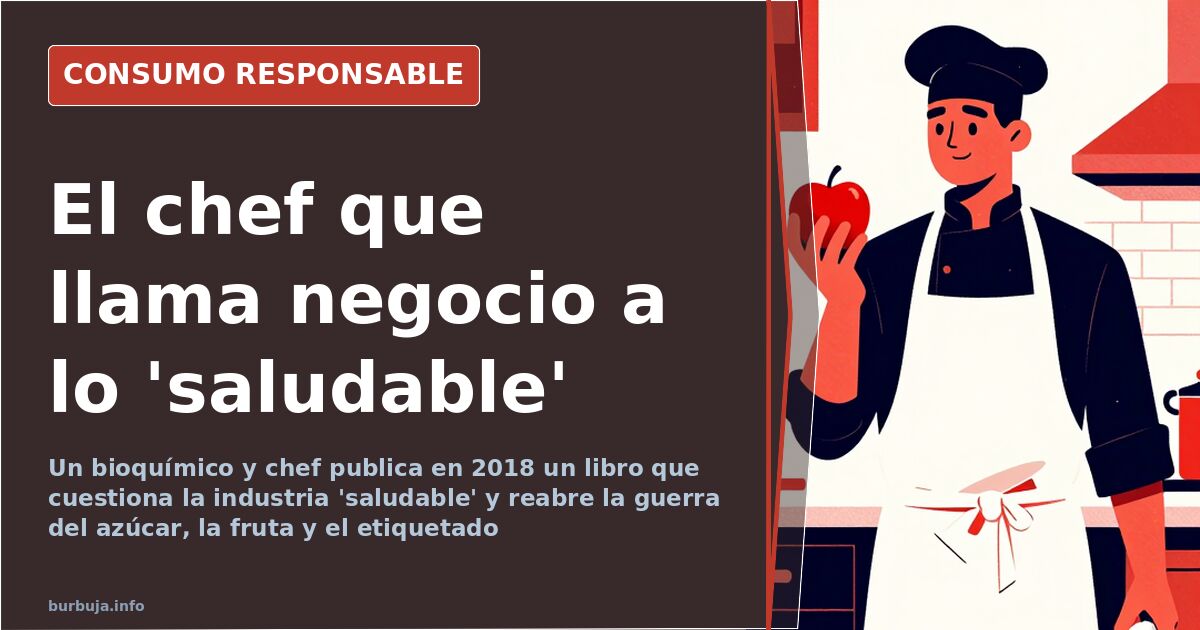
The chef exposing the lies of the 'healthy' industry
Every January brings its prophet and its heretic. In 2018 that role was filled by «The Angry Chef», the book published by the Ariel imprint under that name, born from a blog started in 2016 by an author introduced as a biochemist with extensive experience in the food industry. His thesis spares no one: much of what is sold as healthy is a business, and the crusade against sugar has shifted from evidence to faith. The first reaction is circular suspicion: if he sells books, he's been bought; if he cites a study, there's a lobby behind it.
What does 'The Angry Chef' say and why does it irritate both sides?
The central thesis is not that a miracle diet exists, but that a health industry exists with its own gurus, media and propaganda, just as capable of manipulating as the one it claims to fight. To some it's a breath of fresh air; to others, a book salesman on the enemy's payroll. Doubt over who funds the studies runs through the whole affair.
Some reproach him for having no authority to talk about nutrition as a mere cook. The response from the other side is that the man is, by his own description, a biochemist, and that the angry chef nickname is precisely the label he sells himself under. The paradox remains unresolved: he is attacked both for lacking credentials and for having them.
Sugar: a drug or just another food?
Here the waters divide. One camp argues that refined sugar meets every requirement to be considered a drug: addiction, tolerance and withdrawal symptoms. The challenge is concrete: go three days without a biscuit, without bread, without sugar cubes, without it sneaking into your cold cuts, sauces or juices. If it isn't addictive, let someone prove it without cheating.
The opposing camp's reply is just as blunt. Everything in excess is poison, and arsenic or cyanide are consumed daily in doses that do no harm. Sugar is not bad in itself; it's the quantity that kills. And behind every crusade against a nutrient, in this reading, lurks a psychological need to feel special or smarter than the neighbour.
Is fruit bad because it contains sugar?
No, and no serious voice defends that. Sucrose is glucose plus fructose, the same molecule in table sugar as in fruit. The nuance that defuses the argument is the packaging. In fruit it travels with water, fibre, vitamins and minerals; in a juice or a tray of ham, it doesn't. Fibre blunts the insulin spike, hence the idea that nature places the antidote next to the poison. Fruit is good in spite of its sugar, not because of it.
Then there's fructose and its bad fruta in bodybuilding circles. It's poison, it's worse than glucose. All of this circulates as one-line verdicts, and one-line verdicts don't stand up well to scrutiny.
Paleo, LCHF and the war of the dietary sects
In practice, most agree on the fundamentals: less sugar and flour, more vegetables, more real protein, less ultra-processed food. The differences come with the labels. Some disown the term paleo because it sounds like a fad; others embrace it as sensible eating. Some claim to have lost four and a half kilos in a month simply by cutting out bread and sugar, and others say they eat once a day and feel better. The PURE study is cited as backing for the low-carb diet, and those who ignore it are called out.
The curious thing is that, amid so many trenches, almost nobody defends what they are accused of: nobody is calling for fruit, honey or vegetables to be eliminated. The enemy is not the plate. It's the product.
Labelling: sugar where nobody expects it
The most uncomfortable figure doesn't come from the book but from the supermarket shelf. A cured ham made only with salt contains added sugar: one gram per hundred-gram sliced pack. If they put it in that, they put it in everything. Those trinc a diet controlled for gestational diabetes discover it the hard way: practically every processed food includes sugar, and on the ingredients list it almost never appears under that name, but under any number of disguises.
Who cooks the evidence
There are studies of every kind, and that is exactly what both sides exploit. Some bring up Egyptian mummies with cavities and modern diseases to prove that today's diet makes us ill; others point out that the problem is quantity and lack of fibre. What nobody will sign off on is that serious evidence is more shaped by vested interests than either side admits, and that know thyself remains the cheapest advice on the market.
With the data in hand, the sensible thing would be a pact: less processed food, more real food and no crusades. But pacts don't sell books or supplements, and there, exactly at that point, the analysis stalls again: each side convinced the other has been bought.
Also available in: Deutsch
Summary of a discussion on Burbuja.info - Foro de economía, actualidad y política., translated from Spanish and reviewed before publication. Read the full discussion (100 replies).
More summaries
-
Paleo Diet Raises Cholesterol From 138 to 212
A forum user's total cholesterol jumped from 138 to 212 mg/dL after nine months on a paleo diet, with little change in HDL levels.
-
Study Links Very Low and High Carb Diets to Higher Mortality
Research associates extreme carbohydrate intake with increased death rates. The optimal 55% equates to nearly 300 grams daily.
-
Cheap, Healthy No-Cook Diet: Purees, Legumes, Pressure Cooker
A pressure cooker makes legumes in 45 mins and gazpacho in 15. The debate over daily meals pits the paleo diet against Mediterranean traditions.
-
Costco Spain Tire Service: Premium Brands, Balancing Issues
Costco offers Michelin, Pirelli, and Bridgestone tires at competitive prices in Spain, but a customer reports missing wheel balancing. Key service details.
-
Valve extenders: 10 grams that can make your wheel vibrate
A short valve hidden under the hubcap makes it impossible to inflate the tyre at the petrol station. The 10-gram fix can unbalance the wheel and cause vibrations.
-
The sheet war: calling one side of a page a 'page' sparks outrage
Confusion between 'sheet' and 'page' has triggered a linguistic war among Spanish academics. One side of a sheet or a page? The debate reveals generational tensions and regional divides.