
Spanish food prices surge: Fabada up 43%, not just Mercadona
A 2022 Alcampo receipt reveals basic goods rising up to 57%. Fabada hits €1.40, tripe €2.18, showing widespread inflation in Spain.
English · Original discussion in Spanish · Published
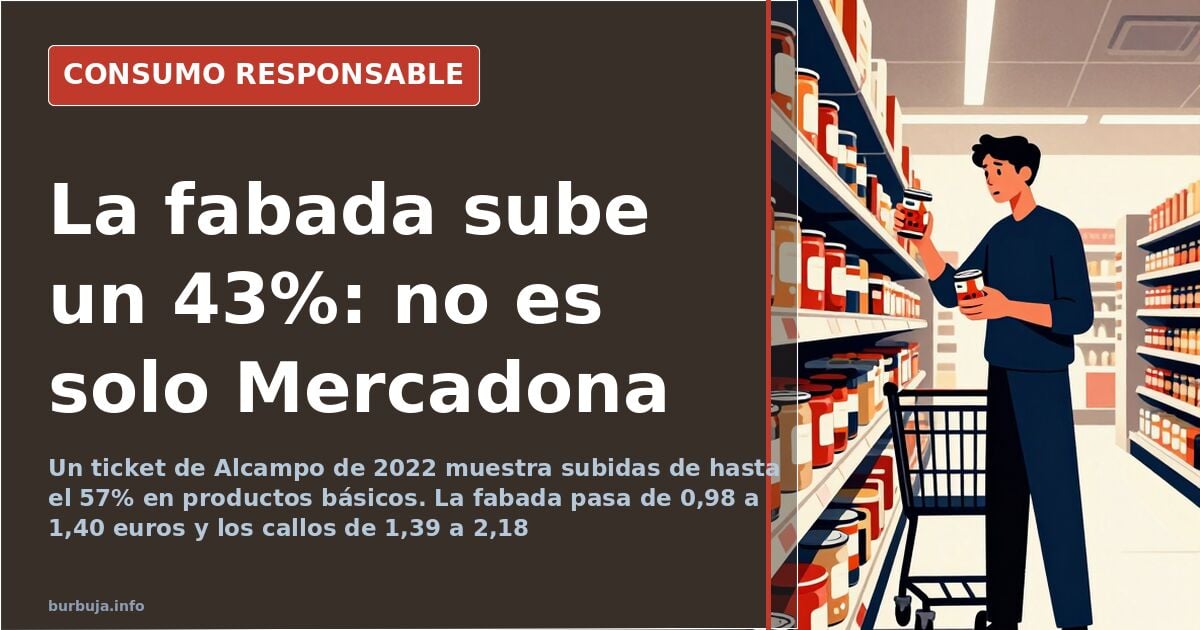
Fabada price jumps from €0.98 to €1.40: The hike isn't limited to Mercadona
An Alcampo receipt from January 2022 illustrates how the shopping basket has changed over three years. The 440-gram fabada can now costs €1.40 instead of €0.98; tripe (callos) rose from €1.39 to €2.18. This is not an isolated case or specific to one chain: the same pattern appears at Eroski, Lidl, Carrefour, and local supermarkets. The average increase discussed is around 25%, with peaks doubling the original price. And the phenomenon extends beyond food.
What went up and by how much: Receipt numbers
The breakdown is telling. The 440g fabada can increased by 43%. Tripe rose by 57%. Peanuts at Eroski went from €1.25 to €1.75; gazpacho from €1.39 to €1.75. Oats included in Carrefour's "30 products for €30" basket — promoted with a sign and VAT reduction — now cost €0.85, 30% more than the €0.65 during the campaign. Cola Cao 100% cocoa jumped from €3 to €3.60 in three days at a local supermarket, and to €4 at Carrefour.
The pattern repeats in basic goods. Apple juice bricks at Mercadona have stayed at €0.65 for a decade, while other flavors rose to €0.98. Dog food weight dropped from 20kg to 18kg, but the price rose from €13 to €18.15. Gummy bears went from €1 to €1.15 with less product and worse taste. Nescafé, which cost €3.99 when the euro was introduced, is now around €5.84 on Alcampo's website.
Why everything rises together: Energy, margins, and copycat effect
The most common argument points to costs. Food distribution margins are thin — below 3% for mass-market goods — so a 200% rise in factory electricity or gas bills is passed almost entirely to final prices. Raw material markets are unstable, and some factories cut production due to shortages. Sunflower oil is the most cited example.
There is a second layer not seen in balance sheets. Those working in multinational retail describe it bluntly: beyond real costs, there is the "last one to raise prices loses" mentality. Everyone raises prices, and everyone has an excuse. Why be the only one not to? Meanwhile, companies use the situation to expand middle management structures under the guise of digitalization.
One company's energy consumption went from €340,000 in 2022 to €1.2 million, according to shared data. That jump cannot be absorbed by margin cuts. It is passed on.
Is it just Mercadona? Focus on one chain
Mercadona draws criticism for several reasons. It has limited product variety, making any price hike more visible. It also carries political baggage: it aligned closely with the Agenda 2030 and attempted to impose facial recognition on customers, a failed move. This makes it a prime target.
But focusing exclusively on Roig distorts the diagnosis. Increases are widespread: Eroski, Lidl, Carrefour, Alcampo, and local supermarkets apply the same pattern. Carrefour's "30 products for €30" basket, launched with media hype, included €1 items to offset expensive ones, and the signage disappeared when the VAT cut fell short. The campaign was, as observers put it, absurd.
Background: Record profits and minimal consumption
Major retailers and energy firms report extraordinary profits during the same period the shopping basket becomes more expensive. Naturgy announced record earnings. Banks did too. This coincidence fuels the theory of exploitation: utilities, banking services, and food are controlled by a handful of operators where real competition does not exist.
Part of the consumer response is to minimize spending. Some have been buying only essentials since March 2020 and paying in cash to avoid bank fees. This strategy has limits: many households have no room left to cut. Monthly food spending has risen from €120 to €150 in some cases, with reductions in dining out and leisure.
The most repeated forecast is that this is not over. If energy costs do not fall and production remains tight, the shopping basket will continue to get more expensive. With caveats: no one knows how much of the current rise is real cost versus opportunism by a sector that, for the first time in years, can raise prices without losing customers.
An Alcampo receipt from January 2022 illustrates how the shopping basket has changed over three years. The 440-gram fabada can now costs €1.40 instead of €0.98; tripe (callos) rose from €1.39 to €2.18. This is not an isolated case or specific to one chain: the same pattern appears at Eroski, Lidl, Carrefour, and local supermarkets. The average increase discussed is around 25%, with peaks doubling the original price. And the phenomenon extends beyond food.
What went up and by how much: Receipt numbers
The breakdown is telling. The 440g fabada can increased by 43%. Tripe rose by 57%. Peanuts at Eroski went from €1.25 to €1.75; gazpacho from €1.39 to €1.75. Oats included in Carrefour's "30 products for €30" basket — promoted with a sign and VAT reduction — now cost €0.85, 30% more than the €0.65 during the campaign. Cola Cao 100% cocoa jumped from €3 to €3.60 in three days at a local supermarket, and to €4 at Carrefour.
The pattern repeats in basic goods. Apple juice bricks at Mercadona have stayed at €0.65 for a decade, while other flavors rose to €0.98. Dog food weight dropped from 20kg to 18kg, but the price rose from €13 to €18.15. Gummy bears went from €1 to €1.15 with less product and worse taste. Nescafé, which cost €3.99 when the euro was introduced, is now around €5.84 on Alcampo's website.
Why everything rises together: Energy, margins, and copycat effect
The most common argument points to costs. Food distribution margins are thin — below 3% for mass-market goods — so a 200% rise in factory electricity or gas bills is passed almost entirely to final prices. Raw material markets are unstable, and some factories cut production due to shortages. Sunflower oil is the most cited example.
There is a second layer not seen in balance sheets. Those working in multinational retail describe it bluntly: beyond real costs, there is the "last one to raise prices loses" mentality. Everyone raises prices, and everyone has an excuse. Why be the only one not to? Meanwhile, companies use the situation to expand middle management structures under the guise of digitalization.
One company's energy consumption went from €340,000 in 2022 to €1.2 million, according to shared data. That jump cannot be absorbed by margin cuts. It is passed on.
Is it just Mercadona? Focus on one chain
Mercadona draws criticism for several reasons. It has limited product variety, making any price hike more visible. It also carries political baggage: it aligned closely with the Agenda 2030 and attempted to impose facial recognition on customers, a failed move. This makes it a prime target.
But focusing exclusively on Roig distorts the diagnosis. Increases are widespread: Eroski, Lidl, Carrefour, Alcampo, and local supermarkets apply the same pattern. Carrefour's "30 products for €30" basket, launched with media hype, included €1 items to offset expensive ones, and the signage disappeared when the VAT cut fell short. The campaign was, as observers put it, absurd.
Background: Record profits and minimal consumption
Major retailers and energy firms report extraordinary profits during the same period the shopping basket becomes more expensive. Naturgy announced record earnings. Banks did too. This coincidence fuels the theory of exploitation: utilities, banking services, and food are controlled by a handful of operators where real competition does not exist.
Part of the consumer response is to minimize spending. Some have been buying only essentials since March 2020 and paying in cash to avoid bank fees. This strategy has limits: many households have no room left to cut. Monthly food spending has risen from €120 to €150 in some cases, with reductions in dining out and leisure.
The most repeated forecast is that this is not over. If energy costs do not fall and production remains tight, the shopping basket will continue to get more expensive. With caveats: no one knows how much of the current rise is real cost versus opportunism by a sector that, for the first time in years, can raise prices without losing customers.
Also available in: Deutsch
Summary of a discussion on Burbuja.info - Foro de economía, actualidad y política., translated from Spanish and reviewed before publication. Read the full discussion (105 replies).
More summaries
-
Spain’s supermarket sauces: fried tomato beats Mercadona
A four-year review of Spanish supermarket sauces from Mercadona, Lidl, Aldi and Carrefour, covering sugar content and prices.
-
2018-2022 Films: List Avoiding Ideological Narratives
Five starting films from 2018-2022 and a question: which recent titles avoid the ideological narrative attributed to current cinema?
-
Best professional PC mouse recommendations: wired, wireless, or ergonomic
A guide to professional PC mice, comparing wired vs. wireless, vertical, and trackball models with price and durability insights.
-
Beachgoers in Spain report growing boredom at the coast
A return to the Valencian coast after a decade reveals high prices, extreme heat, and a lack of activities for visitors.
-
Several compact sedans are available but not sold in Spain
Models like the Renault Mégane or Ford Focus Sedan exist but are missing from the Spanish market due to SUV trends and product cannibalization.
-
Naturally aspirated vs. 1.0 turbo: fuel consumption and reliability
A forum debate compares the longevity of Ford's 1.0 Ecoboost and 1.6 engines, weighing small turbos against traditional petrol engines.