
The British cemetery in Madrid's Carabanchel that leaves people baffled
A British cemetery in Carabanchel, Madrid, sparks a debate over dignity, sovereignty and why foreigners are buried on Spanish soil.
English · Original discussion in Spanish · Published
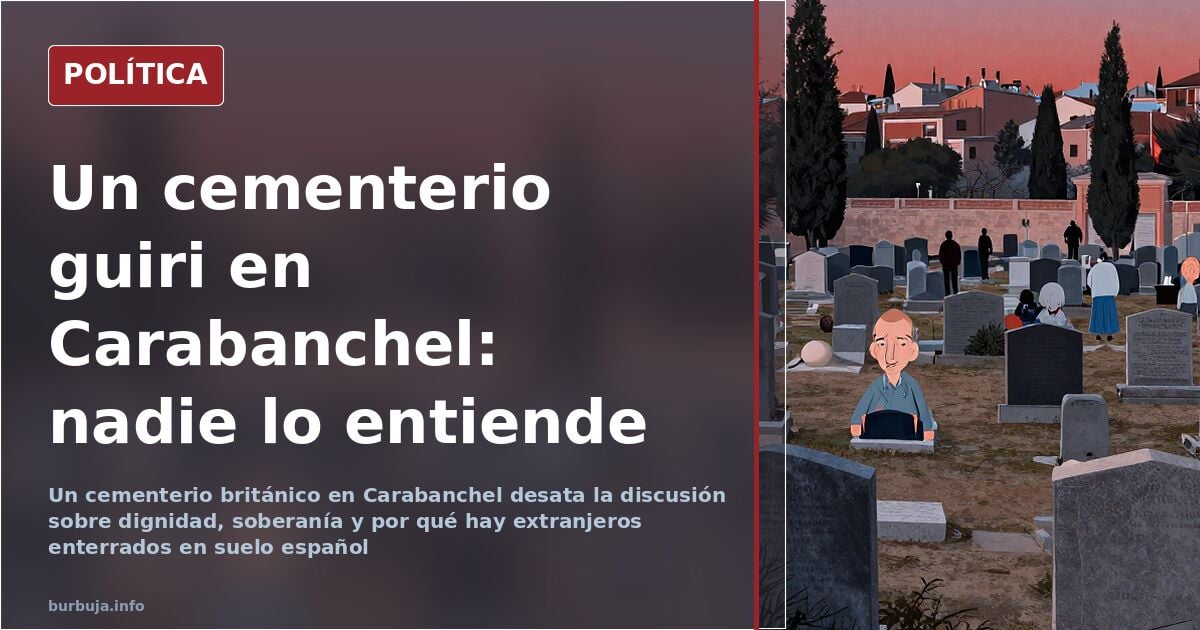
The British cemetery in Carabanchel nobody can quite explain
There is a plot of land in Carabanchel, in a quiet part of Madrid, where Britons and Germans have been buried for decades. It is a foreign cemetery on Spanish soil that most neighbours walk past without noticing, until they stumble upon it by chance. The first reaction is usually the same: what is this doing here? The second, with Wikipedia already open, is to wonder whether something strange lies behind it.
The curious thing is that the discovery does not leave people indifferent. It breeds suspicion. And suspicion, once you scratch the surface, turns into a debate about dignity, sovereignty and who has the right to occupy a square metre of Spanish soil after death. The trigger was a tweet with a song mocking Luther and Calvin. From there, the conversation drifted towards the cemetery and towards something far deeper.
What is the British cemetery of Carabanchel?
It is a historic site, well kept according to those who have seen it up close, even though Wikipedia describes it as somewhat abandoned. It can be visited on weekdays. The surprise of finding it in a working-class neighbourhood of Madrid is genuine: it is not the kind of place you expect around the corner.
The most plausible explanation going around is historical and has to do with religion. In the past, Spanish cemeteries were Catholic, and anyone who departed from that faith — Anglicans, Lutherans, Jews — had to be buried separately. Hence the English cemeteries scattered across Spain, such as the one in Las Palmas de Gran Canaria. It is not an anomaly: it is the mark of a Spain that separated its dead by religion.
Dignity as a weapon
The interesting twist comes when the conversation stops being historical and turns political. Some argue, bluntly, that foreigners have no rights over this land and that such a cemetery is an affront. The proposal, made half in jest, is to exhume the remains, repatriate them and build cheap housing on the site. The suggested name for the development has its own comic touch.
Against that, the majority position is far more prosaic: the dead are no bother. Deceased foreigners cause no problems; the living do. And it is pointed out that there are German cemeteries in France without anyone turning it into a diplomatic row. The German military cemetery of Cuacos de Yuste, near the monastery, is another example of that normality.
The name that unsettles the most suspicious
The conversation takes a turn when someone points out that one of those buried there is not British but German, and asks where his son will end up. At that point the debate stops being about a specific cemetery and becomes about elites: it is suggested that not just anyone is buried in these places, but people with weighty surnames, industrialists and families with history. The conspiracy theory looms, though without any data to support it.
This is exactly where the analysis gets stuck. Some see a harmless historical relic; others, proof that certain families continue to occupy Spanish soil with privileges that not even death cancels. And in between, a neighbour who walked past without knowing what it was and left with the question unanswered. The question of whether there are cemeteries for Spaniards in England hangs in the air, with no reply.
Also available in: Deutsch
Summary of a discussion on Burbuja.info - Foro de economía, actualidad y política., translated from Spanish and reviewed before publication. Read the full discussion (19 replies).
More summaries
-
Hispanism and the tug-of-war over Ceuta, Melilla, and Gibraltar
Rafael Rosselló is accused of placing Ceuta and Melilla under Morocco and Gibraltar under Britain, dividing the Hispanic community between the Americas and Europe.
-
Bolívar and the War to the Death: The Account of a British Traitor
The revisionist debate on Bolívar: the thesis of a traitor funded by London, the Decree of War to the Death, and Marx's biography.
-
Puigdemont's wig: accident or political strategy?
Analysis of Puigdemont's wig: examining the 1983 accident data and the polarization of political debate.
-
Spain's army: torn between NATO and Ceuta, what is it for?
Spain's armed forces are engaged in 16 international missions, yet during the Ceuta crisis they called 112, Spain's emergency number, for help. The perception that they are useless is growing.
-
Pepe Blanco's lobbying firm puts PP and PSOE under one roof
Spain's Civil Guard unit UCO places former ministers from both PP and PSOE inside Pepe Blanco's lobby, as Ábalos and Cerdán point to his role in the Koldo case.
-
Spain's PSOE and the 'gabritatorio' typo used to portray its decline
A typo —'gabritatorio' instead of 'gabinete'— has become shorthand in the debate for the party's supposed internal confusion and its dependence on its coalition partners.