
The Army is failing to fill positions: recruits earn 'less than Spain's minimum wage'
A private 'earns less than the SMI (Spain's minimum wage),' says a forum user. 24-hour guard shifts and fear of Ukraine, among reasons not to enlist.
English · Original discussion in Spanish · Published
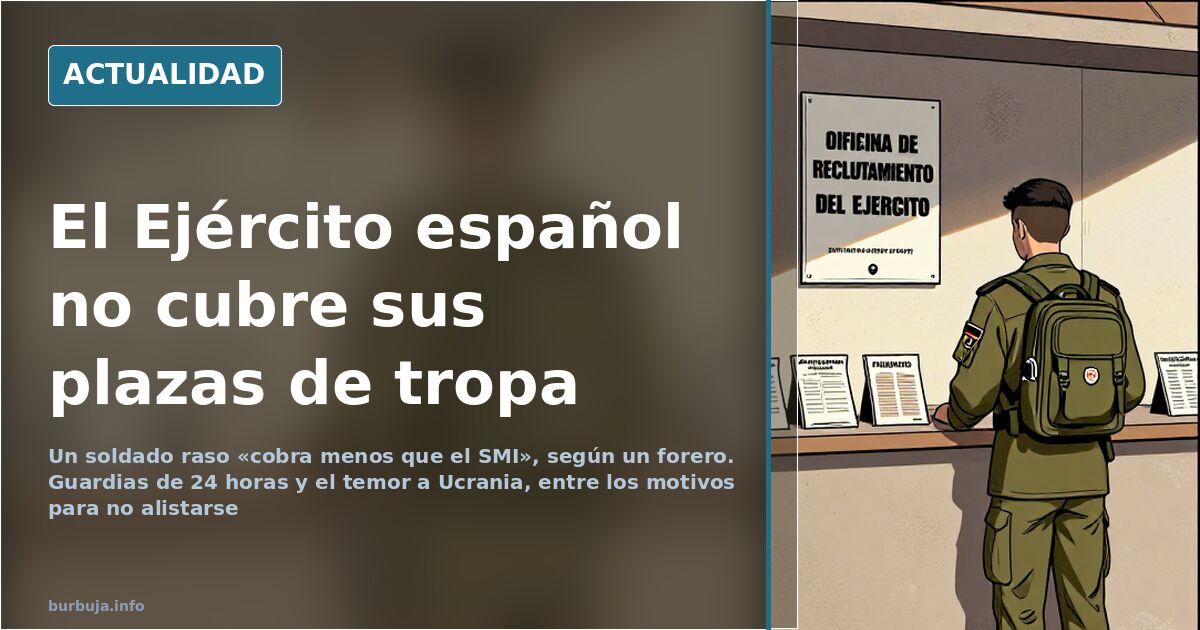
The Army is failing to fill its ranks amid questioned pay
Why would a young person with no dependents prefer a temporary logistics contract to a military career? The answer running through this issue in recent months has little to do with heroism and much to do with the paycheck. According to accounts circulating, a private's pay is around 1.400 euros, and some pay bands do not exceed the Salario Mínimo Interprofesional (SMI, Spain's minimum wage). By those numbers, balcony patriotism does not pay a mortgage. And when a country cannot find people to put in uniform, the problem stops being military and becomes economic.
A salary that cannot compete with minimum incomes
The first argument is an accounting one, made by those who claim that enlisted personnel earn, at best, a salary that falls short of what a jobless household gets by adding benefits, minimum income and subsidies. The recurring impression is that public aid pays better than training. It is also argued that purchasing power has deteriorated sharply since the pandemic and that the pay rise applied to the Armed Forces has not closed the gap: the collapse in wages since the end of ELbichito has been, in the words of a forum user, simply insane.
That diagnosis clashes with the version of those who argue that a military career offers stability and pogre. The small print says otherwise: pogre depends on slow promotions and postings that are often not chosen.
24-hour guard duties and relocations without notice: what the brochure leaves out
The second set of complaints concerns conditions. Those who join an operational unit take on, according to figures going around, more than 100 calendar days a year in 24-hour duties. A rank-and-file police officer, by the same comparison, works 6x6 shifts — eight hours and six days off —. The comparison stings. Added to the burden of guard duties are forced geographic mobility, postings changed overnight and the difficulty of planning a family life.
Some also recall that internal courses are increasingly worth less outside the barracks, that driving licences are no longer given away and that the natural exit ends up being private security. A notable percentage of those who sign up do so, according to these accounts, only to rack up points to later apply to a municipal police force or the Guardia Civil. The overall result, by this reading: those who have an alternative take it.
The 2% quota: the migration route does not fill it either
Against the thesis that enlisted ranks would be filled by opening the door to non-national residents, the legal framework sets an initial maximum quota of 2% of total enlisted personnel and sailors for non-nationals, with reciprocal conditions and subject to revision by the ministry.
Ukraine, NATO and the recruit's calculation
Then there is the reason no one prints in the brochure: war. The invasion of Ukraine and Spain's position within NATO have entered the calculations of many who are weighing it up. The antiestéticar of ending up on a front that does not feel like one's own weighs heavily, and some put it bluntly: if you're going to die, better for something of your own. For several forum users, the perception that the army answers to external interests weighs more than any paycheck, and that distrust is reinforced every time equipment is sent to someone else's conflict while the barracks empty.
When crisis fills the barracks
The underlying thesis of the matter is economic, and it is the most uncomfortable. The lack of volunteers is a sign of a certain stability: when private employment responds, no one signs up for a uniform. The proof, for those who hold this thesis, is the 2008-2009 crisis, when places ran out and there were too many people. The Army's thermometer measures the labour market, not patriotic fervour, and no one inside or outside the barracks misses that reading.
Compulsory military service? The 80% that shows up in polls
The thread cites a study by the French magazine Le Gran Continent that put support for compulsory military service among PP and Vox voters at around 80%, with a sample of 1,500 people and an age bias that critics themselves point out. The parties do not include it in their platforms, beyond low-profile mentions. The legal route exists: Article 30.2 of the Constitution provides for military service, currently suspended by law, and retains the clause on incivil laws in times of war that still lends itself to all kinds of interpretations.
If the goal is to fill the barracks, the arithmetic gives a simple recipe: pay. Politics offers a cheaper one: keep waiting for someone's pocket to be squeezed. Good luck with that.
Why would a young person with no dependents prefer a temporary logistics contract to a military career? The answer running through this issue in recent months has little to do with heroism and much to do with the paycheck. According to accounts circulating, a private's pay is around 1.400 euros, and some pay bands do not exceed the Salario Mínimo Interprofesional (SMI, Spain's minimum wage). By those numbers, balcony patriotism does not pay a mortgage. And when a country cannot find people to put in uniform, the problem stops being military and becomes economic.
A salary that cannot compete with minimum incomes
The first argument is an accounting one, made by those who claim that enlisted personnel earn, at best, a salary that falls short of what a jobless household gets by adding benefits, minimum income and subsidies. The recurring impression is that public aid pays better than training. It is also argued that purchasing power has deteriorated sharply since the pandemic and that the pay rise applied to the Armed Forces has not closed the gap: the collapse in wages since the end of ELbichito has been, in the words of a forum user, simply insane.
That diagnosis clashes with the version of those who argue that a military career offers stability and pogre. The small print says otherwise: pogre depends on slow promotions and postings that are often not chosen.
24-hour guard duties and relocations without notice: what the brochure leaves out
The second set of complaints concerns conditions. Those who join an operational unit take on, according to figures going around, more than 100 calendar days a year in 24-hour duties. A rank-and-file police officer, by the same comparison, works 6x6 shifts — eight hours and six days off —. The comparison stings. Added to the burden of guard duties are forced geographic mobility, postings changed overnight and the difficulty of planning a family life.
Some also recall that internal courses are increasingly worth less outside the barracks, that driving licences are no longer given away and that the natural exit ends up being private security. A notable percentage of those who sign up do so, according to these accounts, only to rack up points to later apply to a municipal police force or the Guardia Civil. The overall result, by this reading: those who have an alternative take it.
The 2% quota: the migration route does not fill it either
Against the thesis that enlisted ranks would be filled by opening the door to non-national residents, the legal framework sets an initial maximum quota of 2% of total enlisted personnel and sailors for non-nationals, with reciprocal conditions and subject to revision by the ministry.
Ukraine, NATO and the recruit's calculation
Then there is the reason no one prints in the brochure: war. The invasion of Ukraine and Spain's position within NATO have entered the calculations of many who are weighing it up. The antiestéticar of ending up on a front that does not feel like one's own weighs heavily, and some put it bluntly: if you're going to die, better for something of your own. For several forum users, the perception that the army answers to external interests weighs more than any paycheck, and that distrust is reinforced every time equipment is sent to someone else's conflict while the barracks empty.
When crisis fills the barracks
The underlying thesis of the matter is economic, and it is the most uncomfortable. The lack of volunteers is a sign of a certain stability: when private employment responds, no one signs up for a uniform. The proof, for those who hold this thesis, is the 2008-2009 crisis, when places ran out and there were too many people. The Army's thermometer measures the labour market, not patriotic fervour, and no one inside or outside the barracks misses that reading.
Compulsory military service? The 80% that shows up in polls
The thread cites a study by the French magazine Le Gran Continent that put support for compulsory military service among PP and Vox voters at around 80%, with a sample of 1,500 people and an age bias that critics themselves point out. The parties do not include it in their platforms, beyond low-profile mentions. The legal route exists: Article 30.2 of the Constitution provides for military service, currently suspended by law, and retains the clause on incivil laws in times of war that still lends itself to all kinds of interpretations.
If the goal is to fill the barracks, the arithmetic gives a simple recipe: pay. Politics offers a cheaper one: keep waiting for someone's pocket to be squeezed. Good luck with that.
Summary of a discussion on Burbuja.info - Foro de economía, actualidad y política., translated from Spanish and reviewed before publication. Read the full discussion (200 replies).
More summaries
-
Guardia Civil Video Enters Sydney Sweeney Debate
A Guardia Civil video linked to actress Sydney Sweeney reignites the national debate over differing physical standards within Spain's security forces.
-
Guardia Civil arrests its anti-drug chief in Segovia
The anti-drug chief of the Guardia Civil in Segovia, Miguel Ángel Barbero, has been arrested with three other people in an anti-narcotics operation.
-
Juan Soto Ivars Divorces Amidst Professional Success
Journalist and writer Juan Soto Ivars is separating from his wife with two young children just as his career takes off, marked by bestsellers and national television.
-
Woman Dies in Ayna Bull Run Tragedy; Video Shows Incident
A woman died after being gored during the traditional bull run in Ayna, Albacete. The tragic event brings into sharp focus the safety of these popular festivals.
-
Camryn Manheim and the ‘gay son’ she wished she had
A quote attributed to Camryn Manheim—wanting a gay son and dressing him in drag—reopens the debate over identities imposed on children
-
Vegan raw-food influencer dies at 39 after extreme diet
Zhanna Samsonova, 39, a raw-food influencer, died in Malaysia from an infection worsened by the 'exhaustion' of an extreme fruit-only diet