
AI Diagnoses Better, But the Operating Room Remains Human
Artificial intelligence now diagnoses in radiology and dermatology, but the replacement of doctors and surgeons is decades away, not years.
English · Original discussion in Spanish · Published
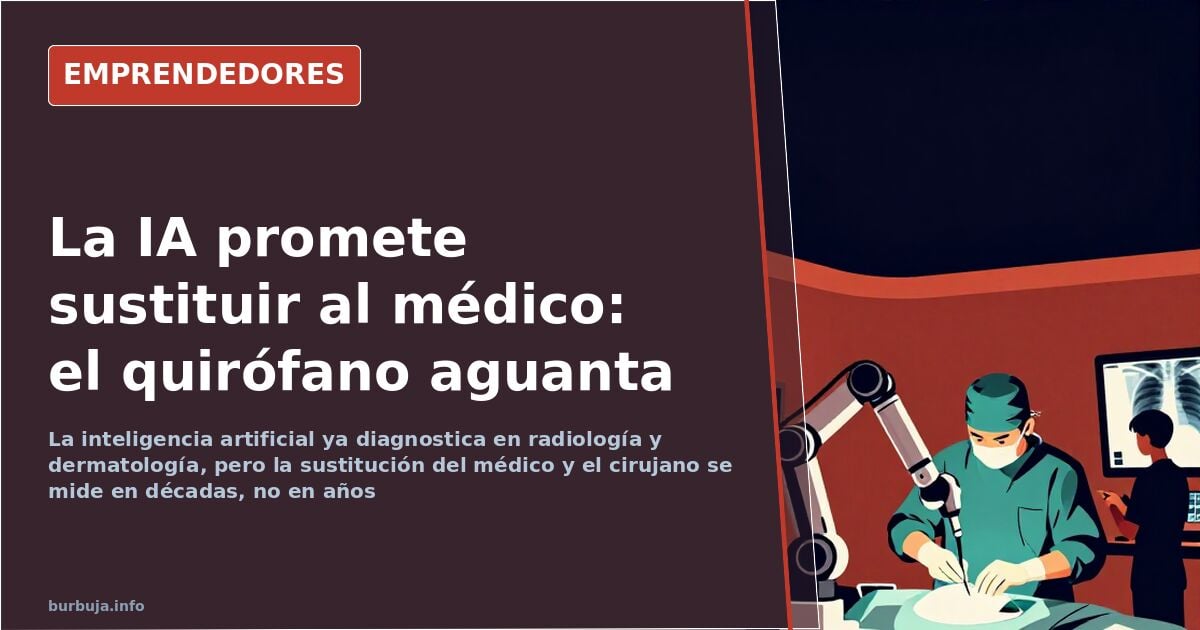
From Cashier to Surgeon: AI Promises to Replace Everyone, But Doesn't Deliver
The medical and surgical professions are on borrowed time. That was the premise that kicked off the analysis five years ago, and each update hits the same wall: artificial intelligence diagnoses, but doesn't operate. The gap between technological promise and a community hospital operating room at three in the morning is a stretch no one has been able to date. Not five years, not ten. Decades, at best.
The terms of the debate are these: if medicine is reduced to associating symptoms, tests, and treatments, it's little more than a database in a lab coat. That reasoning—provocative, and once stated without nuance—is what sustains half the discussion. The problem is that a consultation isn't a catalog search. It's a body that doesn't cooperate, a patient who doesn't tell everything, a family that interrupts, and a decision made with incomplete information.
Can Artificial Intelligence Replace the Doctor?
On the ground, there's consensus: assisted diagnosis already exists and is very powerful in specialties where images lend themselves to algorithm classification, like radiology and dermatology. There, the machine orders, prioritizes, and doesn't tire. Automating the entire consultation is another matter. Generative models themselves have their fine print: they don't distinguish truth from falsehood, and if you insist in the chat, they change the answer to defend the opposite of what they initially said.
The risk isn't that the algorithm makes a mistake; it's that it makes a mistake with a certainty that no one questions. Without a person to read and interpret the result, no model is useful for seriously automating a judgment, a diagnosis, or a decision with consequences. That's the gap separating the demo from deployment.
Pilots, Truckers, and the Myth of Total Automation
The parallel with aviation is the most useful. A commercial aircraft already flies 95% of the time in automatic mode, and no one has emptied the cockpit. The pilot manages, supervises, and decides when the system fails: a flock of birds, a depressurization, a passenger having a heart attack. Brilliant automation in normal situations is clumsy in the unpredictable. And medicine is, by definition, unpredictable.
The same argument debunks the story of the replaced truck driver. Today remains human, not because no one knows how to build the robot, but because the robot that parkours in a lab with a perfect floor doesn't operate on peritonitis with half the staff out sick. That's the gap between the video for investors and the reality of the night shift.
AI Diagnosis Already Works: Why It's Not Enough
Beneath the surface of enthusiasm are practices that have been operating for some time. In metro stations like those in Shanghai, there are consultation booths with artificial intelligence that measure vital signs and offer telemedicine, with the stated goal of reducing wait times. The justice system also uses algorithms to estimate recidivism and search databases, although it has remained in an assistive role. No one has handed over the judge's robe to a model.
The recurring conclusion: AI is just another tool, not a replacement. Diagnosis is the easy part. The difficult part is what isn't automated: listening, perceiving, and deciding with information that isn't in any record.
What's the Experience of Those Who Have Already Lost Their Jobs to AI?
The issue isn't theoretical. Some people now recount firsthand that AI took their job as a translator with a Cambridge degree in hand. It's the uncomfortable reminder: replacement doesn't come from where expected or when announced, but from the soft flank. And some recall that in the 90s, prefabricated houses were promised for 2000 and flying cars for 2015, and we're still waiting.
The lesson is as useful as it is uncomfortable: those who get the date wrong usually get the direction right. AI diagnosis is advancing, automatic surgery is not. Replacement is real, it's slow, and it doesn't ask permission.
Why the Robot Surgeon Isn't Coming in Five Years
Here the debate splits. The optimistic camp points out that humanoid robots will have an acceptable human appearance in a few years, and that combining them with AI closes the circle. The skeptic replies that a technology showcase—the eight robots Amazon already uses in its logistics centers, from Sequoia to Sparrow—is not a healthcare system, and that the distance between a prototype and a public hospital in Spain is a budgetary chasm. In the meantime, the realization that there are 18 million jobs in Spain and none look like they'll disappear tomorrow.
What does creep in sooner is the fine print of adjustment: more tests, more diagnoses, less consultation time. The machine accelerates the process and, incidentally, moves away the hand that used to look you in the eye.
With these elements, the replacement of doctors and surgeons seems a matter of decades, not years. What will arrive sooner isn't the robot that operates on you, but the algorithm that sends you home with a faster diagnosis and a further appointment. The operating room, for now, still has hands. And flying cars, too.
The medical and surgical professions are on borrowed time. That was the premise that kicked off the analysis five years ago, and each update hits the same wall: artificial intelligence diagnoses, but doesn't operate. The gap between technological promise and a community hospital operating room at three in the morning is a stretch no one has been able to date. Not five years, not ten. Decades, at best.
The terms of the debate are these: if medicine is reduced to associating symptoms, tests, and treatments, it's little more than a database in a lab coat. That reasoning—provocative, and once stated without nuance—is what sustains half the discussion. The problem is that a consultation isn't a catalog search. It's a body that doesn't cooperate, a patient who doesn't tell everything, a family that interrupts, and a decision made with incomplete information.
Can Artificial Intelligence Replace the Doctor?
On the ground, there's consensus: assisted diagnosis already exists and is very powerful in specialties where images lend themselves to algorithm classification, like radiology and dermatology. There, the machine orders, prioritizes, and doesn't tire. Automating the entire consultation is another matter. Generative models themselves have their fine print: they don't distinguish truth from falsehood, and if you insist in the chat, they change the answer to defend the opposite of what they initially said.
The risk isn't that the algorithm makes a mistake; it's that it makes a mistake with a certainty that no one questions. Without a person to read and interpret the result, no model is useful for seriously automating a judgment, a diagnosis, or a decision with consequences. That's the gap separating the demo from deployment.
Pilots, Truckers, and the Myth of Total Automation
The parallel with aviation is the most useful. A commercial aircraft already flies 95% of the time in automatic mode, and no one has emptied the cockpit. The pilot manages, supervises, and decides when the system fails: a flock of birds, a depressurization, a passenger having a heart attack. Brilliant automation in normal situations is clumsy in the unpredictable. And medicine is, by definition, unpredictable.
The same argument debunks the story of the replaced truck driver. Today remains human, not because no one knows how to build the robot, but because the robot that parkours in a lab with a perfect floor doesn't operate on peritonitis with half the staff out sick. That's the gap between the video for investors and the reality of the night shift.
AI Diagnosis Already Works: Why It's Not Enough
Beneath the surface of enthusiasm are practices that have been operating for some time. In metro stations like those in Shanghai, there are consultation booths with artificial intelligence that measure vital signs and offer telemedicine, with the stated goal of reducing wait times. The justice system also uses algorithms to estimate recidivism and search databases, although it has remained in an assistive role. No one has handed over the judge's robe to a model.
The recurring conclusion: AI is just another tool, not a replacement. Diagnosis is the easy part. The difficult part is what isn't automated: listening, perceiving, and deciding with information that isn't in any record.
What's the Experience of Those Who Have Already Lost Their Jobs to AI?
The issue isn't theoretical. Some people now recount firsthand that AI took their job as a translator with a Cambridge degree in hand. It's the uncomfortable reminder: replacement doesn't come from where expected or when announced, but from the soft flank. And some recall that in the 90s, prefabricated houses were promised for 2000 and flying cars for 2015, and we're still waiting.
The lesson is as useful as it is uncomfortable: those who get the date wrong usually get the direction right. AI diagnosis is advancing, automatic surgery is not. Replacement is real, it's slow, and it doesn't ask permission.
Why the Robot Surgeon Isn't Coming in Five Years
Here the debate splits. The optimistic camp points out that humanoid robots will have an acceptable human appearance in a few years, and that combining them with AI closes the circle. The skeptic replies that a technology showcase—the eight robots Amazon already uses in its logistics centers, from Sequoia to Sparrow—is not a healthcare system, and that the distance between a prototype and a public hospital in Spain is a budgetary chasm. In the meantime, the realization that there are 18 million jobs in Spain and none look like they'll disappear tomorrow.
What does creep in sooner is the fine print of adjustment: more tests, more diagnoses, less consultation time. The machine accelerates the process and, incidentally, moves away the hand that used to look you in the eye.
With these elements, the replacement of doctors and surgeons seems a matter of decades, not years. What will arrive sooner isn't the robot that operates on you, but the algorithm that sends you home with a faster diagnosis and a further appointment. The operating room, for now, still has hands. And flying cars, too.
Summary of a discussion on Burbuja.info - Foro de economía, actualidad y política., translated from Spanish and reviewed before publication. Read the full discussion (925 replies).
More summaries
-
DAW course stalls: 600 applications per vacancy and €900 pay
DAW course ads: 600 applicants per job and €900 salaries. Sector admits too many junior candidates and too little experience.
-
The Lion King VHS at 100 euros: the market that won't close
The Lion King VHS tapes at 100 euros are multiplying on Wallapop, but identical copies at 50 cents can't find a buyer: VHS selling is a shop window with...
-
Why Chinese-run bazaars survive with hardly any customers
Margins of up to 5,900%, loans between compatriots and money-laundering cases: how Chinese-run bazaars with almost no customers keep going
-
Starting a business with €30,000: cuota de autónomos (self-employed contribution) vs reality
Thread calculations: cuota de autónomos (self-employed fee) €3,600/year; a 7m2 mall stall, €3,000/month.
-
Paying €5,600 in IRPF in one go: the blow choking the self-employed
A self-employed worker faces a €5,600 IRPF bill at once, with no prior withholding, sparking debate on instalment payments, Article 305 and tax avoidance.
-
Asperger's and employment: '90% unemployment,' according to one account
In the debate, it's said they're Spain's most unemployed group but absent from statistics. A 90% figure and the HR filter as a wall are cited.