
The 1970s legal loophole that filled the streets with SUVs
A 4.70m person looks like a Fiesta among SUVs: the rise of these cars stems from a US legal loophole and a preference for high seating.
English · Original discussion in Spanish · Published
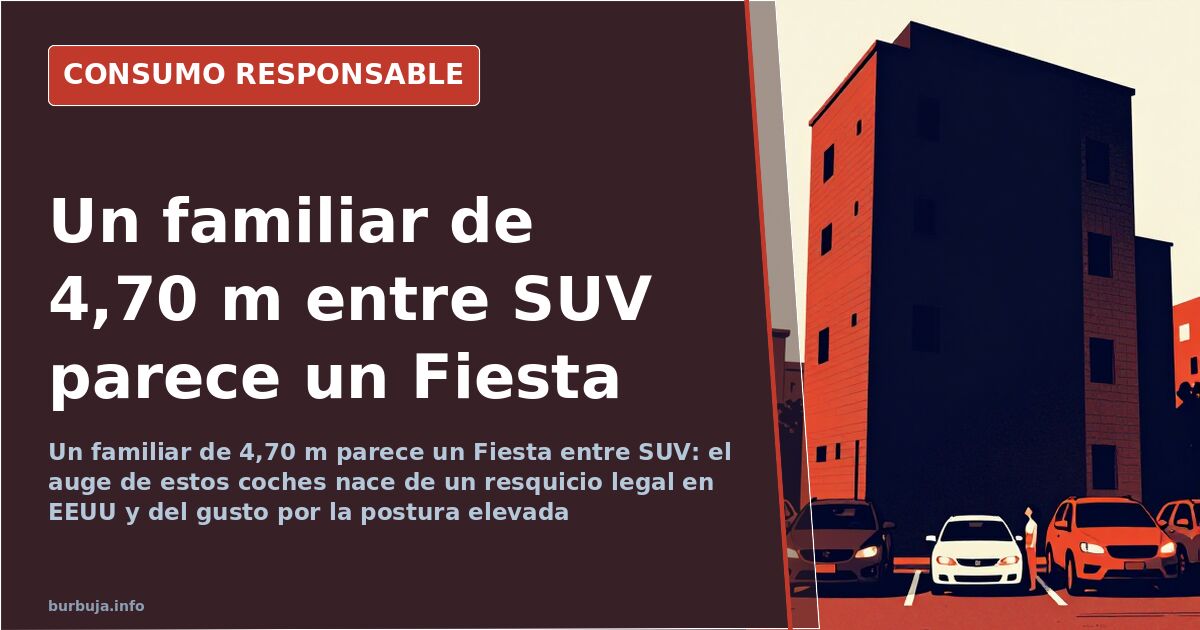
A 4.70m relative who looks like a Fiesta among SUVs
Why does a car that takes up more space, consumes more fuel, and drives worse sell so well? The scene is a beach parking lot. A 4.70m relative placed between SUVs appears, to its owner's eyes, like a modest Ford Fiesta. It wasn't a matter of perspective: the entire row consisted of SUVs or off-roaders. That is the portrait of the phenomenon. The cause must be sought much further away, in the official journal of another country.
The 1970s legal loophole that started it all
The most solid explanation circulating about the SUV boom does not speak of buyer psychology, but of technical regulation. The reason lies in the US environmental legislation of the 1970s. Manufacturers found a loophole in those cases: they created huge cars that did not fit into the categories foreseen by the legislator, and the public bought the product without asking too many questions. Decades later, the trend crossed the Atlantic with the known result.
It is worth highlighting because it is forgotten: the SUV was not designed for the European city with narrow streets or for parallel parking. It was designed to bypass a regulation and add volume. Everything else came later.
What is really bought when buying an SUV?
Very little mechanically, in most cases. A large part of the SUVs circulating in Europe are built on normal passenger car platforms, slightly inflated in size and raised about ten centimeters from the ground. Many do not even offer four-wheel drive, which is the antiestéticature that defines an off-roader. A Renault Captur is, essentially, a Clio with pretensions.
What sells is something else: access and posture. The seat height allows you to get in and out without bending down and place a child seat without contortions, an argument repeated by those who are satisfied with the purchase. And the aggressive, decisive design does the rest in the showcase. There are owners with the full expense sheet in hand —actual consumption, tire wear, purchase price, and residual value— and the result does not always back up the advertising.
The numbers: what it costs, what it weighs, and what it consumes
Contrary to the cliché of the gas guzzler, there is data. A compact diesel SUV covered 2,500 kilometers through Extremadura and Portugal with 6.5 liters per 100 on the highway. Another owner of a diesel Honda CRV reports an average of 5.2 liters and tires with 30,000 kilometers and still one-third of useful life remaining. With these figures, the accusation of waste falls short.
The price is another story. There are SUVs from mainstream brands at the price of a utility car, from about 10,500 euros, and there are top-of-the-range models around 137,100 euros. This huge range is the best proof that the segment does not define a car, but a commercial silhouette.
And then there is physics, which makes no allowances. More mass in the upper part, worse aerodynamics, and poorer response in emergency maneuvers. The accident data available point to a death rate for occupants 6% higher than that of passenger cars, up to 8% higher in the largest ones, and 62% of deaths due to rollover in the year 2000. A specific case: descending a steep track, an SUV spun like a top and the rear end passed the front. Stability control prevented the accident.
Who buys and why: comfort, protection, and mass
Of the explanations circulating, the most repeated is comfort: getting in and out without bending down and seeing traffic over someone else's shoulder. This is combined with a sense of protection that does not depend on the vehicle being safer —often it is not— but on being higher and heavier.
Another current focuses on real use: taking children to school, doing the shopping, nothing more. On this pattern, criticism has been built that goes from aesthetic reproach to urban conflict, and in many cases results in insults towards the driver. It is necessary to separate the analysis from the outburst: the judgment on a purchase choice should not turn into a judgment on the person making it.
And there is the sociological reading: the rise of the SUV as a consequence of the massive incorporation of women into driving in the last twenty-five years, associated with the search for a high seating position. It is a generalization difficult to sustain with data, although it is posed as a purchasing trend and not as anything else.
The ripple effect: fewer compacts and fewer three-door bodies
The SUV is no longer one option among many: it is the option. Around 40% of new cars registered are SUVs, and that drags the entire catalog along. Three-door versions of compacts are disappearing, and with them the simple and cheap body style. In the showroom, they offer SUVs even if the customer asked for another type of car, with easy financing and entry prices that fit almost any paycheck.
The result is also noticeable outside the car: taller vehicles block the visibility of those behind them and worsen the damage in case of a pedestrian strike, an argument repeated every time the coexistence on the streets is discussed.
The definitive argument remains, the one that needs no data: the big donkey, whether it walks or not. Physics remains right. And it continues to not sell a single car in the showroom.
Why does a car that takes up more space, consumes more fuel, and drives worse sell so well? The scene is a beach parking lot. A 4.70m relative placed between SUVs appears, to its owner's eyes, like a modest Ford Fiesta. It wasn't a matter of perspective: the entire row consisted of SUVs or off-roaders. That is the portrait of the phenomenon. The cause must be sought much further away, in the official journal of another country.
The 1970s legal loophole that started it all
The most solid explanation circulating about the SUV boom does not speak of buyer psychology, but of technical regulation. The reason lies in the US environmental legislation of the 1970s. Manufacturers found a loophole in those cases: they created huge cars that did not fit into the categories foreseen by the legislator, and the public bought the product without asking too many questions. Decades later, the trend crossed the Atlantic with the known result.
It is worth highlighting because it is forgotten: the SUV was not designed for the European city with narrow streets or for parallel parking. It was designed to bypass a regulation and add volume. Everything else came later.
What is really bought when buying an SUV?
Very little mechanically, in most cases. A large part of the SUVs circulating in Europe are built on normal passenger car platforms, slightly inflated in size and raised about ten centimeters from the ground. Many do not even offer four-wheel drive, which is the antiestéticature that defines an off-roader. A Renault Captur is, essentially, a Clio with pretensions.
What sells is something else: access and posture. The seat height allows you to get in and out without bending down and place a child seat without contortions, an argument repeated by those who are satisfied with the purchase. And the aggressive, decisive design does the rest in the showcase. There are owners with the full expense sheet in hand —actual consumption, tire wear, purchase price, and residual value— and the result does not always back up the advertising.
The numbers: what it costs, what it weighs, and what it consumes
Contrary to the cliché of the gas guzzler, there is data. A compact diesel SUV covered 2,500 kilometers through Extremadura and Portugal with 6.5 liters per 100 on the highway. Another owner of a diesel Honda CRV reports an average of 5.2 liters and tires with 30,000 kilometers and still one-third of useful life remaining. With these figures, the accusation of waste falls short.
The price is another story. There are SUVs from mainstream brands at the price of a utility car, from about 10,500 euros, and there are top-of-the-range models around 137,100 euros. This huge range is the best proof that the segment does not define a car, but a commercial silhouette.
And then there is physics, which makes no allowances. More mass in the upper part, worse aerodynamics, and poorer response in emergency maneuvers. The accident data available point to a death rate for occupants 6% higher than that of passenger cars, up to 8% higher in the largest ones, and 62% of deaths due to rollover in the year 2000. A specific case: descending a steep track, an SUV spun like a top and the rear end passed the front. Stability control prevented the accident.
Who buys and why: comfort, protection, and mass
Of the explanations circulating, the most repeated is comfort: getting in and out without bending down and seeing traffic over someone else's shoulder. This is combined with a sense of protection that does not depend on the vehicle being safer —often it is not— but on being higher and heavier.
Another current focuses on real use: taking children to school, doing the shopping, nothing more. On this pattern, criticism has been built that goes from aesthetic reproach to urban conflict, and in many cases results in insults towards the driver. It is necessary to separate the analysis from the outburst: the judgment on a purchase choice should not turn into a judgment on the person making it.
And there is the sociological reading: the rise of the SUV as a consequence of the massive incorporation of women into driving in the last twenty-five years, associated with the search for a high seating position. It is a generalization difficult to sustain with data, although it is posed as a purchasing trend and not as anything else.
The ripple effect: fewer compacts and fewer three-door bodies
The SUV is no longer one option among many: it is the option. Around 40% of new cars registered are SUVs, and that drags the entire catalog along. Three-door versions of compacts are disappearing, and with them the simple and cheap body style. In the showroom, they offer SUVs even if the customer asked for another type of car, with easy financing and entry prices that fit almost any paycheck.
The result is also noticeable outside the car: taller vehicles block the visibility of those behind them and worsen the damage in case of a pedestrian strike, an argument repeated every time the coexistence on the streets is discussed.
The definitive argument remains, the one that needs no data: the big donkey, whether it walks or not. Physics remains right. And it continues to not sell a single car in the showroom.
Summary of a discussion on Burbuja.info - Foro de economía, actualidad y política., translated from Spanish and reviewed before publication. Read the full discussion (307 replies).
More summaries
-
Manual gearboxes fall to 41% in Spain as Germany drops to 18%
Manual car sales in Spain drop from 97% to 41% while Germany falls to 18%: automatic now dominates new cars.
-
Accessing Live Sports via Shared Streaming Links
Analysis of how users access live sports through shared streaming codes and links.
-
From Betamax to Google Glass: The Museum of Failed Tech
A review of failed technologies and formats that lost despite having superior products, from Betamax to Google Glass.
-
Gym at 6am: The Life-Changing Routine of an Overweight Young Man
90 kg, 26 years old, and a Spartan plan: gym at 6am, exam prep, and a strict diet. Does it work? Data, risks, and the debate over fasting and caloric deficit.
-
Are legumes disappearing? Structural dietary shift or myth?
Analysis of declining legume consumption: Is it simply laziness or a structural shift in diet and food production?
-
Nvidia prices RTX 4090 at $1,599 and RTX 4080 from $899
Nvidia sets the RTX 4090 at $1,599 and the RTX 4080 from $899, with power draws up to 650 W, amid a 51% drop in gaming sales.