
Nvidia prices RTX 4090 at $1,599 and RTX 4080 from $899
Nvidia sets the RTX 4090 at $1,599 and the RTX 4080 from $899, with power draws up to 650 W, amid a 51% drop in gaming sales.
English · Original discussion in Spanish · Published
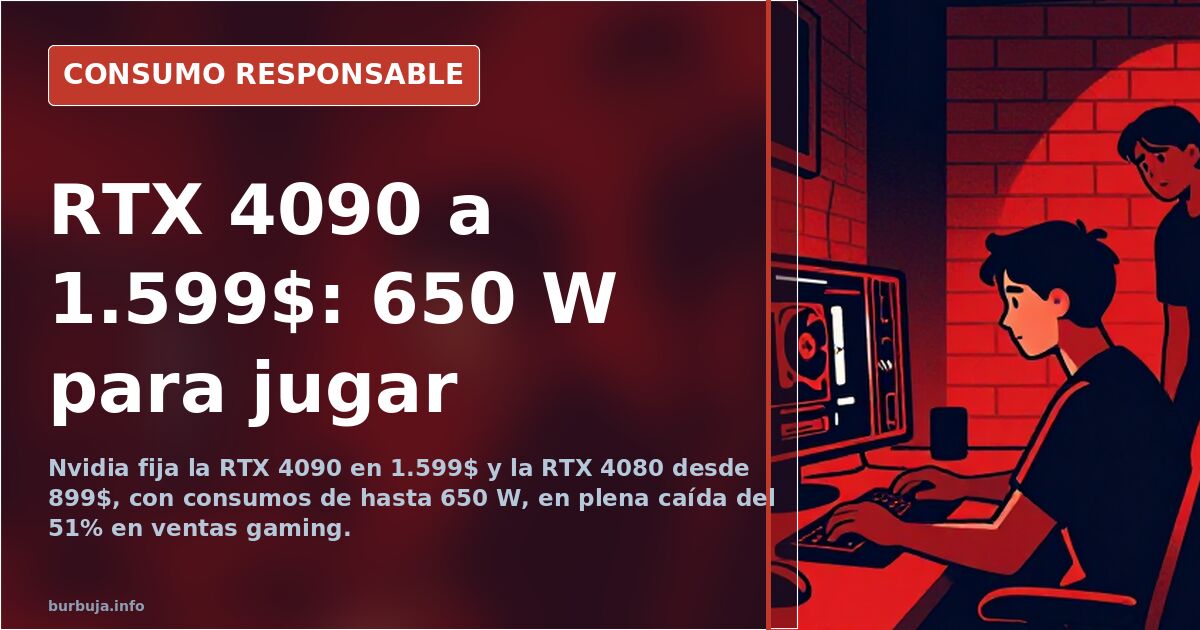
RTX 4090 at $1,599 and RTX 4080 from $899: the unaffordable high-end
Nvidia has priced its new high-end lineup, and the cost demands a double take: $1,599 for the GeForce RTX 4090 and $1,199 for the 16 GB RTX 4080. The company unveiled the Ada Lovelace architecture, manufactured on TSMC's 4N process (four nanometers), antiestéticaturing up to 76 billion transistors and promising double the performance of the previous generation. In ray tracing, it claims up to four times more thanks to DLSS 3.0.
The fine print appears when crossing the Atlantic. The official price in Europe for the RTX 4090 is €1,959 before taxes and duties. And at the entry level of the family, the firm names the 12 GB RTX 4080, which sells for $899, with less memory and a narrower bus than its bigger sisters. In other words: the card that should have been an x70 hits the market with a high-end name.
An x70 disguised as an RTX 4080
The launch trio's numbers leave little room for interpretation. The RTX 4090 antiestéticatures the AD102-300 chip with 16,384 CUDA Cores at 2.23 / 2.52 GHz, 24 GB of Micron GDDR6X at 21 Gbps, and a 384-bit interface delivering 1,008 GB/s of bandwidth. Moving that at 4K 100 FPS is the promise. It launches on October 12.
The RTX 4080 16 GB drops to 9,728 CUDA Cores, 22.5 Gbps, and 256 bits (720 GB/s) for $1,199, arriving in November. The 12 GB version drops to 7,680 CUDA Cores and a 192-bit bus (504 GB/s). That bus, uncharacteristic of a high-end card, reveals the cut. Some argue the smaller 4080 should have been called the RTX 4070, and its $899 price sets the floor for the entire next batch.
450 W standard and peaks of 650 W
The other front is the electricity bill. The RTX 4090 declares a TDP of 450 W that can stretch to 650 W maximum power draw. The 16 GB 4080 stays at 320 W (516 W peak), and the 12 GB version at 285 W (366 W). All are powered via the new PCIe Gen 5 connector, with a free adapter for three 8-pin PCIe connectors.
The official discourse insists that double performance is achieved with the same 450 W energy consumption. Domestic arithmetic tells a different story: at that rate, the power supply ceases to be an accessory and becomes the purchase's second expense. In a generation where even the modestest of the three declares 285 W, the 'all ultra at 4K and 120 FPS' is paid twice.
Why does Nvidia raise prices if mining is dead?
The question looms over the entire announcement. Bitcoin is plummeting, and cryptocurrency mining is nearly extinct, so the lever that sustained prices for two years has vanished. And yet prices rise. The response circulating among buyers is less technical and more cynical: rather than lower the price, they prefer to burn it. The tactic, it is argued, is to keep previous series high so that new products seem like a reasonable leap.
The third-quarter 2022 results add fuel. Nvidia earned $5.931 billion with a profit of $680 million, a 72% year-over-year drop, and its gaming sales plunged 51%. Data centers plugged the hole. Hence the suspicion that the consumer business is no longer the priority: some argue the company wants to be the number one AI provider, and gamers are, at best, a secondary buyer.
DLSS 3.0: frames the card invents
The jewel of the presentation is DLSS 3.0, which generates intermediate frames by predicting scene movement. Nvidia sells it as the great performance multiplier. Experience with previous versions invites caution: some recall that AI 'invented things,' especially on walls and surfaces, the more aggressive the upscaling. More frames, yes; also artifacts, upscaling dependency, and compute time that didn't exist before.
That a card meant to play at 4K needs tricks to reach stable 60 FPS in a newly released title is the launch paradox. Upscaling technology makes sense for a mid-range card stretching its limits. Applied to the top tier, it reads almost as an admission.
The connector that burns and the stock that accumulates
Past the initial noise, units are accumulating on shelves. Cases of burnt power connectors have been noted, a risk no one wants to assume on a card at this price. And in the second-hand market, the alternative gains weight: those looking to play at 1080p find cards from workstation PCs at prices new ones don't even approach.
The full calculation of what it costs to build a system around an RTX 4090 —power supply, connector, case, cooling— yields a figure that surprises even those who took the price for granted. The gap between the new high-end and the rest of the market has continued to widen generation after generation, and this launch consolidates it.
With these numbers, it is reasonable to think Nvidia will correct course if the high-end stays dead in the warehouse. But the company has spent two years demonstrating it prefers to sell less rather than cheaper, and nothing in the announcement suggests a short-term strategy change.
Nvidia has priced its new high-end lineup, and the cost demands a double take: $1,599 for the GeForce RTX 4090 and $1,199 for the 16 GB RTX 4080. The company unveiled the Ada Lovelace architecture, manufactured on TSMC's 4N process (four nanometers), antiestéticaturing up to 76 billion transistors and promising double the performance of the previous generation. In ray tracing, it claims up to four times more thanks to DLSS 3.0.
The fine print appears when crossing the Atlantic. The official price in Europe for the RTX 4090 is €1,959 before taxes and duties. And at the entry level of the family, the firm names the 12 GB RTX 4080, which sells for $899, with less memory and a narrower bus than its bigger sisters. In other words: the card that should have been an x70 hits the market with a high-end name.
An x70 disguised as an RTX 4080
The launch trio's numbers leave little room for interpretation. The RTX 4090 antiestéticatures the AD102-300 chip with 16,384 CUDA Cores at 2.23 / 2.52 GHz, 24 GB of Micron GDDR6X at 21 Gbps, and a 384-bit interface delivering 1,008 GB/s of bandwidth. Moving that at 4K 100 FPS is the promise. It launches on October 12.
The RTX 4080 16 GB drops to 9,728 CUDA Cores, 22.5 Gbps, and 256 bits (720 GB/s) for $1,199, arriving in November. The 12 GB version drops to 7,680 CUDA Cores and a 192-bit bus (504 GB/s). That bus, uncharacteristic of a high-end card, reveals the cut. Some argue the smaller 4080 should have been called the RTX 4070, and its $899 price sets the floor for the entire next batch.
450 W standard and peaks of 650 W
The other front is the electricity bill. The RTX 4090 declares a TDP of 450 W that can stretch to 650 W maximum power draw. The 16 GB 4080 stays at 320 W (516 W peak), and the 12 GB version at 285 W (366 W). All are powered via the new PCIe Gen 5 connector, with a free adapter for three 8-pin PCIe connectors.
The official discourse insists that double performance is achieved with the same 450 W energy consumption. Domestic arithmetic tells a different story: at that rate, the power supply ceases to be an accessory and becomes the purchase's second expense. In a generation where even the modestest of the three declares 285 W, the 'all ultra at 4K and 120 FPS' is paid twice.
Why does Nvidia raise prices if mining is dead?
The question looms over the entire announcement. Bitcoin is plummeting, and cryptocurrency mining is nearly extinct, so the lever that sustained prices for two years has vanished. And yet prices rise. The response circulating among buyers is less technical and more cynical: rather than lower the price, they prefer to burn it. The tactic, it is argued, is to keep previous series high so that new products seem like a reasonable leap.
The third-quarter 2022 results add fuel. Nvidia earned $5.931 billion with a profit of $680 million, a 72% year-over-year drop, and its gaming sales plunged 51%. Data centers plugged the hole. Hence the suspicion that the consumer business is no longer the priority: some argue the company wants to be the number one AI provider, and gamers are, at best, a secondary buyer.
DLSS 3.0: frames the card invents
The jewel of the presentation is DLSS 3.0, which generates intermediate frames by predicting scene movement. Nvidia sells it as the great performance multiplier. Experience with previous versions invites caution: some recall that AI 'invented things,' especially on walls and surfaces, the more aggressive the upscaling. More frames, yes; also artifacts, upscaling dependency, and compute time that didn't exist before.
That a card meant to play at 4K needs tricks to reach stable 60 FPS in a newly released title is the launch paradox. Upscaling technology makes sense for a mid-range card stretching its limits. Applied to the top tier, it reads almost as an admission.
The connector that burns and the stock that accumulates
Past the initial noise, units are accumulating on shelves. Cases of burnt power connectors have been noted, a risk no one wants to assume on a card at this price. And in the second-hand market, the alternative gains weight: those looking to play at 1080p find cards from workstation PCs at prices new ones don't even approach.
The full calculation of what it costs to build a system around an RTX 4090 —power supply, connector, case, cooling— yields a figure that surprises even those who took the price for granted. The gap between the new high-end and the rest of the market has continued to widen generation after generation, and this launch consolidates it.
With these numbers, it is reasonable to think Nvidia will correct course if the high-end stays dead in the warehouse. But the company has spent two years demonstrating it prefers to sell less rather than cheaper, and nothing in the announcement suggests a short-term strategy change.
Summary of a discussion on Burbuja.info - Foro de economía, actualidad y política., translated from Spanish and reviewed before publication. Read the full discussion (281 replies).
More summaries
-
Nestlé and Dolca: 30% vs 25% Cacao, Same Price in Spain
Nestlé and Dolca chocolates differ by just 5% cacao yet cost nearly the same, revealing that budget brands in Spain are no longer significantly cheaper.
-
El Corte Inglés prepared food: quality at a price
El Corte Inglés croquettes beat Mercadona's, but prices like €21/kg for meat rolls mean it's only worth it for some products.
-
Removing a bidet to fit a washing machine: costs and real risks
Removing the bidet and installing a washing machine in its place: about 2 hours of work and a 45 cm machine for around €300. The drain and socket are the problem.
-
Lidl's frozen sardines at €3.90/kg vs. fresh ones
A kilo of frozen sardines costs €3.90 compared to €9-€10 for fresh ones in Madrid. The question is whether the flavor holds up after freezing.
-
Workplace bullying: Spain's silent crisis with no easy exit
Mobbing is often called the perfect crime. Annual suicides linked to harassment in Spain reach 913, highlighting a lack of legal protection.
-
Refurbish a 1980s kitchen without demolition: the real cost
A 300€ fridge, 115€ laminate countertop, and 20€/m² vinyl flooring: how to renovate a 1980s kitchen in Spain without contractors or rubble.