
The 100% Blackout We've Waited Years For, But It Never Arrived
Years after Europe was warned of a 100% chance of a blackout, it hasn't happened. Prepping with supplies and ammunition continues.
English · Original discussion in Spanish · Published
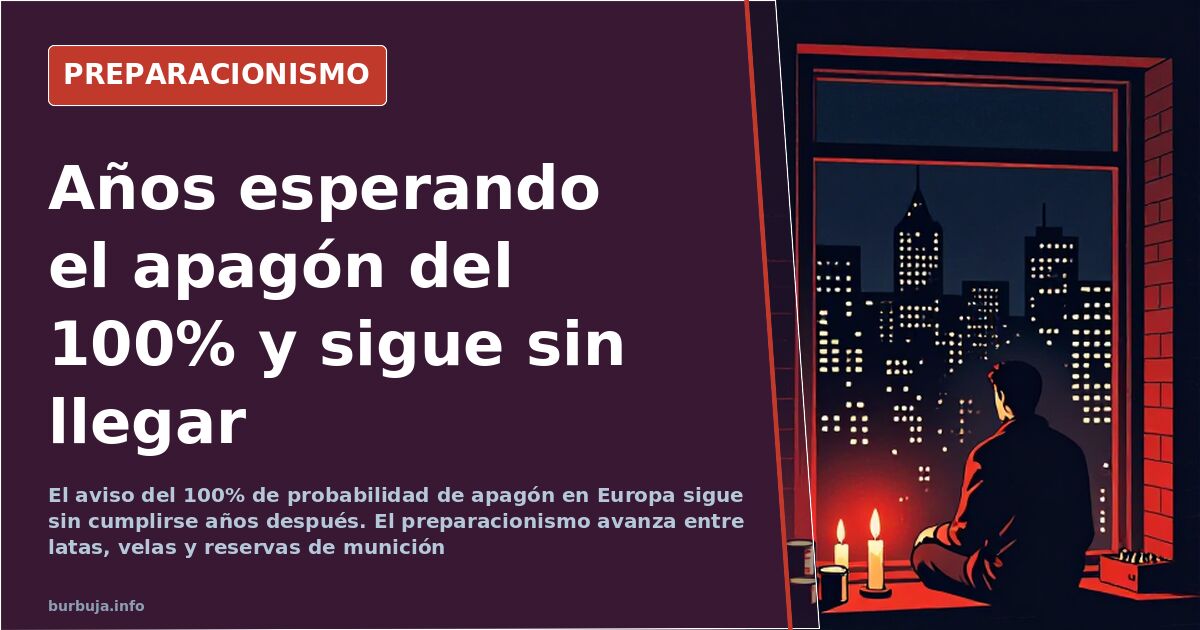
The 100% Probability Blackout That Never Came
Europe has a 100% chance of a large-scale blackout in the next five years. At least, that's the widely held interpretation of emergency guidelines published by the Austrian Army, which Germany, Sweden, and Switzerland echoed with similar recommendations for their citizens. This figure has been the rallying cry for nearly four years, and 1,458 days later, the prediction remains unfulfilled. The blackout hasn't peine. Yet, the discussion persists.
Home Insurance as an Argument for Preparedness
Some defend prepping with a simple analogy: no one buys home insurance expecting their house to burn down, but if it does, they're grateful to have it. Applied to energy, the reasoning is that living with candles, water, and stored food doesn't change daily routines; it merely avoids dependence on supermarkets during the initial weeks of an outage. Mental preparation, they note, is as important as material preparedness: enduring the shortages experienced by others is what emotionally breaks most people.
The classic objection: the Mad Max scenario never materializes, and those who stock cans just in case spend years staring at the horizon without anything happening. Some sum it up with bitter irony: most people can't prepare, so denying it is cheaper than accepting it.
The Warnings That Were Half Right
The timeline of predictions is uncomfortable. In November 2019, a severe crisis was forecast for 2020: the pandemic arrived. In October 2021, blackouts and an energy crisis were warned for 2022: the G7 oil price cap occurred, and supply blockages became a trendy scenario, even appearing as a trigger in a French series about collapse. The crisis arrived. The great blackout, however, did not.
This leads to mutual reproach. Those who have warned for years that the system is fragile argue that warnings are met on elastic timelines and that public debt merely postponed the problem. Those who distrust prophecies retort that by constantly crying wolf, the wolf eventually loses its menace.
From Arsenal to Shopping Cart
Declared inventories range from the reasonable to the operatic. Some include radios, batteries, candles, flashlights, and food for two to three weeks. Others detail 1,000 .22lr rounds, 100 of .300 win mag, and 200 of .243, plus two boxes of 480 7.5mm cartridges for three supposed shooters. In between, the average citizen: just enough groceries to make it to the end of the month, with milk at 1.20 euros on the shelf.
Meanwhile, the social thermometer remains calm. Full terraces are cited as proof that nothing is happening, and simultaneously, as proof that no one realizes what is happening. In October, with Christmas treats already in the supermarket, the balance was the usual: we're still alive.
Sudden Collapse or Slow Decay
This is the real axis of disagreement. Against the scenario of instant collapse, the thesis of gradual decay is gaining ground: no single trigger, with living standards falling incrementally, and the majority adapting without realizing it. From this perspective, extreme prepping is more hindrance than help, as it sells a narrative that alienates those who might take sensible precautions. Others recall that a blackout's beginning is known, but not its end: 3,776 arrests in the largest mass arrest in a city's history are cited as an example of how quickly an outage can degenerate into something worse.
Ultimately, both currents share an uncomfortable common ground: the system is vulnerable, debt is high, and the average family's room for maneuver is narrow. Arguing whether to have candles or rifles is almost a luxury. Given these precedents, the most likely outcome is neither a 100% blackout nor indefinite calm, but rather that the next warning will once again catch almost everyone shopping as if nothing were amiss.
Europe has a 100% chance of a large-scale blackout in the next five years. At least, that's the widely held interpretation of emergency guidelines published by the Austrian Army, which Germany, Sweden, and Switzerland echoed with similar recommendations for their citizens. This figure has been the rallying cry for nearly four years, and 1,458 days later, the prediction remains unfulfilled. The blackout hasn't peine. Yet, the discussion persists.
Home Insurance as an Argument for Preparedness
Some defend prepping with a simple analogy: no one buys home insurance expecting their house to burn down, but if it does, they're grateful to have it. Applied to energy, the reasoning is that living with candles, water, and stored food doesn't change daily routines; it merely avoids dependence on supermarkets during the initial weeks of an outage. Mental preparation, they note, is as important as material preparedness: enduring the shortages experienced by others is what emotionally breaks most people.
The classic objection: the Mad Max scenario never materializes, and those who stock cans just in case spend years staring at the horizon without anything happening. Some sum it up with bitter irony: most people can't prepare, so denying it is cheaper than accepting it.
The Warnings That Were Half Right
The timeline of predictions is uncomfortable. In November 2019, a severe crisis was forecast for 2020: the pandemic arrived. In October 2021, blackouts and an energy crisis were warned for 2022: the G7 oil price cap occurred, and supply blockages became a trendy scenario, even appearing as a trigger in a French series about collapse. The crisis arrived. The great blackout, however, did not.
This leads to mutual reproach. Those who have warned for years that the system is fragile argue that warnings are met on elastic timelines and that public debt merely postponed the problem. Those who distrust prophecies retort that by constantly crying wolf, the wolf eventually loses its menace.
From Arsenal to Shopping Cart
Declared inventories range from the reasonable to the operatic. Some include radios, batteries, candles, flashlights, and food for two to three weeks. Others detail 1,000 .22lr rounds, 100 of .300 win mag, and 200 of .243, plus two boxes of 480 7.5mm cartridges for three supposed shooters. In between, the average citizen: just enough groceries to make it to the end of the month, with milk at 1.20 euros on the shelf.
Meanwhile, the social thermometer remains calm. Full terraces are cited as proof that nothing is happening, and simultaneously, as proof that no one realizes what is happening. In October, with Christmas treats already in the supermarket, the balance was the usual: we're still alive.
Sudden Collapse or Slow Decay
This is the real axis of disagreement. Against the scenario of instant collapse, the thesis of gradual decay is gaining ground: no single trigger, with living standards falling incrementally, and the majority adapting without realizing it. From this perspective, extreme prepping is more hindrance than help, as it sells a narrative that alienates those who might take sensible precautions. Others recall that a blackout's beginning is known, but not its end: 3,776 arrests in the largest mass arrest in a city's history are cited as an example of how quickly an outage can degenerate into something worse.
Ultimately, both currents share an uncomfortable common ground: the system is vulnerable, debt is high, and the average family's room for maneuver is narrow. Arguing whether to have candles or rifles is almost a luxury. Given these precedents, the most likely outcome is neither a 100% blackout nor indefinite calm, but rather that the next warning will once again catch almost everyone shopping as if nothing were amiss.
Summary of a discussion on Burbuja.info - Foro de economía, actualidad y política., translated from Spanish and reviewed before publication. Read the full discussion (171 replies).
More summaries
-
Pepper Spray: The Self-Defense Tool Spain Doesn't Fully Regulate
Is pepper spray legal in Spain? Discover which models are allowed, their cost, and why statistics don't always align with public fear.
-
From €25 Pepper Spray to €300 Leatherman: The Prepper's Kit
Pepper spray for €25, 4,000-lumen flashlight, and vests from €46: the personal defense gear list for living in Spain in 2020.
-
Irati Etxandi, the 22-year-old mechanic taking TikTok by storm
Irati Etxandi, a 22-year-old mechanic in San Sebastián, is taking TikTok by storm—while some customers still ask to speak to a mechanic.
-
Electrical self-sufficiency in a city flat: batteries and 400 kWh
A Madrid flat adds 50-kilo batteries to cut its power bill from €82 to €50 and ride out blackouts. The total cost still doesn’t quite add up.
-
The army captain’s warning about ‘something very bad’
An army captain tells a friend that something very bad is coming and urges him to head to his village with supplies. Reaction: skepticism and stockpiling.
-
Severe flu: 39°C fever and a cough that lasts two weeks
This season's flu is being described as bringing a 39°C fever, six days in bed and a cough that lingers for another two weeks