
Tesla Sales Surge in Spain Thanks to Subsidies and Leasing
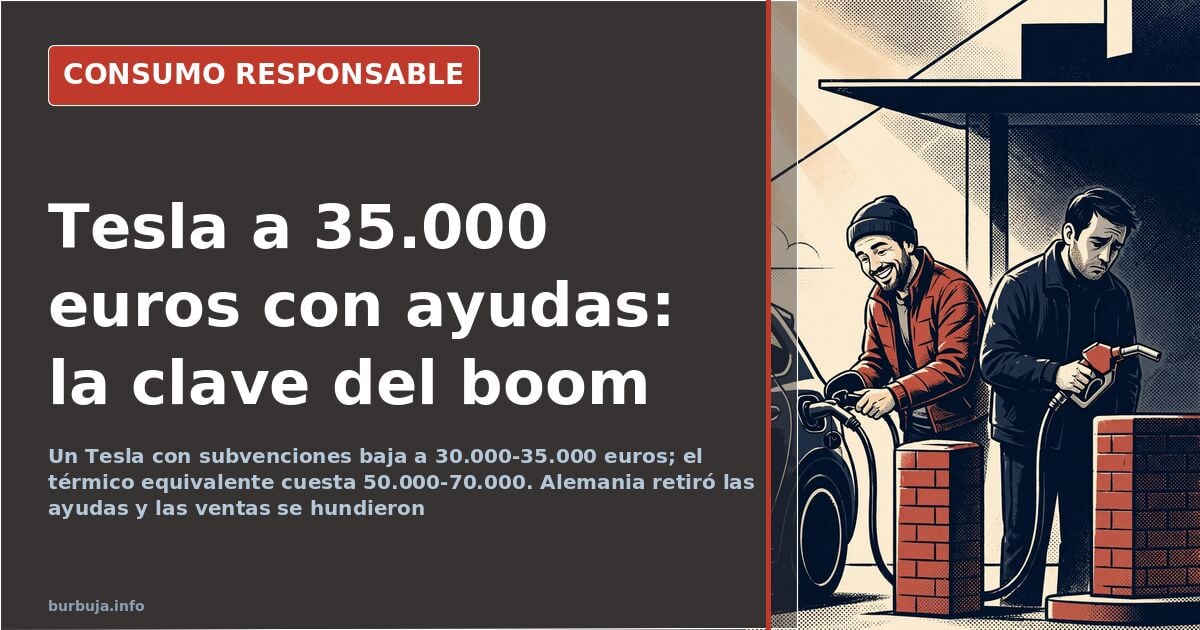
Tesla Model 3 and Y drop to €30k-35k with subsidies, beating petrol cars at €50k-70k. Germany's subsidy withdrawal caused sales to plummet.
English · Original discussion in Spanish · Published
More Teslas on the road: subsidies, leasing, and taxis
Eight. That is the number of Teslas one driver claims to have spotted on a single post-holiday alucinación back home. Another insists that crossing paths with two or three daily is easy in his area. In 2018, he recalls, the Model S was promoted in Spain but was rarely seen. The difference between then and now is not a massive ecological conversion: it is that electric cars have stopped carrying an electric car price. At least, for those buying with external aid.
From €50,000 to €35,000: the calculation explaining the boom
The most repeated calculation is simple arithmetic. A Tesla Model 3 or Model Y, with subsidies, discounts, and tax deductions, is priced between €30,000 and €35,000. The car that same profile used to buy — well-equipped petrol — costs €50,000 or €70,000. The argument is not that electric cars are cheap, but that the comparison has been inverted.
This is joined by a channel barely reflected in private statistics: corporate leasing. The mechanism is known. The company deducts X from the salary, the company adds X+Y, and the car ends up in the garage. In the UK, according to a circulating story, four or five years ago they were seen "by the pair," as if given away with yogurts; now, fewer. Some go further, claiming that those who receive one sell it to return to gasoline.
Registration numbers support part of the story. In the last month discussed, Tesla was the second best-selling model in Spain, only behind the Dacia Sandero. Taxi drivers are also buying, especially in urban fleets. The brand concentrates its offer on two models with one million units each, placing it high in the model ranking, not the manufacturer ranking: it produces about two million cars annually, compared to ten million for Toyota or Volkswagen.
Why does Tesla disappear from the ranking in August?
Because it sells one month out of three. The bulk of deliveries arrive by ship, once per quarter; the remaining months are residual units. In August, the same car leading the table in a good month dropped to position 74. Anyone looking only at that data concludes the phenomenon has deflated; anyone looking at the full quarter sees the opposite.
Germany withdrew subsidies and lots filled up
The German episode serves as a natural experiment. When the country withdrew electric car subsidies overnight, images appeared of an airport parking lot converted into a lot, with new Teslas as far as the eye could see. These were discussed on television with the explanation that they were thrown at low prices and still not selling. The lesson drawn: much of European demand was the subsidy.
From this comes the most gloomy prediction. If subsidies fall, sales plummet. This is not a verified forecast, but a scenario that fits, given that the final price depends on what the taxpayer provides.
The battery: neither 100 kilometers nor a quarter of autonomy
Here the analysis splits in two. A driver with five years and about 130,000 kilometers claims his degradation is 7.8% and has been stable for a couple of years. Another speaks of 7.2% in five years. In contrast, panic estimates suggest that after eight or ten years, autonomy drops to a quarter, or that a car homologated for 500 or 600 kilometers is only good for 100 real ones because the cycle is measured at an average of 60 km/h, and anyone wanting 1,200 life cycles can only use a third.
Technology allows nuance. NMC cells used between 20% and 80% exceed 1,500 cycles maintaining 80% capacity; LFP cells, after 3,000 cycles, remain above 90%. The fine print, others reply, is that tests are done at one-third of nominal current and favorable temperatures. No one has the definitive figure, and manufacturers cover themselves with buffers preventing charging to 100% and discharging to 0%.
The most uncomfortable testimony is not technical. A traveler recounts that in August, in Seville, he asked for an electric taxi, and the driver said he could not turn on the air conditioning because the charge would not last for the service. One case does not make statistics, but it illustrates the point: autonomy is not a number, it is a number with the air conditioning on.
Reliability: the ranking each reads as they wish
OCU data allows for opposite interpretations. Tesla scores 84 out of 100 in reliability, above Skoda and Seat (82), Volkswagen and Citroën (80), Opel (76), and far from Land Rover (64).
With these numbers, claiming Tesla is the least reliable brand on the market is difficult. What can be said is that it shares a score with Fiat, which is no honor. And that the brand using the same platform as Skoda appears in the top five, inviting doubt about the thermometer.
What no one discounts: the one who sells it later
The second-hand market is the pending bill. Those who bought five years ago with subsidies may find their car is worth much less than they paid, and electric depreciation trinc the same path as its technology. In China, the world's largest market, electric trucks already account for 10% of sales. In Spain, the same Tesla that is second best-selling in one month is 74th in another. A manufacturer placing two million cars a year does not need to convince everyone. It is enough with the part that does not pay the full price.
Eight. That is the number of Teslas one driver claims to have spotted on a single post-holiday alucinación back home. Another insists that crossing paths with two or three daily is easy in his area. In 2018, he recalls, the Model S was promoted in Spain but was rarely seen. The difference between then and now is not a massive ecological conversion: it is that electric cars have stopped carrying an electric car price. At least, for those buying with external aid.
From €50,000 to €35,000: the calculation explaining the boom
The most repeated calculation is simple arithmetic. A Tesla Model 3 or Model Y, with subsidies, discounts, and tax deductions, is priced between €30,000 and €35,000. The car that same profile used to buy — well-equipped petrol — costs €50,000 or €70,000. The argument is not that electric cars are cheap, but that the comparison has been inverted.
This is joined by a channel barely reflected in private statistics: corporate leasing. The mechanism is known. The company deducts X from the salary, the company adds X+Y, and the car ends up in the garage. In the UK, according to a circulating story, four or five years ago they were seen "by the pair," as if given away with yogurts; now, fewer. Some go further, claiming that those who receive one sell it to return to gasoline.
Registration numbers support part of the story. In the last month discussed, Tesla was the second best-selling model in Spain, only behind the Dacia Sandero. Taxi drivers are also buying, especially in urban fleets. The brand concentrates its offer on two models with one million units each, placing it high in the model ranking, not the manufacturer ranking: it produces about two million cars annually, compared to ten million for Toyota or Volkswagen.
Why does Tesla disappear from the ranking in August?
Because it sells one month out of three. The bulk of deliveries arrive by ship, once per quarter; the remaining months are residual units. In August, the same car leading the table in a good month dropped to position 74. Anyone looking only at that data concludes the phenomenon has deflated; anyone looking at the full quarter sees the opposite.
Germany withdrew subsidies and lots filled up
The German episode serves as a natural experiment. When the country withdrew electric car subsidies overnight, images appeared of an airport parking lot converted into a lot, with new Teslas as far as the eye could see. These were discussed on television with the explanation that they were thrown at low prices and still not selling. The lesson drawn: much of European demand was the subsidy.
From this comes the most gloomy prediction. If subsidies fall, sales plummet. This is not a verified forecast, but a scenario that fits, given that the final price depends on what the taxpayer provides.
The battery: neither 100 kilometers nor a quarter of autonomy
Here the analysis splits in two. A driver with five years and about 130,000 kilometers claims his degradation is 7.8% and has been stable for a couple of years. Another speaks of 7.2% in five years. In contrast, panic estimates suggest that after eight or ten years, autonomy drops to a quarter, or that a car homologated for 500 or 600 kilometers is only good for 100 real ones because the cycle is measured at an average of 60 km/h, and anyone wanting 1,200 life cycles can only use a third.
Technology allows nuance. NMC cells used between 20% and 80% exceed 1,500 cycles maintaining 80% capacity; LFP cells, after 3,000 cycles, remain above 90%. The fine print, others reply, is that tests are done at one-third of nominal current and favorable temperatures. No one has the definitive figure, and manufacturers cover themselves with buffers preventing charging to 100% and discharging to 0%.
The most uncomfortable testimony is not technical. A traveler recounts that in August, in Seville, he asked for an electric taxi, and the driver said he could not turn on the air conditioning because the charge would not last for the service. One case does not make statistics, but it illustrates the point: autonomy is not a number, it is a number with the air conditioning on.
Reliability: the ranking each reads as they wish
OCU data allows for opposite interpretations. Tesla scores 84 out of 100 in reliability, above Skoda and Seat (82), Volkswagen and Citroën (80), Opel (76), and far from Land Rover (64).
- Lexus: 98
- Suzuki: 93
- Toyota: 91
- Tesla: 84
- Seat: 82
- Land Rover: 64
With these numbers, claiming Tesla is the least reliable brand on the market is difficult. What can be said is that it shares a score with Fiat, which is no honor. And that the brand using the same platform as Skoda appears in the top five, inviting doubt about the thermometer.
What no one discounts: the one who sells it later
The second-hand market is the pending bill. Those who bought five years ago with subsidies may find their car is worth much less than they paid, and electric depreciation trinc the same path as its technology. In China, the world's largest market, electric trucks already account for 10% of sales. In Spain, the same Tesla that is second best-selling in one month is 74th in another. A manufacturer placing two million cars a year does not need to convince everyone. It is enough with the part that does not pay the full price.
Summary of a discussion on Burbuja.info - Foro de economía, actualidad y política., translated from Spanish and reviewed before publication. Read the full discussion (270 replies).
More summaries
-
Electric quadricycle vs. EV: can it really save money?
A family with four cars and solar panels considers a small electric quadricycle to cut costs. Does it make sense versus a conventional EV? A cost analysis.
-
Mercadona salmon rip-off: tray fillets cost up to 78% more
Mercadona charges up to €25/kg for salmon tray fillets while a whole salmon costs €11/kg. Data and tips to save.
-
Carrefour's 3x2 Promotion: Hidden Price Inflation and Customer Complaints
Carrefour customers allege that the 3x2 offer hides inflated prices, with the discount on the cheapest item diluted, resulting in minimal or zero real savings.
-
AliExpress Football Shirts at €0.99 vs. Real Madrid's €185 Official Kit
A Cartagena FC jersey sells for €0.99 on AliExpress, while a Real Madrid official kit costs €185. This highlights debates on quality, customs duties, and local employment.
-
Dressing at 30: From tracksuits to chinos and shirts
How to transition your wardrobe at 30 by trading tracksuits for chinos and shirts, exploring smart casual style, color combinations, and key pieces like boots and jackets.
-
Gym at 50: Strong muscles, worn joints
Twenty years of heavy lifting leaves knees and shoulders damaged, while sedentary people suffer no pain. The joint cost of the gym at 50 is under review.