
Gym at 50: Strong muscles, worn joints
Twenty years of heavy lifting leaves knees and shoulders damaged, while sedentary people suffer no pain. The joint cost of the gym at 50 is under review.
English · Original discussion in Spanish · Published
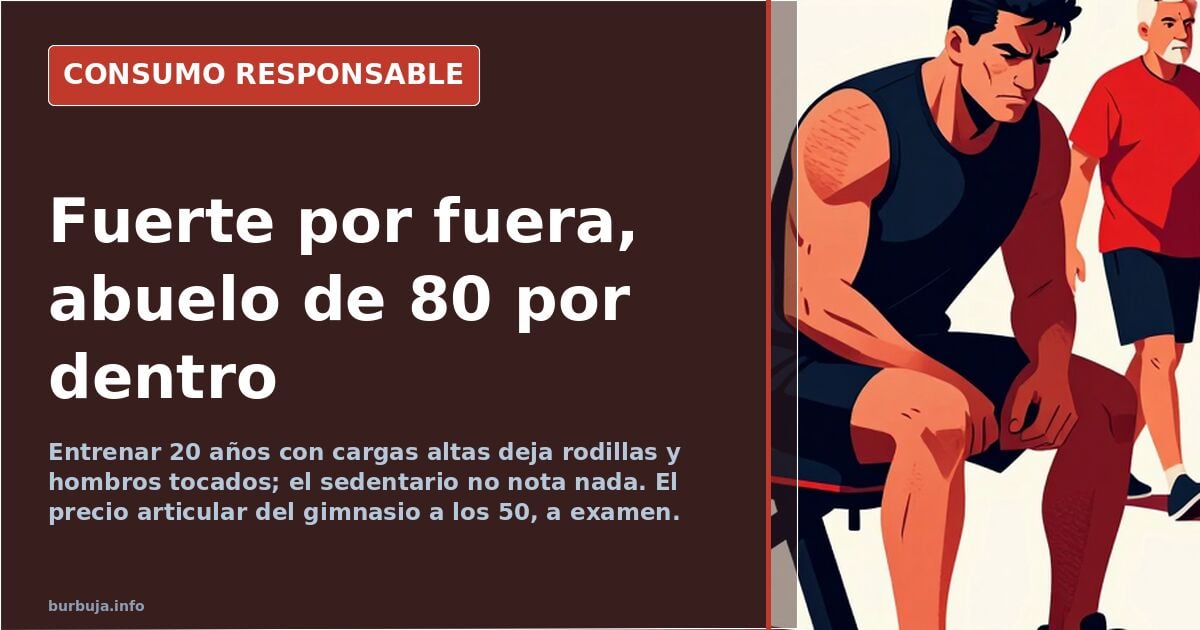
Gym at 50: strong outside, worn inside
A recurring scene in any office involves a 48-year-old man with a tank-like physique who needs help getting into his car and cannot work bent over. Beside him, colleagues with beer bellies and no gym routine have no joint complaints. The image is uncomfortable because it contradicts the manual: those who take care of themselves appear worn, while those who do not seem intact. This paradox, taken to the extreme, fuels a fundamental debate about what intense exercise does to the body over the years.
Is lifting heavy weights bad with age?
The thesis supporting this reading is blunt: the human anatomy is not designed to move colossal weights, and what breaks is not the muscle, but the joint. The diagnosis relies on everyday cases: people who have trained for 20 years and have damaged knees, shoulders, and backs, medicated for pain, with apparent strength hiding internal deterioration. The recurring image is of someone strong on the outside and 80 years old on the inside.
The focus is on the kilos. The Smith machine with 100 kilos, the leg press with 80 or 100, the deadlift and squat with 200. In contrast, the recommended alternative is the dumbbell of 12 or 14 kilos and going home. And a recurring warning: if you need knee braces to perform an exercise, that exercise is no longer for you. "It's crazy," summarizes one of the most critical voices; lumbar supports or knee braces are not equipment, they are a warning.
Deadlifts, 200-kilo squats, and the addiction to iron
Among those who admit to training all their lives, the consensus is uncomfortable. It is argued that deadlifts and 200-kilo squats inevitably cause injury, and that the most manageable approach is moderate cardio with weights in the range of 10-12RM. The nuance is significant: the problem would not be the exercise itself, but the excessive weight and the pursuit of volume.
Even in this moderate version, a psychological factor pushing in the opposite direction is recognized. Lifting kilos works like a drug: the stronger you are, the more you want to lift. This is the mechanism that separates the person who trains with head from the one who ends up signing a foreseen injury. The recommendation circulating in age brackets adds another layer: from the age of 45, magnesium for the joints and a review of which movements still make sense.
The counterattack: muscle as protection, not threat
Not everyone accepts the story of wear and tear. The most solid objection argues that deterioration at advanced ages is similar between those who train and those who do not, because it is caused by age, not the bar. And it adds a biomechanical argument: strong muscles hold the joint and make that wear more manageable, not worse. From this perspective, blaming iron for what is inherent to the years confuses the cause with the witness.
Along the same lines is the idea that each age has its sport, and that at 20 years going hard pays off, while at 50 it is reckless. There is also the appeal to routines of isolation by muscle groups, with strict control and no maximum loads, as a way to train strength without accumulating damage. In the end, the meeting point between the two sides is narrower than it seems: no one defends the nonsense and no one defends the couch. The division lies in where the border is placed.
The extreme case: Ronnie Coleman, Gasol, and injured young people
As evidence, elite bodybuilding is invoked. The recurring name is Ronnie Coleman, who at 58 years pays with his mobility the price of an extreme iron career. In professional sports, the pattern repeats: an interview with Gasol admitted that practically all elite athletes retire damaged, many with thirty and few left. The muscle goes; the joints remain.
The warning extends to the youngest, sometimes the most reckless. In front of the leg press, boys are seen screaming in pain, with routines that, according to this reading, deform bones and dislocate knees from the first day. The destruction is not noticeable then because young muscle supports everything. It becomes noticeable later. And there is a recent example of an 18-year-old boy who, after going to play basketball in the United States, had been injured since January.
Strong and damaged, or sedentary and intact
There is a current that inverts the framework: overweight is not a healthy refuge from the gym, but a problem in itself. According to this argument, staying fit is an obligation, especially in jobs that require physical endurance and force you to be prepared to help others. Those who defend sedentary lifestyle as a natural advantage have an easy response: he who never trained never has a peak to lose. A quote from Woody Allen is cited: "I prefer to atrophy."
The surprising data
At the end of the path, the most difficult counterexample is not a gym, but a garden. A 91-year-old grandfather who continued working with a hoe, carrying weight all his life, with better mobility than many thirty-something gym-goers. And another who reached 99 without ever stepping on a machine. Activity yes, Olympic bars no. The question remains open: no one fully explains why the one who takes care of himself ends up medicated and the one who abandons himself, intact.
A recurring scene in any office involves a 48-year-old man with a tank-like physique who needs help getting into his car and cannot work bent over. Beside him, colleagues with beer bellies and no gym routine have no joint complaints. The image is uncomfortable because it contradicts the manual: those who take care of themselves appear worn, while those who do not seem intact. This paradox, taken to the extreme, fuels a fundamental debate about what intense exercise does to the body over the years.
Is lifting heavy weights bad with age?
The thesis supporting this reading is blunt: the human anatomy is not designed to move colossal weights, and what breaks is not the muscle, but the joint. The diagnosis relies on everyday cases: people who have trained for 20 years and have damaged knees, shoulders, and backs, medicated for pain, with apparent strength hiding internal deterioration. The recurring image is of someone strong on the outside and 80 years old on the inside.
The focus is on the kilos. The Smith machine with 100 kilos, the leg press with 80 or 100, the deadlift and squat with 200. In contrast, the recommended alternative is the dumbbell of 12 or 14 kilos and going home. And a recurring warning: if you need knee braces to perform an exercise, that exercise is no longer for you. "It's crazy," summarizes one of the most critical voices; lumbar supports or knee braces are not equipment, they are a warning.
Deadlifts, 200-kilo squats, and the addiction to iron
Among those who admit to training all their lives, the consensus is uncomfortable. It is argued that deadlifts and 200-kilo squats inevitably cause injury, and that the most manageable approach is moderate cardio with weights in the range of 10-12RM. The nuance is significant: the problem would not be the exercise itself, but the excessive weight and the pursuit of volume.
Even in this moderate version, a psychological factor pushing in the opposite direction is recognized. Lifting kilos works like a drug: the stronger you are, the more you want to lift. This is the mechanism that separates the person who trains with head from the one who ends up signing a foreseen injury. The recommendation circulating in age brackets adds another layer: from the age of 45, magnesium for the joints and a review of which movements still make sense.
The counterattack: muscle as protection, not threat
Not everyone accepts the story of wear and tear. The most solid objection argues that deterioration at advanced ages is similar between those who train and those who do not, because it is caused by age, not the bar. And it adds a biomechanical argument: strong muscles hold the joint and make that wear more manageable, not worse. From this perspective, blaming iron for what is inherent to the years confuses the cause with the witness.
Along the same lines is the idea that each age has its sport, and that at 20 years going hard pays off, while at 50 it is reckless. There is also the appeal to routines of isolation by muscle groups, with strict control and no maximum loads, as a way to train strength without accumulating damage. In the end, the meeting point between the two sides is narrower than it seems: no one defends the nonsense and no one defends the couch. The division lies in where the border is placed.
The extreme case: Ronnie Coleman, Gasol, and injured young people
As evidence, elite bodybuilding is invoked. The recurring name is Ronnie Coleman, who at 58 years pays with his mobility the price of an extreme iron career. In professional sports, the pattern repeats: an interview with Gasol admitted that practically all elite athletes retire damaged, many with thirty and few left. The muscle goes; the joints remain.
The warning extends to the youngest, sometimes the most reckless. In front of the leg press, boys are seen screaming in pain, with routines that, according to this reading, deform bones and dislocate knees from the first day. The destruction is not noticeable then because young muscle supports everything. It becomes noticeable later. And there is a recent example of an 18-year-old boy who, after going to play basketball in the United States, had been injured since January.
Strong and damaged, or sedentary and intact
There is a current that inverts the framework: overweight is not a healthy refuge from the gym, but a problem in itself. According to this argument, staying fit is an obligation, especially in jobs that require physical endurance and force you to be prepared to help others. Those who defend sedentary lifestyle as a natural advantage have an easy response: he who never trained never has a peak to lose. A quote from Woody Allen is cited: "I prefer to atrophy."
The surprising data
At the end of the path, the most difficult counterexample is not a gym, but a garden. A 91-year-old grandfather who continued working with a hoe, carrying weight all his life, with better mobility than many thirty-something gym-goers. And another who reached 99 without ever stepping on a machine. Activity yes, Olympic bars no. The question remains open: no one fully explains why the one who takes care of himself ends up medicated and the one who abandons himself, intact.
Summary of a discussion on Burbuja.info - Foro de economía, actualidad y política., translated from Spanish and reviewed before publication. Read the full discussion (263 replies).
More summaries
-
Albo and frozen Louriño, the most recommended callos on the forum
Several forum members criticise Litoral and recommend Albo, La Nora and, above all, the frozen Louriño
-
How to Record Android Calls Without Root Using ACR Phone
ACR Phone and APH bypass Android restrictions to record calls without root on Android 13 and 14.
-
Why Strict Veganism Is Accused of Causing Emaciation
The debate on emaciated vegans relies on photos, not studies. Protein, basket costs, and morality mix without conclusive data.
-
Microcement bathroom on plasterboard: €8,000 with no tiles
A microcement bathroom on plasterboard cost €8,000: €3,700 for labor and materials, €4,300 for purchases. The material divides opinion among users.
-
The 40-Euro Monthly Diet: 2,200 Calories and 100 Triglycerides
Breakdown of a 40-euro monthly diet: 7.5 euros for peanuts, 12 euros for fruit, and 2,200 daily calories. The same menu now costs over 150 euros.
-
Bluetooth Headphones: The Hidden Cost of Convenience
We analyze prices, sound quality, battery life, and health risks of Bluetooth headphones. Data suggests wired models still offer superior value and longevity.