
Dressing at 30: From tracksuits to chinos and shirts
How to transition your wardrobe at 30 by trading tracksuits for chinos and shirts, exploring smart casual style, color combinations, and key pieces like boots and jackets.
English · Original discussion in Spanish · Published
Dressing at 30: From tracksuits to chinos and shirts
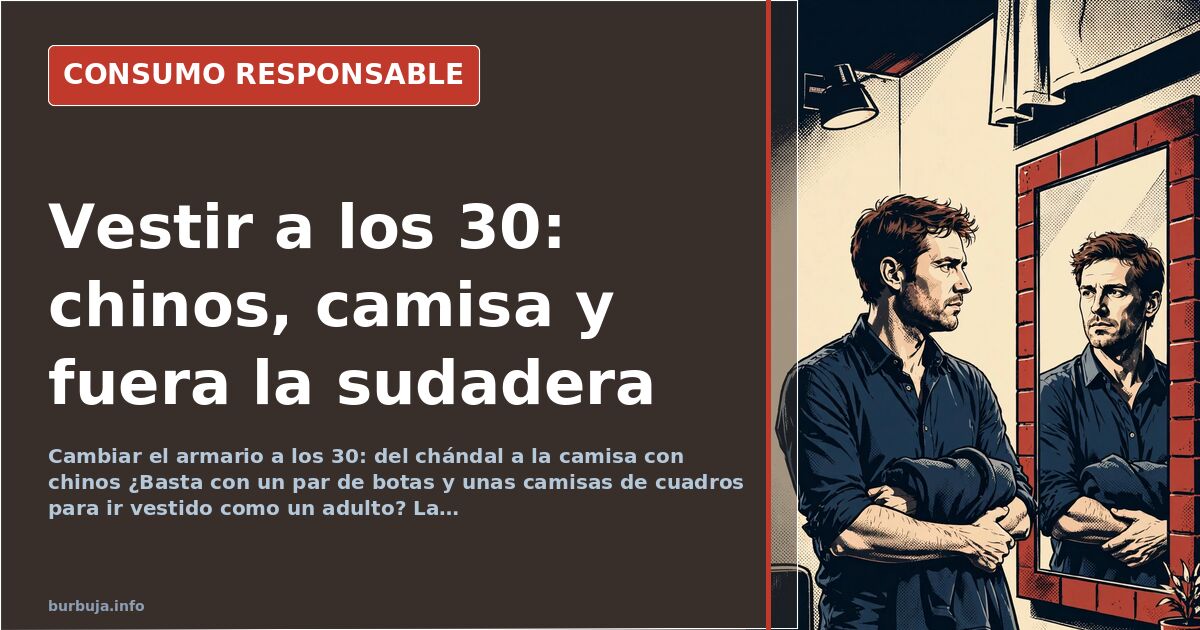
Is a pair of boots and some plaid shirts enough to dress like an adult? The question comes from someone who already has black and brown boots, several plaid shirts that only work with jeans, and the feeling that their wardrobe has fallen short. They want to see chinos with shirts, a touch of smart casual, and a clear guide. What they get is an improvised manual, a discussion about age, and plenty of irony. In their early 30s, a whole generation looks at their clothes and doesn't recognize themselves.
What colors of chinos go with almost everything
Navy, khaki, olive green, or gray chinos work with almost any shirt. The trick is to cross colors well: khaki accepts pink, white, green, blue, orange, yellow, red, gray, and lavender; navy matches with pink, white, light blue, orange, yellow, and red; olive green calls for pink, white, blue, intense orange, or khaki itself; and gray holds up with blue, red, khaki, white, and pink. The ambitious version raises the stakes: five suits —black, navy, gray, brown, and cream— plus shirts in white, cream, and light blue would give, according to the shared calculation, up to 75 different combinations, all presented as elegant. The brand recommended for that expense is John Ford, without despising Zara or Springfield.
Tuck the shirt in or leave it out?
Wearing the shirt outside is the fast track to a casual look and, in summer, the only sensible one. But it requires a garment that is not too long, otherwise it hangs like a bathrobe. Some people at 45 years old never tuck it in, while others argue the opposite with a reasonable point: formality is marked by style, not the position of the fabric. The full scale —sport, casual, smart casual, formal, black tie— is handled better than any loose garment. And a footwear detail that repeats: if there is a belt, shoe and belt of the same tonalidad.
Use what you have before buying anything
Before checking out, the most repeated advice is also the most boring: squeeze what you already have until it breaks, rotating garments so wear is equitable. The issue is about responsible consumption and it shows here. Added to this is a warning that almost no one applies: the problem is not the quantity, but the rotation. Forty shirts that are never worn occupy the same closet as five daily-use ones. Only when the bottom runs out does it make sense to replenish, and then it is advisable to go for neutral colors, which go with everything and save decisions at seven in the morning.
Boots with chinos: smart casual or skinhead subterfuge?
With boots and chinos, there is a risk of ending up looking like a pale imitation of skinhead aesthetics, rather than a well-dressed adult. The warning is blunt for certain registers: for something formal, shoes are requested, even if it is a buckle shoe, or a discreet black sneaker, the kind worn by goalkeepers and waiters. The Nike Air Force 1 black shoes are cited as a middle ground between youthful and discreet, with cheaper alternatives. In terms of fit, narrow is dead: the skinny fit is dying, the slim does balancing acts, and pants with a pleat win —two if one wants to risk it—, a short cut with a turn-up. For shirts, wide collar with buttons, American style from the 60s-70s, no mini collars. Footwear, preferably suede with a semi-rounded toe.
The jacket proposed instead of the bomber
Harrington-style jackets appear as a stylish substitute for the bomber: less voluminous, more elegant without leaving the informal. One from the brand Merc, blue with a tartan lining, sold for less than 80 euros and now hovers around 100 on Amazon. The only drawback mentioned is the neck closure, uncomfortable at times. There is a valid warning for almost all these jackets: the point at the cuffs and hem breaks in a couple of years even if the fabric remains impeccable, and stores continue to sell them happily. The budget handled by the asker is blunt: nothing over 150 euros.
Does clothing for age exist?
The most repeated answer is no. "Wearing diapers and a bib is for babies, but the rest," summarizes a stance that runs through the entire conversation: that everyone dresses as they please and that, in the end, we all go to die. Against that, the real discomfort of someone in their early 30s opening their closet and seeing only pop culture t-shirts —calculating they are 60%— which start to look like a child's. At 38, some live in tracksuits and hoodies without complexes, purely for comfort, and some confess they would like to look like Ryan Gosling but cannot afford it. Elegance, it is insisted, is not bought: it is not the same to dress well as to be elegant, and a 20-euro watch fulfills the same function as one worth 200,000.
In the end, the only garment that truly expires is not in the closet: it is the idea that a number —30, 40, or 45— decides what one wears in the morning. The iron, however, is non-negotiable.
Is a pair of boots and some plaid shirts enough to dress like an adult? The question comes from someone who already has black and brown boots, several plaid shirts that only work with jeans, and the feeling that their wardrobe has fallen short. They want to see chinos with shirts, a touch of smart casual, and a clear guide. What they get is an improvised manual, a discussion about age, and plenty of irony. In their early 30s, a whole generation looks at their clothes and doesn't recognize themselves.
What colors of chinos go with almost everything
Navy, khaki, olive green, or gray chinos work with almost any shirt. The trick is to cross colors well: khaki accepts pink, white, green, blue, orange, yellow, red, gray, and lavender; navy matches with pink, white, light blue, orange, yellow, and red; olive green calls for pink, white, blue, intense orange, or khaki itself; and gray holds up with blue, red, khaki, white, and pink. The ambitious version raises the stakes: five suits —black, navy, gray, brown, and cream— plus shirts in white, cream, and light blue would give, according to the shared calculation, up to 75 different combinations, all presented as elegant. The brand recommended for that expense is John Ford, without despising Zara or Springfield.
Tuck the shirt in or leave it out?
Wearing the shirt outside is the fast track to a casual look and, in summer, the only sensible one. But it requires a garment that is not too long, otherwise it hangs like a bathrobe. Some people at 45 years old never tuck it in, while others argue the opposite with a reasonable point: formality is marked by style, not the position of the fabric. The full scale —sport, casual, smart casual, formal, black tie— is handled better than any loose garment. And a footwear detail that repeats: if there is a belt, shoe and belt of the same tonalidad.
Use what you have before buying anything
Before checking out, the most repeated advice is also the most boring: squeeze what you already have until it breaks, rotating garments so wear is equitable. The issue is about responsible consumption and it shows here. Added to this is a warning that almost no one applies: the problem is not the quantity, but the rotation. Forty shirts that are never worn occupy the same closet as five daily-use ones. Only when the bottom runs out does it make sense to replenish, and then it is advisable to go for neutral colors, which go with everything and save decisions at seven in the morning.
Boots with chinos: smart casual or skinhead subterfuge?
With boots and chinos, there is a risk of ending up looking like a pale imitation of skinhead aesthetics, rather than a well-dressed adult. The warning is blunt for certain registers: for something formal, shoes are requested, even if it is a buckle shoe, or a discreet black sneaker, the kind worn by goalkeepers and waiters. The Nike Air Force 1 black shoes are cited as a middle ground between youthful and discreet, with cheaper alternatives. In terms of fit, narrow is dead: the skinny fit is dying, the slim does balancing acts, and pants with a pleat win —two if one wants to risk it—, a short cut with a turn-up. For shirts, wide collar with buttons, American style from the 60s-70s, no mini collars. Footwear, preferably suede with a semi-rounded toe.
The jacket proposed instead of the bomber
Harrington-style jackets appear as a stylish substitute for the bomber: less voluminous, more elegant without leaving the informal. One from the brand Merc, blue with a tartan lining, sold for less than 80 euros and now hovers around 100 on Amazon. The only drawback mentioned is the neck closure, uncomfortable at times. There is a valid warning for almost all these jackets: the point at the cuffs and hem breaks in a couple of years even if the fabric remains impeccable, and stores continue to sell them happily. The budget handled by the asker is blunt: nothing over 150 euros.
Does clothing for age exist?
The most repeated answer is no. "Wearing diapers and a bib is for babies, but the rest," summarizes a stance that runs through the entire conversation: that everyone dresses as they please and that, in the end, we all go to die. Against that, the real discomfort of someone in their early 30s opening their closet and seeing only pop culture t-shirts —calculating they are 60%— which start to look like a child's. At 38, some live in tracksuits and hoodies without complexes, purely for comfort, and some confess they would like to look like Ryan Gosling but cannot afford it. Elegance, it is insisted, is not bought: it is not the same to dress well as to be elegant, and a 20-euro watch fulfills the same function as one worth 200,000.
In the end, the only garment that truly expires is not in the closet: it is the idea that a number —30, 40, or 45— decides what one wears in the morning. The iron, however, is non-negotiable.
Summary of a discussion on Burbuja.info - Foro de economía, actualidad y política., translated from Spanish and reviewed before publication. Read the full discussion (262 replies).
More summaries
-
Dressing Well with 13 Items: The Minimal Wardrobe That Works
Three pairs of trousers, three shirts, and a few accessories: the formula for dressing well with 13 items, pitting minimal wardrobe advocates against...
-
Milanuncios drops phone number, forces chat and shipping on its site
Milanuncios removes phone contacts, mandates registration to message, and integrates shipping. Sellers report a sharp drop in buyer inquiries.
-
Creatine: Strength Boost in Two Weeks, No Link to Baldness
Five grams of creatine daily boost strength in two weeks. Experts debunk the baldness myth, clarifying that the supplement lacks hormonal effects and does not cause hair loss.
-
Why I Must Take Cholesterol Pills Forever: My Body Makes It, WTF?
Is chronic statin use a medical necessity or a pharmaceutical business model ignoring real metabolic management?
-
Brussels forces attached bottle caps: 13% less plastic
The European Waste Law mandates attached caps on cartons since July 2024. Central Lechera Asturiana has implemented the change, cutting plastic use by 13%.
-
The Fifth-Gamma Business: Paying 16€ for a 1.16€ Item
A 16€ restaurant coulant costs 1.16€ at Makro. Fifth-gamma products fill menus, driving up prices without customer awareness.