
Tesla Sales Slump in Europe as Musk Becomes Liability
Tesla sales drop in Europe, with Musk's activism cited as cause. The record of 17 million cars sold in 2024 complicates the boycott narrative.
English · Original discussion in Spanish · Published
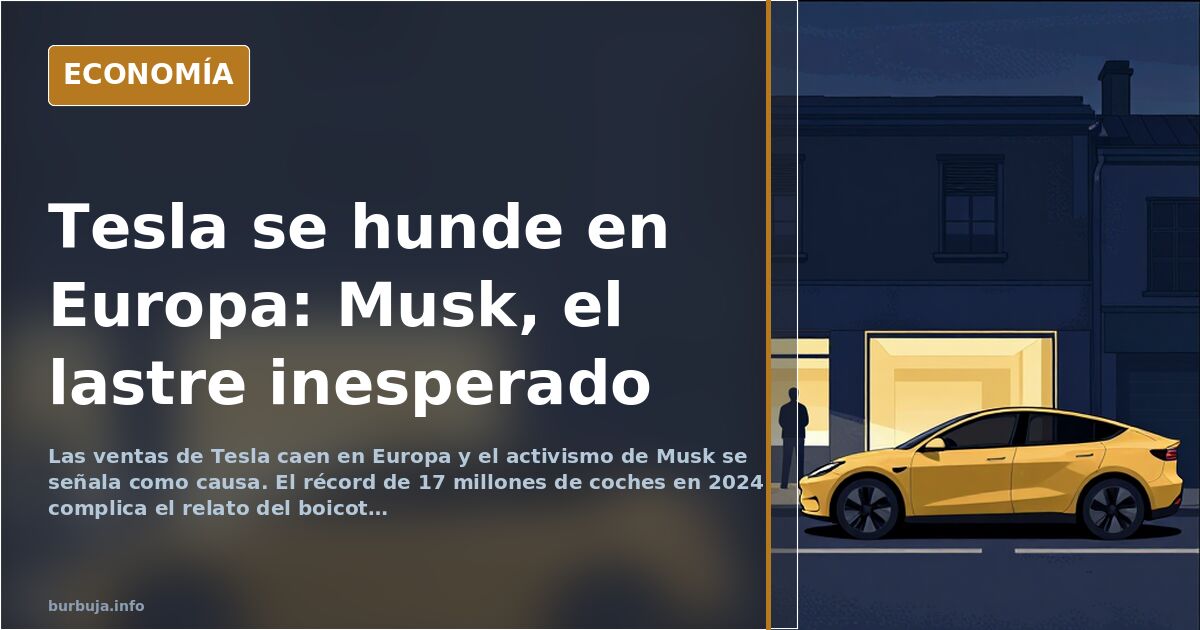
Tesla Sales Fall in Europe and Debate Heats Up
A European dealership with cars lined up and no one inside. Tesla sales are plummeting in Europe, and the reason buyers point to isn't under the hood: it's on their owner's X account. Elon Musk's political activism has become the most repeated argument explaining why the world's best-selling electric car has stopped selling as well as before in the Old Continent.
The reaction was immediate. Some argue that the slump has nothing to do with politics and that the real reason is that the brand has already sold to almost everyone who wanted and could afford an EV. Others point to the removal of public purchase subsidies. And a third, louder group directly celebrates the fall as punishment for the owner.
Why Are Tesla Sales Falling in Europe?
The most repeated argument in the conversation is political. Musk has plunged into the European public debate, and a portion of potential buyers have decided they don't want to fund their owner's opinions with their money. This is what has been called in other sectors "voting with your wallet": the product is good, but the owner is annoying.
Against this weighs an uncomfortable data point. Tesla sold 17 million cars in 2024, a world record, according to information shared in the discussion. If the political boycott were the determining factor, that record wouldn't add up. The figure comes from a participant who attributes it to Reuters.
The second argument is more prosaic: the withdrawal of public subsidies for buying electric vehicles. When the State stops putting up money, the product has to sell itself. And if the product needs subsidies to be competitive, the question is why.
Price, Range, and the Contract No One Reads
Beyond the political noise, there is a product problem that the debate brings to light. Electric vehicles are expensive, and their depreciation is questionable. A participant calculates that an EV won't last 25 years like a combustion engine without spending a fortune on batteries, which increases the cost per kilometer driven. Another responds that their Tesla batteries now cost about 9,000 euros installed and should drop to less than 3,000 in three or four years.
There is a third front, more worrying: the contract. A participant claims that the Tesla contract clearly states that the car does not belong to you, but to the brand, and that they can stop it whenever they want. It is an assertion that has not been verified in the discussion, but it has ignited the debate on the actual ownership of a connected car.
The Forgotten Context: The Whole Industry Is Falling
Against the narrative of political punishment, there is a disorienting data point: the entire automotive industry is falling at a similar rate. Mercedes, BMW, Ford, the Volkswagen Group, Stellantis. If the problem were Musk, only Tesla would fall. If the problem is the market, everyone falls.
It is the strongest argument from those who reject the boycott thesis. The fall of Tesla would not be an isolated phenomenon, but the most visible part of a broader sectoral adjustment. The doubt is whether Tesla falls more than the average or at the same pace.
What Musk Risks With His Activism
The core issue is whether a CEO can afford the luxury of alienating half of his potential customer base. Musk owns only 20% of Tesla, as noted in the discussion, which limits his personal exposure but not his ability to damage the brand.
Some argue that Musk is a genius who revolutionized the aerospace industry with SpaceX and co-founded OpenAI. Others respond that a genius who scares away customers is a poorly managed genius. So far, the market has not proven either side right.
With these elements, the fall of Tesla in Europe should have a clear explanation. It doesn't. And as long as the debate remains political, the data will continue to be uncomfortable for everyone.
Also available in: Deutsch
Summary of a discussion on Burbuja.info - Foro de economía, actualidad y política., translated from Spanish and reviewed before publication. Read the full discussion (192 replies).
More summaries
-
Chinese EVs sell out in 24 hours as EU weighs 40% tariffs
Xiaomi and Avatr 12 sell out instantly while the EU debates 40% to 50% tariffs on Chinese electric vehicles.
-
Europe's EV sector stalls amid factory halts and cancellations
Volkswagen pauses plants, Germany cuts EV subsidies, and a Chinese SUV leads Spanish sales. The industry is adrift.
-
EV debate: Imminent revolution or nonsense?
The 2025 EV debate: optimistic forecasts clash with scepticism over costs, range and viability. Revolution or bubble?
-
Ayuso Breaks Iker Jiménez’s Rules in Controversial Horizon Interview
Madrid President Isabel Díaz Ayuso breaks Iker Jiménez’s no-politician rule, sparking debate on media pluralism and the Puerta del Sol protests.
-
Allegations of election meddling in Brazil as Pedro Sánchez takes notes
The runoff between Bolsonaro and Lula da Silva is marked by a two-hour extension of polling station hours and 60% support for Lula among overseas voters. Click through for the data.
-
Spain's 29N election: forum users weigh tactical voting, abstention and punishment votes
A forum thread frames Spain's 29N vote as a contest between tactical voting, abstention and punishing the parties. Arguments and opinions from participants.