
EV debate: Imminent revolution or nonsense?
The 2025 EV debate: optimistic forecasts clash with scepticism over costs, range and viability. Revolution or bubble?
English · Original discussion in Spanish · Published
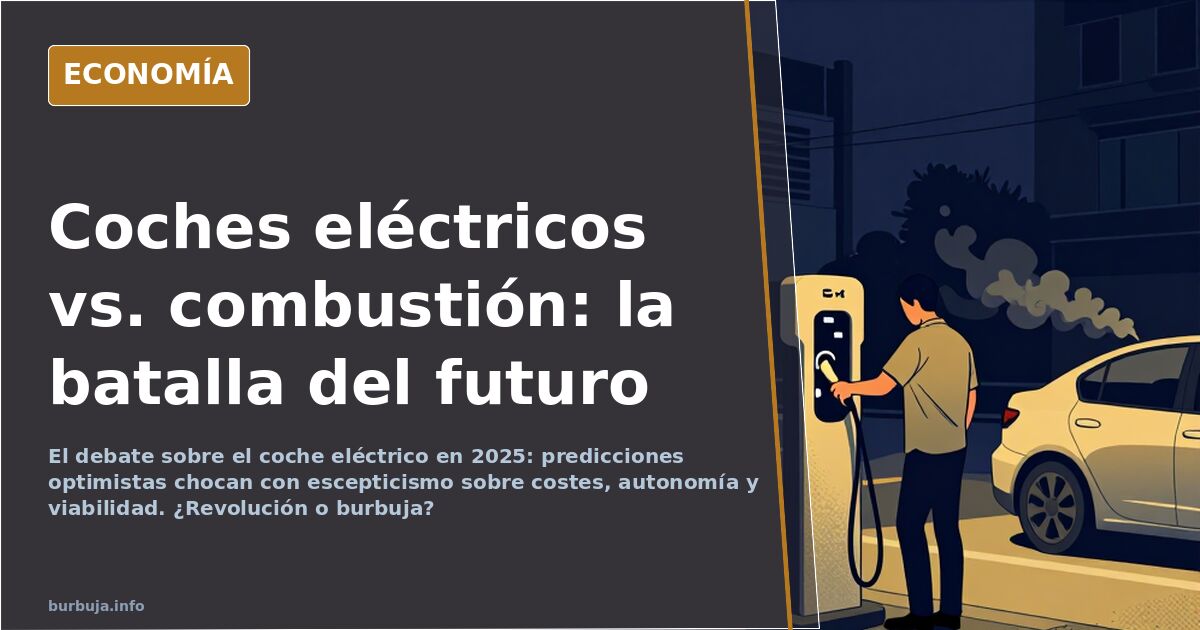
The electric car: a promising future or an imminent bubble?
The debate over the mass adoption of electric vehicles (EVs) in Europe and Spain is intensifying, with predictions pointing to an imminent take-off in 2025. However, opinions are deeply divided, oscillating between blind faith in the technology and entrenched scepticism that questions its viability and cost for the average citizen.
The promise of 2025: mirage or unavoidable reality?
The most optimistic projections, such as those of user Ángel Díaz, predict a crucial 2025 for EVs. Russia is expected to lose the war, which would stabilise oil prices, while electric car sales would soar. This scenario rests on the projected fall in oil demand in China and the resulting dominance of EVs, reaching a 70% market share. According to this view, dealerships for traditional brands such as Toyota, Volkswagen or Nissan would already be losing ground massively in the Asian giant, forcing alliances with Chinese manufacturers to survive.
However, this vision clashes head-on with that of other participants. Remerus, for example, describes the situation of the car industry in Europe as “very bad”, blaming leaders for having “shot themselves in the foot”. Hannibaal's perspective is even more critical, calling the EV a “product for the rich” and doubting its deployment in essential fleets such as ambulances, police or firefighters. The rollout of electric buses in Madrid is cited as an example of pogre, but the arrival of Chinese factories such as BYD's in Hungary in 2025, with cars at reduced prices, generates both anticipation and suspicion.
Cost, range and infrastructure: the big hurdles
One of the central points of disagreement is price. It is argued that a Volkswagen ID.3 in China costs 16.000€, a figure unattainable for the European market, where a significant surcharge is perceived. Dependence on raw materials and the automation of Chinese factories are cited as factors in competitiveness, while in Europe the protection of an uncompetitive industry through tariffs is criticised. Economic viability for the average citizen is a recurring theme. User th3burbu quips about Spaniards' ability to pay more than 30.000€ for a “washing machine on wheels”, when access to housing is a greater priority.
Range and charging infrastructure are also debated. Solid-state and sodium batteries are mentioned as possible revolutions, but they are dismissed as “unrealistic projects” or “living in cloud cuckoo land”. The long-term reliability of batteries, which are estimated to lose their effectiveness after around 15 years, is another factor raising doubts compared with the durability of traditional combustion engines.
Ideological polarisation and an uncertain future
The debate goes beyond the purely technical and economic, entering ideological territory. Ángel Díaz even associates “opponents of the electric car” with pro-Russian positions, conspiracy theorists and climate change deniers. This generalisation is flatly rejected by other participants, who accuse Díaz of being a “liar and manipulator”. The 2030 Agenda and the Sustainable Development Goals (SDGs) are mentioned as the backdrop to the imposition of EVs, generating rejection among those who see it as an ideological policy that ignores objective reasons.
The current state of the Spanish car market, with a registration volume lower than in 2006 despite a larger population, adds a note of general concern. While some see EVs as the only way to comply with environmental regulations and political objectives, others warn of a possible collapse of the sector if economic and infrastructure barriers are not addressed. The question left hanging is whether the electric car will manage to democratise or will become consolidated as a niche market for a few, leaving the bulk of the population with increasingly restricted and costly mobility.
The debate over the mass adoption of electric vehicles (EVs) in Europe and Spain is intensifying, with predictions pointing to an imminent take-off in 2025. However, opinions are deeply divided, oscillating between blind faith in the technology and entrenched scepticism that questions its viability and cost for the average citizen.
The promise of 2025: mirage or unavoidable reality?
The most optimistic projections, such as those of user Ángel Díaz, predict a crucial 2025 for EVs. Russia is expected to lose the war, which would stabilise oil prices, while electric car sales would soar. This scenario rests on the projected fall in oil demand in China and the resulting dominance of EVs, reaching a 70% market share. According to this view, dealerships for traditional brands such as Toyota, Volkswagen or Nissan would already be losing ground massively in the Asian giant, forcing alliances with Chinese manufacturers to survive.
However, this vision clashes head-on with that of other participants. Remerus, for example, describes the situation of the car industry in Europe as “very bad”, blaming leaders for having “shot themselves in the foot”. Hannibaal's perspective is even more critical, calling the EV a “product for the rich” and doubting its deployment in essential fleets such as ambulances, police or firefighters. The rollout of electric buses in Madrid is cited as an example of pogre, but the arrival of Chinese factories such as BYD's in Hungary in 2025, with cars at reduced prices, generates both anticipation and suspicion.
Cost, range and infrastructure: the big hurdles
One of the central points of disagreement is price. It is argued that a Volkswagen ID.3 in China costs 16.000€, a figure unattainable for the European market, where a significant surcharge is perceived. Dependence on raw materials and the automation of Chinese factories are cited as factors in competitiveness, while in Europe the protection of an uncompetitive industry through tariffs is criticised. Economic viability for the average citizen is a recurring theme. User th3burbu quips about Spaniards' ability to pay more than 30.000€ for a “washing machine on wheels”, when access to housing is a greater priority.
Range and charging infrastructure are also debated. Solid-state and sodium batteries are mentioned as possible revolutions, but they are dismissed as “unrealistic projects” or “living in cloud cuckoo land”. The long-term reliability of batteries, which are estimated to lose their effectiveness after around 15 years, is another factor raising doubts compared with the durability of traditional combustion engines.
Ideological polarisation and an uncertain future
The debate goes beyond the purely technical and economic, entering ideological territory. Ángel Díaz even associates “opponents of the electric car” with pro-Russian positions, conspiracy theorists and climate change deniers. This generalisation is flatly rejected by other participants, who accuse Díaz of being a “liar and manipulator”. The 2030 Agenda and the Sustainable Development Goals (SDGs) are mentioned as the backdrop to the imposition of EVs, generating rejection among those who see it as an ideological policy that ignores objective reasons.
The current state of the Spanish car market, with a registration volume lower than in 2006 despite a larger population, adds a note of general concern. While some see EVs as the only way to comply with environmental regulations and political objectives, others warn of a possible collapse of the sector if economic and infrastructure barriers are not addressed. The question left hanging is whether the electric car will manage to democratise or will become consolidated as a niche market for a few, leaving the bulk of the population with increasingly restricted and costly mobility.
Summary of a discussion on Burbuja.info - Foro de economía, actualidad y política., translated from Spanish and reviewed before publication. Read the full discussion (228 replies).
More summaries
-
Angelines Barceló Isn't Angels and Didn't Finish Journalism
María de los Ángeles, not Angels: the case of the presenter without a degree reopens the debate on qualifications, promotions by contacts, and forbidden names.
-
Angels Barceló leaves ‘hostile’ Madrid for Catalonia
Vox scores 9% in Madrid city and does not govern: the figure used to rebut Angels Barceló’s reason for moving to Catalonia
-
The Modern Worker's Cage: Escaping the Infinite Cycle of Burnout
Work has become a cage where daily effort consumes health and time. Discover why we push ourselves so hard and how to break the cycle.
-
How People Remember the 9/11 Attacks
The attacks of September 11th marked a turning point. Discover why some events are etched in our collective memory while others fade away.
-
Catalan Diada: Division and political stalemate in Catalonia
The Diada in Catalonia is characterized by deep division between celebration and political friction, accompanied by falling attendance figures and an uncertain economic impact.
-
Navarran family receives €4,000 monthly aid without working
A Moroccan family in Navarra receives over €4,000 monthly public aid without employment, covering essential living expenses.