
Tesla Optimus robot expected to cost €20,000
A new video of Tesla's humanoid robot reignites debate: can a €20,000 unit with €3,000 annual maintenance replace human workers?
English · Original discussion in Spanish · Published
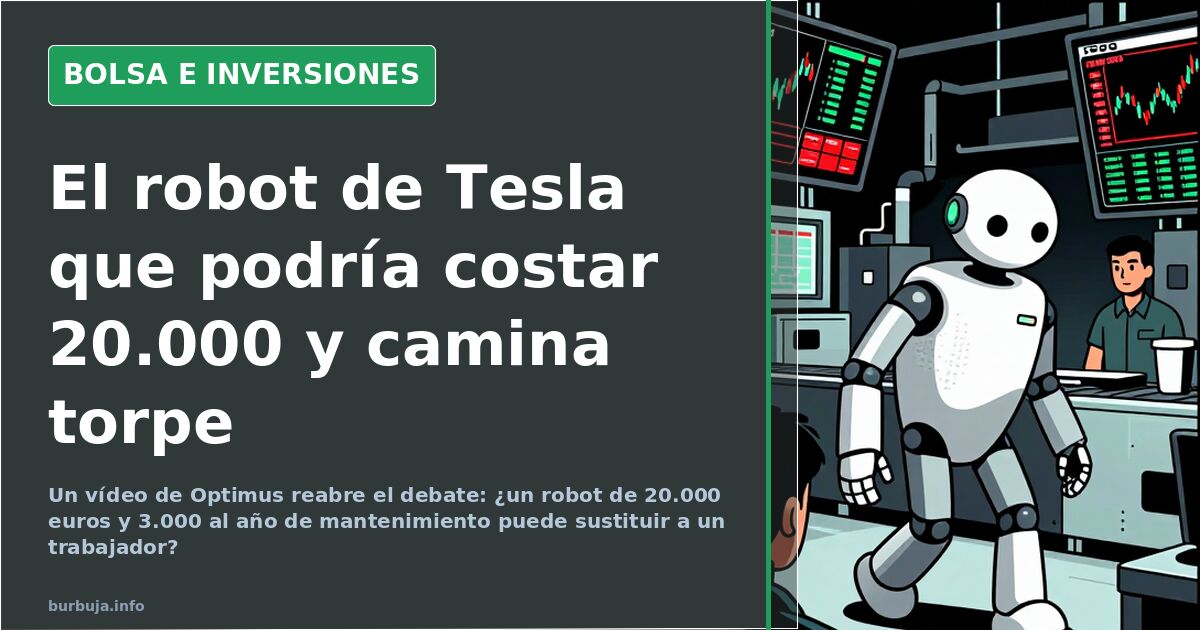
Tesla’s €20,000 Optimus robot still walks awkwardly
Tesla has stirred the pot again with a video of its humanoid robot, Optimus: an automaton moving through a room where the best part is saved for last. There are no public specifications or commercial launch dates; the price floated in the thread is around €20,000 per unit, and the project has only been on the table for two years. The reaction from Spanish investors shifted from mockery to serious analysis within paragraphs. And the most uncomfortable data point isn't the robot itself: it's who will buy it.
Is it profitable to replace a worker with a €20,000 robot?
The math came up quickly and became the core of the discussion: if the robot costs €20,000 and annual maintenance stays at €3,000, it would be cheaper than hiring, according to one participant. He accepts this without nuance: "Maintenance, if it's €3k a year, is already cheap compared to hiring."
Against this, the fundamental objection: if maintenance ends up costing more than a worker's annual minimum wage (SMI), it doesn't pay off. So far, no one has put on the table how much training, factory integration, or downtime due to breakdowns costs. The debate remains stuck in the spreadsheet, and that's where it starts to leak.
The video isn't the factory
This is the most repeated criticism. The ad, according to one comment, looks like a render from Maya or 3ds Max, and yet the robot walks with clumsiness detectable at first glance. "It's nothing but propaganda," summarizes one of the most celebrated jabs in the exchange, comparing its gait to that of someone injured. The vulnerability while walking, they say, is the least promotional detail of the entire setup.
The counterargument comes from the other side of the ring: Boston Dynamics has been the bomb for over a decade and still has no notable commercial product. Its robot dog is on sale for about $75,000, a high figure that, as pointed out, hasn't peine up a market. The difference argued is that Optimus learns, whereas the quadruped only adapts to terrain after being programmed for each function. That nuance—learning versus programming—is what project defenders use to draw distinctions.
The knot nobody unties: who buys if nobody earns?
Here the conversation abandons engineering and enters economics head-on. If 60% of workers are robots, who buys the products? The optimistic answer holds that people consume even if they don't produce, and there will still be clothes, food, and cars. The pessimistic one paints a two-estimulante ilegal scenario: elites with free slave labor trading among themselves—one makes supercars, another yachts—and a majority surviving on basic income while healthcare access degrades.
To this is added the demographic factor. In a society full of elderly people without children, warns one voice in the exchange, these inventions and self-driving cars will sell like hotcakes, provided they are minimally functional. Demographics push in the same direction as the robot: fewer hands and more years on top.
Is Tesla a car company or an AI company?
That is the reading held by the most enthusiastic. The Optimus program would be a child of autopilot development: solving autonomous driving has forced building reusable AI technology for other products. The problem, admitted even by investors who are inside, is that all this remains potential and not certainty. Some buy Tesla for the electric vehicle—with the Model 3 between €32,000 and €35,000 after regional deductions, according to a comment—and not for the AI.
In the background, a recurring idea: Moore's Law applied to everything, geometric growth that, as maintained, most people fail to fully understand. And a calculation circulating: a thousand Nvidia shares bought ten years ago would be worth half a million today.
The project is barely two years old—nothing compared to industry cycles—and the person leading the Dojo program just fell, according to a comment in the thread, without the reason being explained. With that landscape, the question hangs in the air: if truly no one is going to produce, for whom does Tesla manufacture?
Tesla has stirred the pot again with a video of its humanoid robot, Optimus: an automaton moving through a room where the best part is saved for last. There are no public specifications or commercial launch dates; the price floated in the thread is around €20,000 per unit, and the project has only been on the table for two years. The reaction from Spanish investors shifted from mockery to serious analysis within paragraphs. And the most uncomfortable data point isn't the robot itself: it's who will buy it.
Is it profitable to replace a worker with a €20,000 robot?
The math came up quickly and became the core of the discussion: if the robot costs €20,000 and annual maintenance stays at €3,000, it would be cheaper than hiring, according to one participant. He accepts this without nuance: "Maintenance, if it's €3k a year, is already cheap compared to hiring."
Against this, the fundamental objection: if maintenance ends up costing more than a worker's annual minimum wage (SMI), it doesn't pay off. So far, no one has put on the table how much training, factory integration, or downtime due to breakdowns costs. The debate remains stuck in the spreadsheet, and that's where it starts to leak.
The video isn't the factory
This is the most repeated criticism. The ad, according to one comment, looks like a render from Maya or 3ds Max, and yet the robot walks with clumsiness detectable at first glance. "It's nothing but propaganda," summarizes one of the most celebrated jabs in the exchange, comparing its gait to that of someone injured. The vulnerability while walking, they say, is the least promotional detail of the entire setup.
The counterargument comes from the other side of the ring: Boston Dynamics has been the bomb for over a decade and still has no notable commercial product. Its robot dog is on sale for about $75,000, a high figure that, as pointed out, hasn't peine up a market. The difference argued is that Optimus learns, whereas the quadruped only adapts to terrain after being programmed for each function. That nuance—learning versus programming—is what project defenders use to draw distinctions.
The knot nobody unties: who buys if nobody earns?
Here the conversation abandons engineering and enters economics head-on. If 60% of workers are robots, who buys the products? The optimistic answer holds that people consume even if they don't produce, and there will still be clothes, food, and cars. The pessimistic one paints a two-estimulante ilegal scenario: elites with free slave labor trading among themselves—one makes supercars, another yachts—and a majority surviving on basic income while healthcare access degrades.
To this is added the demographic factor. In a society full of elderly people without children, warns one voice in the exchange, these inventions and self-driving cars will sell like hotcakes, provided they are minimally functional. Demographics push in the same direction as the robot: fewer hands and more years on top.
Is Tesla a car company or an AI company?
That is the reading held by the most enthusiastic. The Optimus program would be a child of autopilot development: solving autonomous driving has forced building reusable AI technology for other products. The problem, admitted even by investors who are inside, is that all this remains potential and not certainty. Some buy Tesla for the electric vehicle—with the Model 3 between €32,000 and €35,000 after regional deductions, according to a comment—and not for the AI.
In the background, a recurring idea: Moore's Law applied to everything, geometric growth that, as maintained, most people fail to fully understand. And a calculation circulating: a thousand Nvidia shares bought ten years ago would be worth half a million today.
The project is barely two years old—nothing compared to industry cycles—and the person leading the Dojo program just fell, according to a comment in the thread, without the reason being explained. With that landscape, the question hangs in the air: if truly no one is going to produce, for whom does Tesla manufacture?
Also available in: Deutsch
Summary of a discussion on Burbuja.info - Foro de economía, actualidad y política., translated from Spanish and reviewed before publication. Read the full discussion (146 replies).
More summaries
-
Hotel101 sells rooms in Valdebebas for €208,800
Hotel101 sells rooms in Valdebebas for €208,800 plus VAT with monthly income distribution and doubts about what happens if the operator goes bankrupt
-
Trade Republic and Spain's Model 720: when to declare
Trade Republic now operates with a Spanish IBAN, but custody in omnibus accounts outside Spain leaves the question: must you file Model 720?
-
Pablo Gil trader reviews: respect and bearish bias
Two years warning of a stock market crash that hasn't come: opinions on Pablo Gil, the YouTube trader, split between respect and bias.
-
Gold surges from $1,900 to $2,650 sparking debate
Gold rose from $1,900 to $2,650 amid inflation and safe-haven debates. Analysts disagree on the ceiling.
-
Samsung Galaxy S7: Still a Daily Driver in Spain
Some users keep the 2016 Samsung Galaxy S7 as their main phone, sparking debate on tech resistance versus frugality.
-
Novacyt: PCR test drove shares from €0.12 to €12
Novacyt surged from €0.12 to €11.30 with its PCR test, then fell 50% on Pfizer's vaccine news. Its 2020 results significantly missed expectations.