
Novacyt: PCR test drove shares from €0.12 to €12
Novacyt surged from €0.12 to €11.30 with its PCR test, then fell 50% on Pfizer's vaccine news. Its 2020 results significantly missed expectations.
English · Original discussion in Spanish · Published
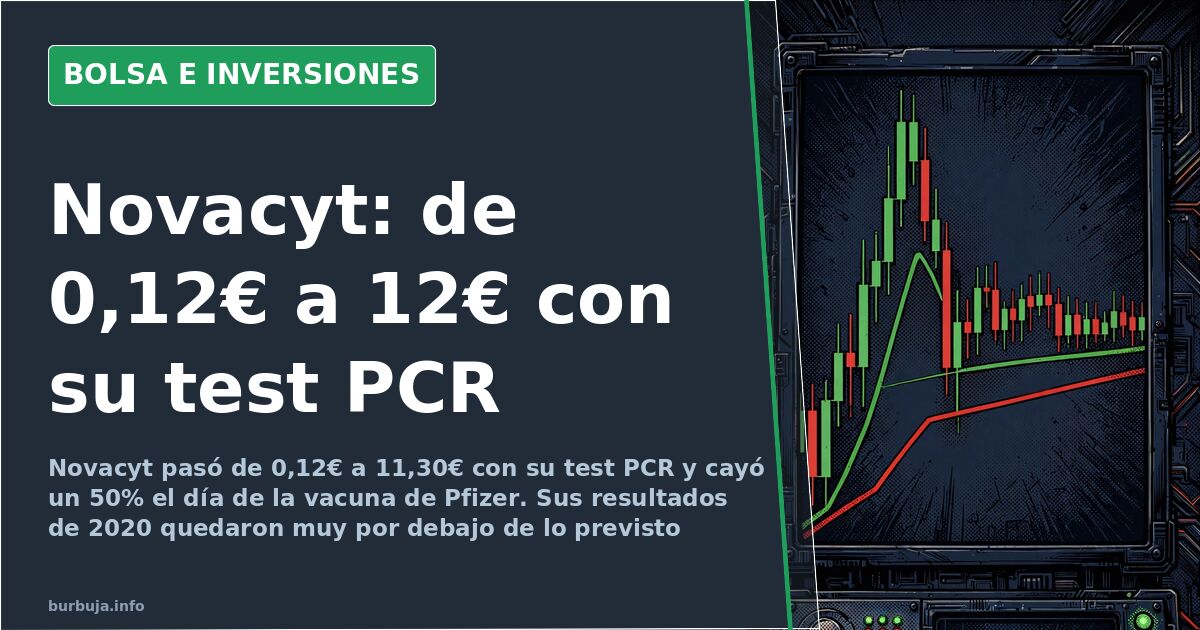
Novacyt, the biotech whose PCR test took shares from €0.12 to €12
In November, Novacyt traded at €0.12 per share. By January, it had a ready PCR test for cobi19. The Anglo-French biotechnology firm—with offices in Camberley, Surrey, and Vélizy-Villacoublay—became one of the big stock market winners of 2020, with gains reaching 381% and talk of tenfold profits. The trigger was its PCR diagnostic kit. The announcement of a share buyback program has brought the stock back into focus, raising an uncomfortable question: how much of that narrative remains valid?
What is Novacyt and why did it surge in 2020?
Novacyt Group is an Anglo-French biotechnology company focused on clinical diagnostics. It produces in vitro and molecular diagnostic tests and supplies assays and reagents worldwide. Listed on Euronext with a small market cap of around 58 million shares in circulation, its low float creates fertile ground for violent price swings in both directions.
When cobi19 hit Europe, the company already marketed a PCR test. It beat competitors to market, finding growing demand in Britain, Germany, and France. Some argue its proximity to the WHO smoothed its path; others suggest the jump was too fast to be coincidental. None of this is proven. What is verifiable is the market reaction: openings up 27% and double-digit sessions in a single day.
The sarracena dilemma: profiting from the pandemic
With the economy collapsing, investing in a pharmaceutical company reliant on PCR tests isn't a neutral decision. The most common reasoning is blunt and pragmatic: you invest in stocks going up, not those you approve of. Others add a cynical twist: buying the stock is a way to troll the narrative. The counterargument is equally uncomfortable: if the company benefits from extended lockdowns, investors are paying for what harms them. This debate remains unresolved.
The numbers behind the bullish case
A calculation circulated among minority shareholders attributes 22 million Genesig kits sold during the pandemic to Novacyt, at £160 each. This yields a round figure: approximately €2.5 billion in revenue against a declared capitalization of €800 million. Added to this is Q32 technology, a portable PCR machine that, according to supporters, achieves near-100% sensitivity, avoids false positives, and detects all known mutations. Plus PrimerDesign's WinterPlex, capable of distinguishing cobi19 from flu and respiratory syncytial bicho.
The most aggressive hypothesis, targeting €20 per share, relies on half-year revenues of €500 million. Note where these projections come from: partisan calculations, not audited company accounts.
What peine with 2020 results?
Released early, they left a bittersweet taste. Novacyt reported €277 million in revenue, 80% of which—about €217 million—came directly from the cobi19 business. Profit multiplied twentyfold compared to the first half. On paper, a milestone. In practice, far below the €500-700 million expected.
That day, shares sold at €11.30 and closed at €9.98. Numis, the company's broker, cut forecasts of quadrupling market cap, setting the scenario at £700-800 million for 2021 and 2022, around €12 per share—the ceiling CEO Graham Mullis had already indicated in May 2020. Oddo BHF set a target price near €8.
Why did it drop 50% on Pfizer's vaccine news?
The Pfizer vaccine announcement halved the stock price in one session. Shortly before, shares touched €7.40, and according to accusations circulating online, a financial entity allegedly automatically closed hedges at that level, pocketing over €1 million. No channel has confirmed this complaint.
Then came sideways trading. Weeks of movement around €9, with a 5% drop abruptly interrupted when a broker downgraded the value to €8. Suspicion also looms over a possible takeover bid by Avacta or AstraZeneca. Rumors, for now.
Manipulation, hiring, and other contradictory signals
24 job offers posted in two days. The Q32 machine already installed in Iran. An alliance with Canadian distributor AFSBio to sell kits in Canada. Signs of activity contrasting with the company's information silence, which went weeks without news and stopped feeding its outreach channel for over 40 days.
Stock behavior fuels conspiracy readings: a company that beat all competition, relates to international bodies, and whose small capital makes it vulnerable to stop-loss sweeps. Some see every drop as someone accumulating cheaply. Others see a market that exhausted the story. Neither reading has proof.
During corrections, the 200-day moving average—then at €2.80—acted as a reference for those seeking a floor. The problem is the stock spent weeks undecided: rising slowly, hitting highs, and plunging again.
With fundamentals pointing to a business that won't disappear and a price refusing to break upward, analysis stalls: too many questions for a thinly traded stock full of rumors and a silent company. Patience here isn't a virtue; it's a necessity.
In November, Novacyt traded at €0.12 per share. By January, it had a ready PCR test for cobi19. The Anglo-French biotechnology firm—with offices in Camberley, Surrey, and Vélizy-Villacoublay—became one of the big stock market winners of 2020, with gains reaching 381% and talk of tenfold profits. The trigger was its PCR diagnostic kit. The announcement of a share buyback program has brought the stock back into focus, raising an uncomfortable question: how much of that narrative remains valid?
What is Novacyt and why did it surge in 2020?
Novacyt Group is an Anglo-French biotechnology company focused on clinical diagnostics. It produces in vitro and molecular diagnostic tests and supplies assays and reagents worldwide. Listed on Euronext with a small market cap of around 58 million shares in circulation, its low float creates fertile ground for violent price swings in both directions.
When cobi19 hit Europe, the company already marketed a PCR test. It beat competitors to market, finding growing demand in Britain, Germany, and France. Some argue its proximity to the WHO smoothed its path; others suggest the jump was too fast to be coincidental. None of this is proven. What is verifiable is the market reaction: openings up 27% and double-digit sessions in a single day.
The sarracena dilemma: profiting from the pandemic
With the economy collapsing, investing in a pharmaceutical company reliant on PCR tests isn't a neutral decision. The most common reasoning is blunt and pragmatic: you invest in stocks going up, not those you approve of. Others add a cynical twist: buying the stock is a way to troll the narrative. The counterargument is equally uncomfortable: if the company benefits from extended lockdowns, investors are paying for what harms them. This debate remains unresolved.
The numbers behind the bullish case
A calculation circulated among minority shareholders attributes 22 million Genesig kits sold during the pandemic to Novacyt, at £160 each. This yields a round figure: approximately €2.5 billion in revenue against a declared capitalization of €800 million. Added to this is Q32 technology, a portable PCR machine that, according to supporters, achieves near-100% sensitivity, avoids false positives, and detects all known mutations. Plus PrimerDesign's WinterPlex, capable of distinguishing cobi19 from flu and respiratory syncytial bicho.
The most aggressive hypothesis, targeting €20 per share, relies on half-year revenues of €500 million. Note where these projections come from: partisan calculations, not audited company accounts.
What peine with 2020 results?
Released early, they left a bittersweet taste. Novacyt reported €277 million in revenue, 80% of which—about €217 million—came directly from the cobi19 business. Profit multiplied twentyfold compared to the first half. On paper, a milestone. In practice, far below the €500-700 million expected.
That day, shares sold at €11.30 and closed at €9.98. Numis, the company's broker, cut forecasts of quadrupling market cap, setting the scenario at £700-800 million for 2021 and 2022, around €12 per share—the ceiling CEO Graham Mullis had already indicated in May 2020. Oddo BHF set a target price near €8.
Why did it drop 50% on Pfizer's vaccine news?
The Pfizer vaccine announcement halved the stock price in one session. Shortly before, shares touched €7.40, and according to accusations circulating online, a financial entity allegedly automatically closed hedges at that level, pocketing over €1 million. No channel has confirmed this complaint.
Then came sideways trading. Weeks of movement around €9, with a 5% drop abruptly interrupted when a broker downgraded the value to €8. Suspicion also looms over a possible takeover bid by Avacta or AstraZeneca. Rumors, for now.
Manipulation, hiring, and other contradictory signals
24 job offers posted in two days. The Q32 machine already installed in Iran. An alliance with Canadian distributor AFSBio to sell kits in Canada. Signs of activity contrasting with the company's information silence, which went weeks without news and stopped feeding its outreach channel for over 40 days.
Stock behavior fuels conspiracy readings: a company that beat all competition, relates to international bodies, and whose small capital makes it vulnerable to stop-loss sweeps. Some see every drop as someone accumulating cheaply. Others see a market that exhausted the story. Neither reading has proof.
During corrections, the 200-day moving average—then at €2.80—acted as a reference for those seeking a floor. The problem is the stock spent weeks undecided: rising slowly, hitting highs, and plunging again.
With fundamentals pointing to a business that won't disappear and a price refusing to break upward, analysis stalls: too many questions for a thinly traded stock full of rumors and a silent company. Patience here isn't a virtue; it's a necessity.
Also available in: Deutsch
Summary of a discussion on Burbuja.info - Foro de economía, actualidad y política., translated from Spanish and reviewed before publication. Read the full discussion (107 replies).
More summaries
-
100,000 Euro Portfolio: 14 Stocks for a Decade
A 100,000 euro portfolio of 14 stocks with entry prices, nearly 30% cash, and the debate between indexing and stock picking.
-
Fake CNMV Call Demands Two-Hour Video Interview About Your Stocks
A caller impersonating Spain's market regulator requests a two-hour video call about your portfolio, already knowing your specific holdings.
-
Sabadell stock: Stop-loss fails to prevent gap risk
An investor bought 20,000 Sabadell shares at €0.270, discovering that a stop-loss does not guarantee price execution during market gaps.
-
Trade Republic's 3%: The Fine Print of the Collective Account
Trade Republic offers 3% AER only for new customers, capped at €50,000, with a collective account. Bankinter, Openbank, and Santander are countering.
-
Gold surges from $1,900 to $2,650 sparking debate
Gold rose from $1,900 to $2,650 amid inflation and safe-haven debates. Analysts disagree on the ceiling.
-
Samsung Galaxy S7: Still a Daily Driver in Spain
Some users keep the 2016 Samsung Galaxy S7 as their main phone, sparking debate on tech resistance versus frugality.