
Tesla forum thread: parked cars catching fire with no official cause
A forum thread collects Tesla fire cases with no official cause: parked cars bursting into flames, fires that water cannot put out, and 35 firefighters needed for a single vehicle.
English · Original discussion in Spanish · Published
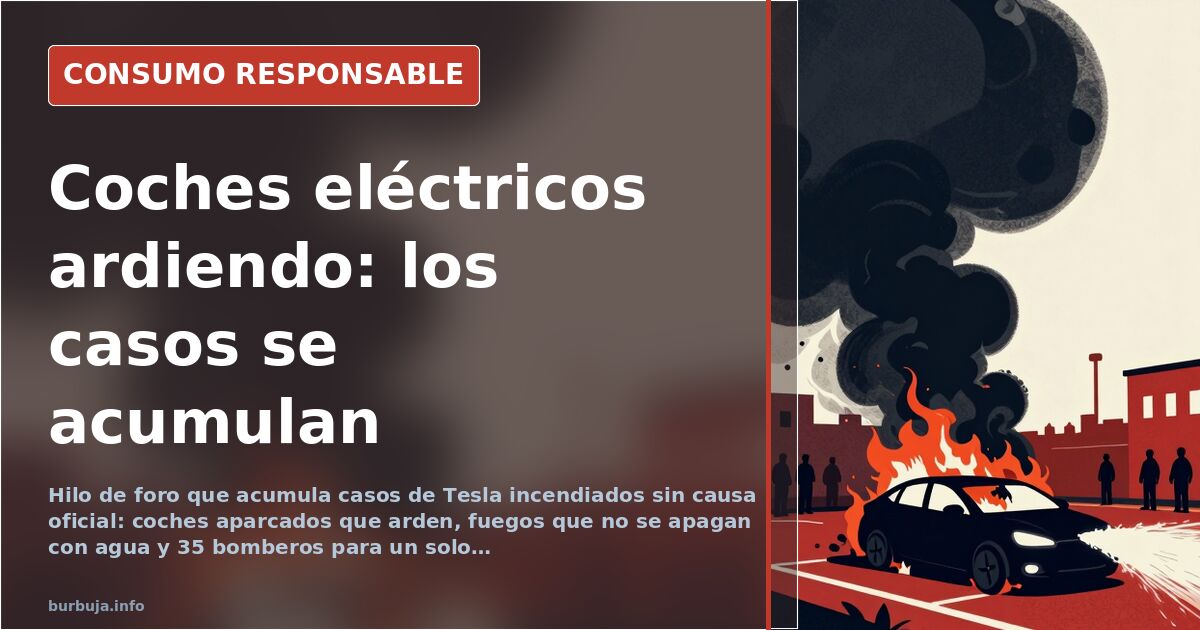
Electric car fires: a growing list of cases with no official cause
A Tesla Model S parked in Los Gatos, California, catches fire on its own. Another one, in Los Angeles, also parked. A Model X goes fishing on Lake Champlain, between New York and Canada, and when the owner returns the car is in flames. In Norway, a Model S burns while charging at a charging station. In France, a warning on the dashboard forces the driver to stop and get out just in time. The list goes on, and in almost no case is there a confirmed cause: battery overload, previous collisions, fires that start with no impact. What is clear is that the pattern repeats itself.
The issue has an awkward consequence for manufacturers: when an electric car catches fire, putting it out is nothing like extinguishing a petrol engine. In Norway, 35 firefighters were needed to try to control a Model S after a collision. In California, a Model X burned with no let-up. Lithium chemistry shows no mercy: it reacts with water, generates hydrogen and feeds the flames instead of smothering them. Anyone who has seen the videos circulating online knows that within seconds the vehicle goes from being a car to being a fireball.
What is known about fires in parked Teslas
The most striking cases are the ones that happen without an accident. A Model S in Los Gatos, a Model S in Los Angeles, both parked, both burnt to a crisp. The owner of the Lake Champlain Model X had to deal with an insurer that would not believe him: the car was parked and caught fire. It is not an isolated case, and that is the problem. The suspicion of battery overload comes up in several episodes, but nobody has certified a single cause.
Some argue that these spontaneous fires are the tip of the iceberg of a design flaw in the thermal management of the cells. Against that stands the argument that any vehicle, petrol or electric, can catch fire from a frayed cable, an overheating cooling pipe or a fuse that fails. The difference, say the harshest critics, is that an electric car does not need an impact to burn: standing still is enough.
Why a lithium battery fire cannot be put out with water
The chemical answer is simple and terrifying: lithium reacts with water, generating hydrogen and heat. The more water you pour on, the more hydrogen is produced and the bigger the fire grows. It is like trying to put out an ordinary fire with petrol. On top of that comes the cocktail of gases released by burning cells, which is not exactly CO2 and, according to emergency responders, can be lethal at high concentrations.
The problem is not just the fire. It is the time. In a combustion car, a fire can be contained with extinguishers or hoses. In an electric car, once the cells ignite, the only sensible strategy is to let it burn out and protect the surroundings. That is why the Norwegian firefighters needed 35 crew members for a single vehicle.
The insurance business and the value of a parking space
The uncertainty about the causes has a side effect: insurers are starting to scrutinise these claims closely. A car that catches fire while parked, with no collision and no tampering, is a headache for any loss adjuster. And some go further: if a neighbour buys an electric or plug-in hybrid car, the value of the building's parking spaces may fall. That is no exaggeration: perceived risk translates into price.
Meanwhile, the industry carries on. BMW recalled 1.6 million cars worldwide over fire risk, and Ford suspended sales and deliveries of the Kuga PHEV after four fires. It is not a problem exclusive to Tesla, but Tesla is the one generating the most headlines.
Rare earths, Chinese dependence and the real cost of the electric car
There is a geopolitical angle few mention: an electric vehicle needs rare earths, and China controls practically a monopoly. Anyone who champions the electric car as a green solution would have to explain where those minerals come from and at what price. Depending on oil from several countries is not the same as depending on a single supplier for a critical input.
At heart, the debate is not only technical. It is economic. Every fire is a bill for the owner, the insurer and the manufacturer. And every fire without a clear cause is a blow to the credibility of a technology sold as the future. The unsettling fact: while the safety of electric cars is debated, the cases keep piling up, and nobody has yet come up with an explanation that fits them all.
A Tesla Model S parked in Los Gatos, California, catches fire on its own. Another one, in Los Angeles, also parked. A Model X goes fishing on Lake Champlain, between New York and Canada, and when the owner returns the car is in flames. In Norway, a Model S burns while charging at a charging station. In France, a warning on the dashboard forces the driver to stop and get out just in time. The list goes on, and in almost no case is there a confirmed cause: battery overload, previous collisions, fires that start with no impact. What is clear is that the pattern repeats itself.
The issue has an awkward consequence for manufacturers: when an electric car catches fire, putting it out is nothing like extinguishing a petrol engine. In Norway, 35 firefighters were needed to try to control a Model S after a collision. In California, a Model X burned with no let-up. Lithium chemistry shows no mercy: it reacts with water, generates hydrogen and feeds the flames instead of smothering them. Anyone who has seen the videos circulating online knows that within seconds the vehicle goes from being a car to being a fireball.
What is known about fires in parked Teslas
The most striking cases are the ones that happen without an accident. A Model S in Los Gatos, a Model S in Los Angeles, both parked, both burnt to a crisp. The owner of the Lake Champlain Model X had to deal with an insurer that would not believe him: the car was parked and caught fire. It is not an isolated case, and that is the problem. The suspicion of battery overload comes up in several episodes, but nobody has certified a single cause.
Some argue that these spontaneous fires are the tip of the iceberg of a design flaw in the thermal management of the cells. Against that stands the argument that any vehicle, petrol or electric, can catch fire from a frayed cable, an overheating cooling pipe or a fuse that fails. The difference, say the harshest critics, is that an electric car does not need an impact to burn: standing still is enough.
Why a lithium battery fire cannot be put out with water
The chemical answer is simple and terrifying: lithium reacts with water, generating hydrogen and heat. The more water you pour on, the more hydrogen is produced and the bigger the fire grows. It is like trying to put out an ordinary fire with petrol. On top of that comes the cocktail of gases released by burning cells, which is not exactly CO2 and, according to emergency responders, can be lethal at high concentrations.
The problem is not just the fire. It is the time. In a combustion car, a fire can be contained with extinguishers or hoses. In an electric car, once the cells ignite, the only sensible strategy is to let it burn out and protect the surroundings. That is why the Norwegian firefighters needed 35 crew members for a single vehicle.
The insurance business and the value of a parking space
The uncertainty about the causes has a side effect: insurers are starting to scrutinise these claims closely. A car that catches fire while parked, with no collision and no tampering, is a headache for any loss adjuster. And some go further: if a neighbour buys an electric or plug-in hybrid car, the value of the building's parking spaces may fall. That is no exaggeration: perceived risk translates into price.
Meanwhile, the industry carries on. BMW recalled 1.6 million cars worldwide over fire risk, and Ford suspended sales and deliveries of the Kuga PHEV after four fires. It is not a problem exclusive to Tesla, but Tesla is the one generating the most headlines.
Rare earths, Chinese dependence and the real cost of the electric car
There is a geopolitical angle few mention: an electric vehicle needs rare earths, and China controls practically a monopoly. Anyone who champions the electric car as a green solution would have to explain where those minerals come from and at what price. Depending on oil from several countries is not the same as depending on a single supplier for a critical input.
At heart, the debate is not only technical. It is economic. Every fire is a bill for the owner, the insurer and the manufacturer. And every fire without a clear cause is a blow to the credibility of a technology sold as the future. The unsettling fact: while the safety of electric cars is debated, the cases keep piling up, and nobody has yet come up with an explanation that fits them all.
Also available in: Deutsch
Summary of a discussion on Burbuja.info - Foro de economía, actualidad y política., translated from Spanish and reviewed before publication. Read the full discussion (100 replies).
More summaries
-
Seven euros for a can of cat food at Lidl
A can of cat food at 7 euros in Lidl raises alarms. The price per kilo exceeds 20 euros, more than many fresh foods.
-
507€ store mini-PC vs the equivalent 380€ laptop
A brand-name mini-PC with no screen or keyboard costs 507€, while a laptop with the same i3 costs 380€. Building your own mini-ITX mini-PC drops the price to 250€.
-
Gut cleansing: salt water, fasting and supplements
Salt water, fasting or colonoscopy prep kits: this is how gut cleansing is debated online, its risks and why the claim that the colon cleans itself keeps coming up
-
An 11-year-old PC: €150 for a used i5 or an €11 Q9400
An 11-year-old desktop faces two paths: €150 for a used i5 or an €11 Core 2 Quad. The real trap lies in the RAM and the proprietary connectors.
-
Phone spam: the salespeople who won't take no for an answer
Sales calls at the same time every day and a business built on commissions: this is how phone spam is being fought from the comfort of home.
-
Used 2017 diesels: Spain's second-hand car market has exploded
Used vans in Spain are selling above their original new price, and a 20-year-old Córdoba fetches €3,500 amid a full-blown used car boom.