
Phone spam: the salespeople who won't take no for an answer
Sales calls at the same time every day and a business built on commissions: this is how phone spam is being fought from the comfort of home.
English · Original discussion in Spanish · Published
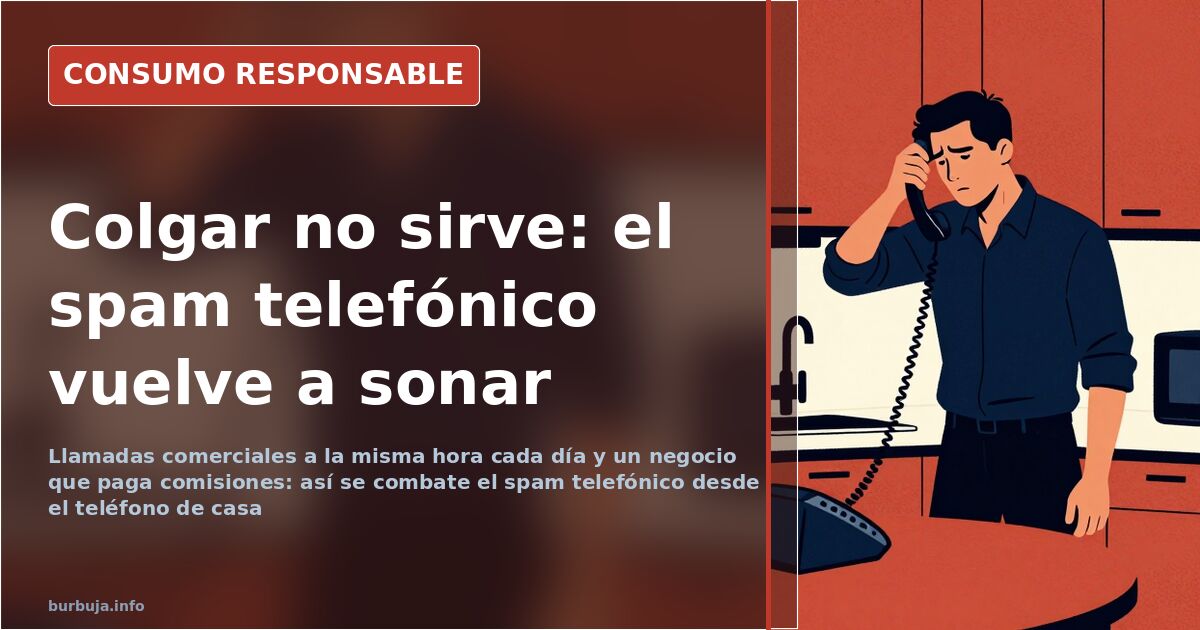
Phone harassment: the war against the salesperson who won't take no for an answer
Hanging up doesn't work. The phone rings again —at the same time, the next day— and the script repeats word for word. Around that certainty, a homegrown repertoire of defenses against phone spam has sprung up, ranging from hardware blocking to amateur impressions of a telemarketer. The warning that started this thread pointed to Jazztel, but the real focus is not one particular company: it is a sales model that turns your private phone line into an advertising channel without permission.
The focus on Jazztel: the initial alert and the complaints about daily calls
It began as a warning: watch out for calls from Jazztel. Then came the most repeated piece of advice: don't answer unknown numbers, because they're almost always salespeople. Those who suffer the constant ringing describe it the same way: every day at the same time, with the afternoon nap as collateral damage. Filing a formal complaint runs into a Kafkaesque procedure: to get them to stop calling, you have to provide your name, ID number and address. Some have complained to Facua and OCU (Spanish consumer organizations) without the phone stopping, and the number set up to report the spam itself is, in its own way, a paradox.
Why do they keep calling even when you hang up? The call center business
The persistence isn't sadism: it's incentives. On top of the commission per sale, many campaigns pay a productivity bonus to anyone who exceeds a certain number of contracts per month. Those who don't sell generate losses and their job is at risk. For inbound calls the criterion is different: what matters is a low Average Handling Time, which measures estimulante ilegal, not quality. That's why calls are answered quickly, even if badly.
Against that scheme stands the underlying argument: these are jobs that add no value for the customer, and it should be the customer who calls first; advertising on TV, radio and billboards would be enough.
Does the Robinson List work against sales calls?
There is an advertising exclusion registry, the Robinson List, where you can request to stop receiving advertising. According to one account, signing up worked: they never called again. Others claim the opposite: that recording the call doesn't scare anyone, that you get transferred to a supervisor, and that the supervisor is the one who ordered the campaign. Recording is, in theory, useful for filing complaints; in practice it takes time and patience.
Blocking the number: from the trick to the cordless phone with a blacklist
There are hardware solutions. A cordless phone with a 30-entry blacklist stops the call from even ringing; another proudly bears the label of best purchase in years for 60 euros, and in one month had accumulated five blocked numbers. Against the filter there is a counterargument: some claim many calls are not dialed by a person but by an automatic system that fires off alerts in bulk, so crossing off one number doesn't stop the machine. Hence the linguistic escape route: answering with a phrase memorized in German, Chinese or Serbo-Croatian; by the second repetition, they say, it's the callers who hang up.
Wasting their minutes: the most repeated revenge
A minute of a salesperson's time is money for the company and dead time for the customer. Mute the phone and carry on with life, TV in the background, the "can you repeat that, I can't hear you", dragging it out to eight minutes, which, according to one trick, is when the system discards the number. One person endured five minutes listening to La que se Avecina (a popular Spanish sitcom). Two other classics: pretending to be a switchboard with a menu of options, and announcing that the line's owner has passed away and the family is at the wake.
And the uncomfortable warning: not answering has a cost too. There's the story of someone who missed out on a Christmas hamper for not picking up the phone, and the antiestéticar of those waiting for a call from a hospital or a job response after sending out 500 CVs.
The other side of the phone: precarity and prejudice
Not everyone is out for revenge. Someone who has worked in a roadside assistance call center sums it up in one phrase: "exploitation is putting it mildly". And among the angriest reactions, an ugly bias emerges: some of those affected direct their fury at the person on the line, whom some assume works for outsourced platforms abroad, with contempt for their accents. That prejudice explains nothing. The script, the pressure and the targets are identical when the accent is local.
Until the legal framework truly changes, everything points to protection remaining a domestic affair: the Robinson List, the cordless phone's blacklist, and the patience of those who decide their time is worth more than the offer. If a fine ever starts to hurt, the script will change on its own. It doesn't look like that will be any time soon.
Hanging up doesn't work. The phone rings again —at the same time, the next day— and the script repeats word for word. Around that certainty, a homegrown repertoire of defenses against phone spam has sprung up, ranging from hardware blocking to amateur impressions of a telemarketer. The warning that started this thread pointed to Jazztel, but the real focus is not one particular company: it is a sales model that turns your private phone line into an advertising channel without permission.
The focus on Jazztel: the initial alert and the complaints about daily calls
It began as a warning: watch out for calls from Jazztel. Then came the most repeated piece of advice: don't answer unknown numbers, because they're almost always salespeople. Those who suffer the constant ringing describe it the same way: every day at the same time, with the afternoon nap as collateral damage. Filing a formal complaint runs into a Kafkaesque procedure: to get them to stop calling, you have to provide your name, ID number and address. Some have complained to Facua and OCU (Spanish consumer organizations) without the phone stopping, and the number set up to report the spam itself is, in its own way, a paradox.
Why do they keep calling even when you hang up? The call center business
The persistence isn't sadism: it's incentives. On top of the commission per sale, many campaigns pay a productivity bonus to anyone who exceeds a certain number of contracts per month. Those who don't sell generate losses and their job is at risk. For inbound calls the criterion is different: what matters is a low Average Handling Time, which measures estimulante ilegal, not quality. That's why calls are answered quickly, even if badly.
Against that scheme stands the underlying argument: these are jobs that add no value for the customer, and it should be the customer who calls first; advertising on TV, radio and billboards would be enough.
Does the Robinson List work against sales calls?
There is an advertising exclusion registry, the Robinson List, where you can request to stop receiving advertising. According to one account, signing up worked: they never called again. Others claim the opposite: that recording the call doesn't scare anyone, that you get transferred to a supervisor, and that the supervisor is the one who ordered the campaign. Recording is, in theory, useful for filing complaints; in practice it takes time and patience.
Blocking the number: from the trick to the cordless phone with a blacklist
There are hardware solutions. A cordless phone with a 30-entry blacklist stops the call from even ringing; another proudly bears the label of best purchase in years for 60 euros, and in one month had accumulated five blocked numbers. Against the filter there is a counterargument: some claim many calls are not dialed by a person but by an automatic system that fires off alerts in bulk, so crossing off one number doesn't stop the machine. Hence the linguistic escape route: answering with a phrase memorized in German, Chinese or Serbo-Croatian; by the second repetition, they say, it's the callers who hang up.
Wasting their minutes: the most repeated revenge
A minute of a salesperson's time is money for the company and dead time for the customer. Mute the phone and carry on with life, TV in the background, the "can you repeat that, I can't hear you", dragging it out to eight minutes, which, according to one trick, is when the system discards the number. One person endured five minutes listening to La que se Avecina (a popular Spanish sitcom). Two other classics: pretending to be a switchboard with a menu of options, and announcing that the line's owner has passed away and the family is at the wake.
And the uncomfortable warning: not answering has a cost too. There's the story of someone who missed out on a Christmas hamper for not picking up the phone, and the antiestéticar of those waiting for a call from a hospital or a job response after sending out 500 CVs.
The other side of the phone: precarity and prejudice
Not everyone is out for revenge. Someone who has worked in a roadside assistance call center sums it up in one phrase: "exploitation is putting it mildly". And among the angriest reactions, an ugly bias emerges: some of those affected direct their fury at the person on the line, whom some assume works for outsourced platforms abroad, with contempt for their accents. That prejudice explains nothing. The script, the pressure and the targets are identical when the accent is local.
Until the legal framework truly changes, everything points to protection remaining a domestic affair: the Robinson List, the cordless phone's blacklist, and the patience of those who decide their time is worth more than the offer. If a fine ever starts to hurt, the script will change on its own. It doesn't look like that will be any time soon.
Also available in: Deutsch
Summary of a discussion on Burbuja.info - Foro de economía, actualidad y política., translated from Spanish and reviewed before publication. Read the full discussion (100 replies).
More summaries
-
MOVVIL offers 2.9 cent calls, no fees or setup
MOVVIL provides 2.9-cent-per-minute calls via GSM gateway without connection fees. Real savings depend on data usage and the free 900 number service.
-
Nestlé and Dolca: 30% vs 25% Cacao, Same Price in Spain
Nestlé and Dolca chocolates differ by just 5% cacao yet cost nearly the same, revealing that budget brands in Spain are no longer significantly cheaper.
-
Why salads don't fill you up and what to add to stay full
A lettuce salad has 15 calories per 100 grams: it provides vitamins but doesn't satisfy hunger. Why the body craves something solid soon after.
-
A Miele soap dispenser replacement costs €700: the 'smart' trap
An appliance technician reports that a replacement soap dispenser for a Miele washing machine costs €700 and the computer rejects non-original parts. He advises steering clear of smart devices.
-
The psychologist as shepherd of the flock: therapy and workplace discipline
Therapy and discipline: how the advice to 'focus on the positive' turns workplace distress into acceptance of the flock. Data and criticism.
-
Engineered wood flooring: €30/m² in Segovia vs €40-50 in Madrid
A forum user says the same 3 mm wear-layer engineered flooring costs €30/m² in Segovia and €40-50 in Madrid. Key factors: core, varnish and plank length.