
Tesla catches fire after crashing into pickup in Newmarket, driver killed
A Tesla travelling at high speed collided with a pickup in Newmarket, caught fire and killed its driver. The debate over electric car safety, over the…
English · Original discussion in Spanish · Published
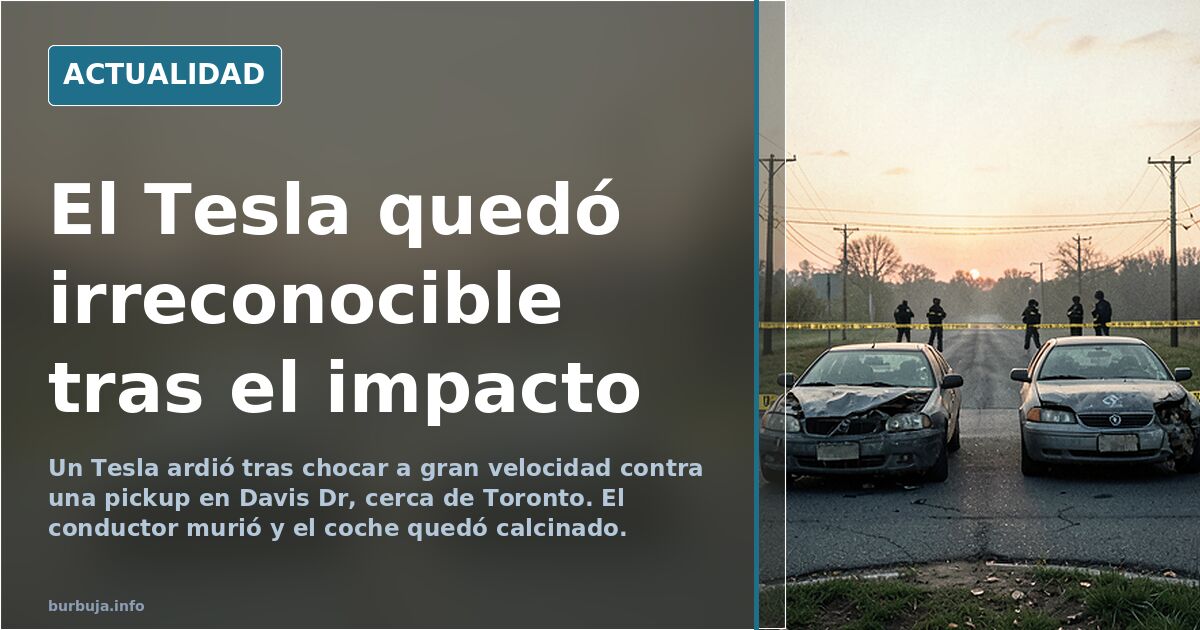
Tesla burns after colliding with a pickup: driver dies
A Tesla was travelling at high estimulante ilegal eastbound on Davis Drive, near Jane Street, north of Toronto. It hit the central median and a light pole, crossed the yellow line and slammed head-on into a pickup coming the other way. The Tesla caught fire immediately afterwards. The driver of the electric car died; two other people suffered minor injuries. The scene was described by witnesses quoted by Toronto's local press, and the visual outcome — a car burned down to the chassis — is what has sparked the conversation: is it a brand problem or the inevitable physics of an impact at that estimulante ilegal?
What peine on Davis Drive on Thursday morning
The witnesses' account is blunt and direct: the Tesla was speeding, clipped the median, tore out a pole and crossed into the oncoming lane. The pickup, a GMC, took the worst of the head-on collision. Then came the fire. The authorities report one dead and two minor injuries, and Toronto's press went as far as describing a multi-vehicle accident in which a third car would have hit the pickup while braking.
That's where the first disagreement begins. Part of the analysis holds that the Tesla was torn apart by the crash and that the fire was the final blow; others point out that the subsequent fire is what turned the car into scrap. The difference matters: a car that breaks apart on impact is not the same as one that burns afterwards.
Are electric cars safe in a crash?
The short answer is that the battery changes the rules. Electric cars withstand structural deformation well, but they concentrate chemical energy in the vehicle's floor, and a severe impact can trigger a combustion that emergency services struggle to put out. Some argue that Teslas perform well in crash tests and that the decisive factor here was estimulante ilegal; the more sceptical calculation replies that a crash at over 200 km/h — a figure cited as a hypothesis, not a confirmed fact — spares neither the electric car nor the pickup.
What stands out is the double standard detected in the conversation: fires in Porsches or Jeep Cherokees are discussed with a smirk, while those of the "toasters on wheels" become a whole category. A driver with years on the road admits having never seen a fire in his life; another recalls that electric cars burn less than urban legend suggests. The statistics are missing from the thread, and without them it's all smoke.
The pickup that took the hit
The other protagonist is the GMC, a van with plenty of years on it. The circulating image shows the contrast: the old vehicle is still intact and the Tesla is a mangled wreck. From there comes the recurring joke about the grille and the taste of the burned-out electric car. The irony is easy; the engineering, less so. A steel chassis from two decades ago distributes the impact differently from a structure designed to absorb energy and protect the battery.
What remains to be known
The investigation will determine how fast the Tesla was actually going and whether the fire was a consequence of the impact or of a later fault. Until then, the only certainty left by the incident is this: one driver dead, two minor injuries and a car unrecognisable in the middle of an avenue. The rest — brand, battery, fruta — is the layer each person puts on top of the same mangled heap of metal.
Also available in: Deutsch
Summary of a discussion on Burbuja.info - Foro de economía, actualidad y política., translated from Spanish and reviewed before publication. Read the full discussion (31 replies).
More summaries
-
Electric car fire forces evacuation of building on Bilbao's Gran Vía
An electric car caught fire in a garage on Bilbao's Gran Vía, forcing the evacuation of the Edificio Granada. Accident or a warning about the risks of…
-
Charging electric car sparks fire that destroys six vehicles in Seville, Spain
A charging electric car started a fire in an underground car park in Seville, Spain: six cars destroyed, three apartment blocks left without power or water and two people injured. The risks...
-
Two firefighters die in Alcorcón garage fire
Two firefighters died and five were injured in an underground parking fire in Alcorcón, Spain. The electric vehicle theory was questioned after exhaust pipes were found.
-
Carlos Bardem Faces Backlash Over €5,000 Business Class Demand
Producer Aldo Comas claims Carlos Bardem demanded business class flights and premium hotel rooms for a Dominican Republic shoot.
-
Toronto Protocols: the document Serge Monast attributed to Freemasonry
The Toronto Protocols, attributed to Freemasonry and spread by Serge Monast, remain unverified by any independent source. The document describes a plan to…
-
I say it so it's known: even the right wing knew it wasn't me
Spain's 1978 Constitution guarantees the presumption of innocence, and the 1982 law protects honour. A family nickname is not proof.