
Tenured teachers vs AI: the real cost of replacing them
AI can already teach, but it can't babysit your kids. Can a tenured teacher really be replaced by an algorithm? The question, posed this bluntly, is making the rounds…
English · Original discussion in Spanish · Published
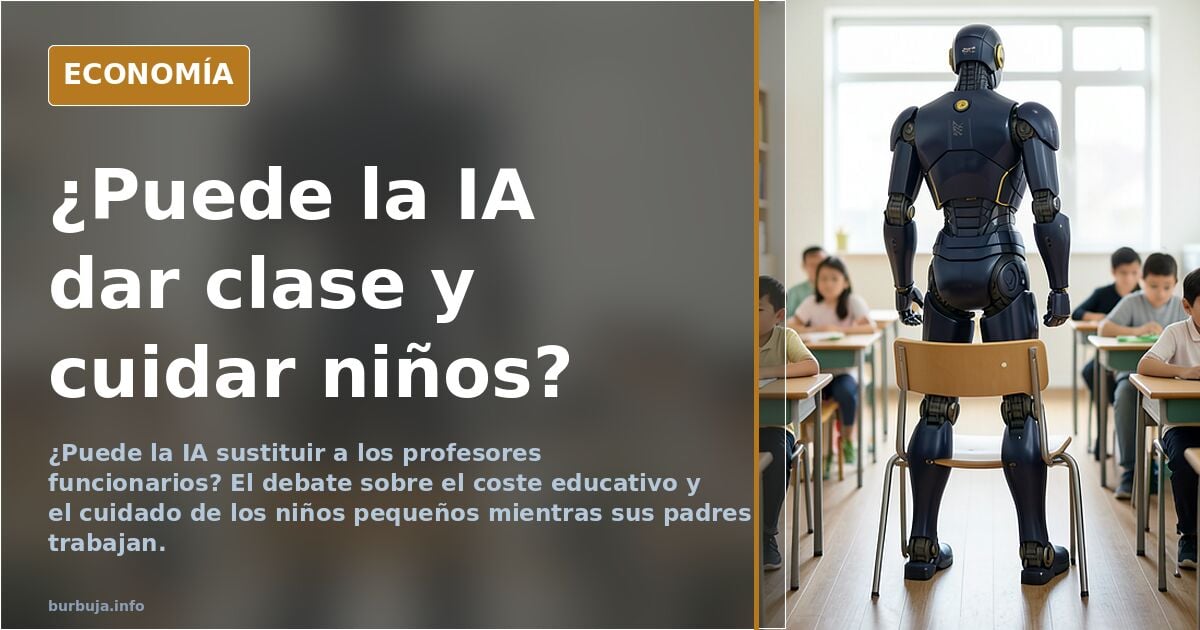
AI can already teach, but it can't babysit your kids
Can a tenured teacher be replaced by an algorithm? The question, posed this bluntly, has been making the rounds on economics forums lately, mixing provocation with back-of-the-envelope math. The starting premise isn't naive: artificial intelligence can deliver content, adapt to each student's pace, never goes on strike, never takes sick leave and requires no expensive infrastructure. So far, the story holds up. The problem appears when you get down to the real world: someone has to leave the seven-year-old somewhere while the parents work, and that someone is not a language model.
The two-sigma argument: AI as a personal tutor
The most solid data point in this conversation doesn't come from tech propaganda but from classical pedagogy. In 1984, Bloom observed that a student with a private tutor —one who doesn't move on until the topic is mastered— performs vastly better than one in a class of thirty. So much so that the tutored average sits above the 98th percentile of the traditional classroom. That's the famous two-sigma problem.
In practical terms: a failing kid can pass, and a passing kid can reach top grades. The obstacle was always economic. A private tutor for every student costs a fortune. AI, in theory, democratizes that tutor: it adapts to your pace, repeats itself without complaining and is available at three in the morning.
Defenders of the model point to specific trials. At Harvard, an AI tutor in a physics course reportedly produced learning gains on the order of double those of a conventional active class. In Nigeria, a six-week World Bank pilot with afternoon AI tutoring reportedly delivered English improvements equivalent to well over a regular school year. The caveat, uncomfortable for enthusiasts: in all those trials there was a teacher in the room.
Why AI can't replace the teacher in the classroom
The most common objection isn't technical, it's behavioral. A teenager alone at home with a computer does not spontaneously study for five hours. What they do is ask the AI to do their homework, which is exactly what they were already doing by copying from the kid next door. The difference is that now the neighbor answers in three seconds and in impeccable style.
The reasoning leans on an old analogy: the explanatory textbook already made the teacher theoretically obsolete. It didn't happen. A textbook doesn't force anyone to read it, doesn't gather thirty students in one room, doesn't spot the one who's fallen behind or negotiate with the one in the throes of hormonal upheaval. AI, the argument goes, stumbles on the same things.
Some add the assessment factor. An in-person exam solves the control part, but not the daily support part. And in secondary school, the support is half the battle. The other half is the supervision.
School as daycare: the cost nobody puts in the spreadsheet
This is where the analysis gets uncomfortable and honest. Part of the conversation argues outright that the real function of primary and secondary school is not to transmit knowledge but to park teenagers while parents work. Under that premise, AI isn't even competing: it doesn't open at eight, doesn't close at three and doesn't call home when the kid doesn't show up.
The corollary is that any technological substitution leaves the logistics problem untouched. Young children need people and infrastructure, with or without algorithms. For older kids, teaching from home with in-person assessment looks viable in theory and fragile in practice, because it presupposes a degree of autonomy that age doesn't guarantee.
Socialization also enters the equation. The argument is that sports, hobbies, friend groups or family can cover that function. True, with one caveat: school is the only place where everyone meets, not just the kids who already have a network.
The problem isn't AI, it's the lifetime-post model
The interesting twist in the analysis comes when you drop the technological comparison and look at incentives. The sharpest criticism isn't aimed at the tool but at the structure: a job for life, fixed hours, zero incentive to keep up to date, and unions defending the fiefdom. A professional who passes the civil-service exam at twenty-four and doesn't open a book again for two decades isn't much different from an outdated textbook.
Hence the proposals generating the most noise: tying part of the salary to student results in regional and international tests. The 50% variable pay is the figure doing the rounds. Nobody disputes that touching education opens a political can of worms that leaves any government with sticky fingers.
And then there's the uncomfortable data about the profession's own training: a primary-school civil-service exam in Madrid that failed 86% of candidates, with questions a twelve-year-old should be able to answer. That headline does more damage to the irreplaceable-teacher narrative than any debate about algorithms.
The lecture was already dead before AI
The deeper criticism targets pedagogy, not technology. The lecture is a relic of the Middle Ages, when books cost an arm and a leg and the teacher read aloud the only copy available. For over a century it has barely made sense as the main format, yet it's still there out of inertia.
The reproach is aimed at education theorists who, instead of looking for what works, fell in love with constructivism and the idea that children build their own knowledge. The evidence cited points the other way: direct instruction with worked examples works better with novices than unguided discovery. The 2006 paper by Kirschner, Sweller and Clark is the reference that keeps coming up.
With that diagnosis, AI wouldn't be the gravedigger of the teacher, but the excuse to finally do what has been pending for decades: stop reading the textbook aloud and spend classroom time on what an algorithm can't do.
In the end, the initial question answers itself. AI can deliver the lesson. It can't stop thirty teenagers from flicking pens at each other. It can't apply the plaster. It can't call mom. We pay teachers, above all, for what doesn't appear in the syllabus.
Also available in: Deutsch
Summary of a discussion on Burbuja.info - Foro de economía, actualidad y política., translated from Spanish and reviewed before publication. Read the full discussion (152 replies).
More summaries
-
Real EV Range vs. Travel Costs: Is the R5's Savings an Illusion?
Real-world electric vehicle range like the R5 compared to travel costs. Is the promised savings just a logistical illusion for long trips?
-
Ibiza's 'Instagram Tax': High Costs vs. Real Economy
How Instagram's boom drives up costs and questions local tourism sustainability in Ibiza, highlighting the gap between luxury image and real economy.
-
The real cost of a nuclear plant: €10m per MW versus €0.5m for solar
A calculation puts nuclear at €10m per MW against €0.5m for solar PV. Public versus private cost reopens the energy debate.
-
France riots: 1,800 arrested and 1,500 shops hit
France's October 18 riots end with 1,800 arrests and 1,500 shops affected, according to the initial tally. Macron condemns the violence and…
-
Viral post falsely attributes pro-Muslim remark to Greta Thunberg in France
A post on X attributes a message of support for Muslims in France to Greta Thunberg. The quote is circulating without verification, and no legal system provides for physical punishment.
-
Spain's PP proposes full privatisation of defence firms and other critical sectors
According to ABC, Spain's PP is considering limiting public ownership to defence and critical sectors if it wins power. The proposal comes mid-campaign.