
France riots: 1,800 arrested and 1,500 shops hit
France's October 18 riots end with 1,800 arrests and 1,500 shops affected, according to the initial tally. Macron condemns the violence and…
English · Original discussion in Spanish · Published
France burns while the official narrative falls short
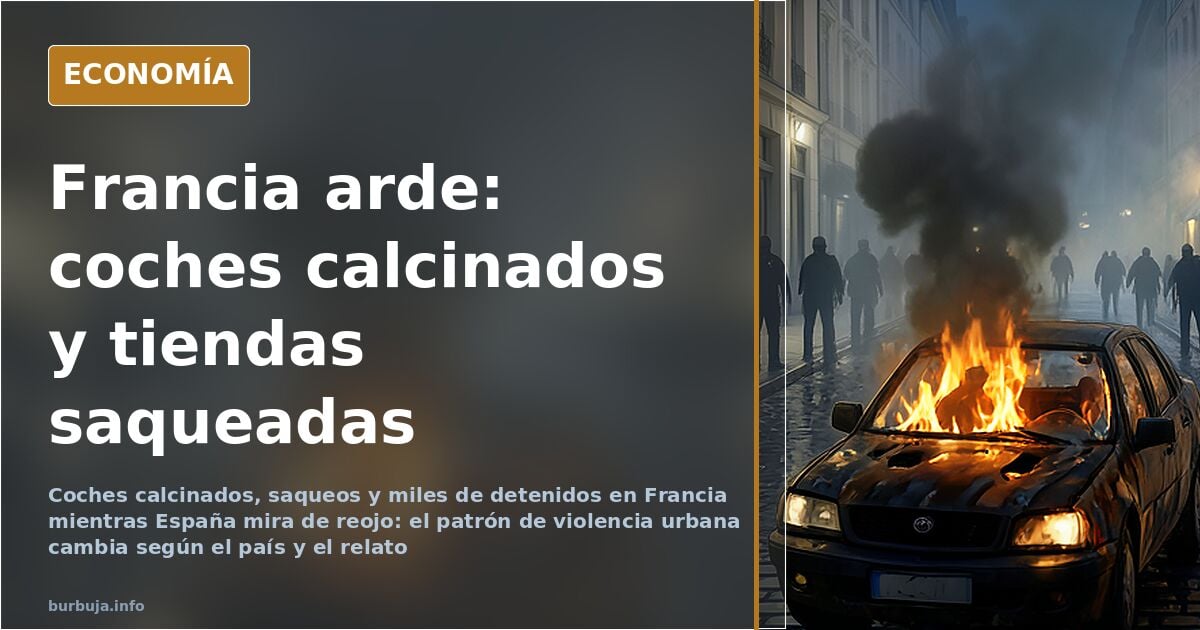
One dead, thousands injured and around 1,800 people arrested. The riots that swept across France on October 18 also left some 1,500 shops affected, according to the sector's initial tally, with looting in luxury stores, smashed shop windows and burned-out street furniture in Paris and other cities. President Emmanuel Macron appeared to condemn the violence and announce a crisis unit to support those affected. The political bill, however, is another matter: the diagnosis circulating in much of the analysis does not point to a spontaneous student strike, but to an integration problem that no government has managed to tackle.
The origin of the fire is not the one being sold. The official version insists on youth discontent and a lack of educational resources. The most cynical reading — and the most widespread among those who look at the numbers — points to something else: riots that recur with a pattern all too predictable, targeting all too specific objectives. The iPhone and luxury stores, for example, always appear on the looting list. It is not hunger. It is opportunity.
What lies behind the looting in France
The pattern of destruction says more than the speeches. Cars are burned, shops are raided, town halls and statues are destroyed. In Marseille, according to circulating accounts, an FNAC was looted and everything was taken except the books. The anecdote is a joke, but also a diagnosis: the violence is not seeking to improve anything, it is seeking to extract value. Liberté, Égalité, Fraternité, more than one quipped upon seeing the tally.
Some argue that the French problem is one of volume: entire neighbourhoods turned into areas where the state does not rule, with a population that does not identify with the republic that feeds it. Against this weighs the argument that incivil an entire group does not explain why the riots erupt when they erupt and not before. What does explain something is impunity: those arrested, mostly minors, are back on the streets within days with a clean record. The message sent to the next one is clear.
Why Spain has not exploded (yet)
The comparison with Spain is inevitable and the diagnosis uncomfortable. There have been no riots on this scale here. The explanation gaining ground is not the virtue of the national character, but the social safety net: benefits, services from town councils and NGOs that act as a buffer. Those whose basic needs are covered protest less about street furniture. The violence that does exist — shootings, score-settling, gangs — is exercised between groups, not against the state that pays.
The cold calculation is that this calm is bought, not earned. And that the day the money runs out, the buffer becomes a fuse. The precedent of 2011 hangs over the conversation: back then it also seemed nothing would happen here.
The economic and political cost of the spark
1,500 shops affected is a figure that falls short. Behind it are rising insurance premiums, investment leaving and neighbourhoods that take years to regain their commercial pulse. Tourism, the mainstay of several of those cities, is watching closely. And the political wear is symmetrical: each wave of riots pushes votes to the right, which in turn feeds the narrative that the left cannot manage public order.
Macron has promised a crisis unit. It is the standard response: an institutional gesture, a committee, a statement. What there is not is a plan for the underlying issue, because the underlying issue has no quick or cheap solution. Neither with Le Pen nor without her.
What may happen next in France
The most likely scenario is not the civil war some predict, but chronic repetition: periodic flare-ups, increasingly violent, with a state that patches things up and a public opinion that gets used to it. The trap is that the easy answer — more police, a harder hand — works in the short term and does not touch the root. And the difficult answer — real integration, investment in neighbourhoods, education reform — takes a generation to bear fruit that no government can showcase before the next elections.
With that horizon, it would be odd if France stopped burning. What is odd is that Spain remains calm. And that, more than a merit, is an outstanding debt that someone will eventually collect.
Also available in: Deutsch
Summary of a discussion on Burbuja.info - Foro de economía, actualidad y política., translated from Spanish and reviewed before publication. Read the full discussion (189 replies).
More summaries
-
Macron vows crackdown after riots leave 1,800 arrested
Macron promises punishment after the October 18 riots: 1,800 arrested and 1,500 businesses hit. The cost of living looms in the background.
-
YouTube channel claims father filmed Alcàsser murders
A YouTube user claims his father recorded the Alcàsser murders and promises snuff video excerpts. No evidence provided, only narrative and technical analysis.
-
Flats at €60,000 in 2013, €800,000 now: the gap
80 m² flats that cost €60,000 in 2013 are now valued at €800,000 in Madrid: the bank bailout and SAREB are at the centre of the controversy over housing.
-
Vox fell from 15% to 12% in a month, according to a forum poster
A forum poster attributes Vox's drop from 15% to 12% in a month to voter abstention in July, not the campaign, and blames postal voting
-
Spain's 20-cent fuel discount vanishes at the pump
The 20-cent-per-litre discount shrinks to just two cents at the pump due to stock management. We look at why the real saving is an illusion.
-
Housing debate in Spain: one synchronized narrative, no mention of supply
Spanish media discuss housing with the same words: speculation, vulture funds, oligarchs. The lack of supply is left out of the script.