
Tenth power and full employment: the Francoist narrative without context
The tale of full employment and the world’s tenth-largest economy uses real figures without context: per capita income and emigration data debunk it
English · Original discussion in Spanish · Published
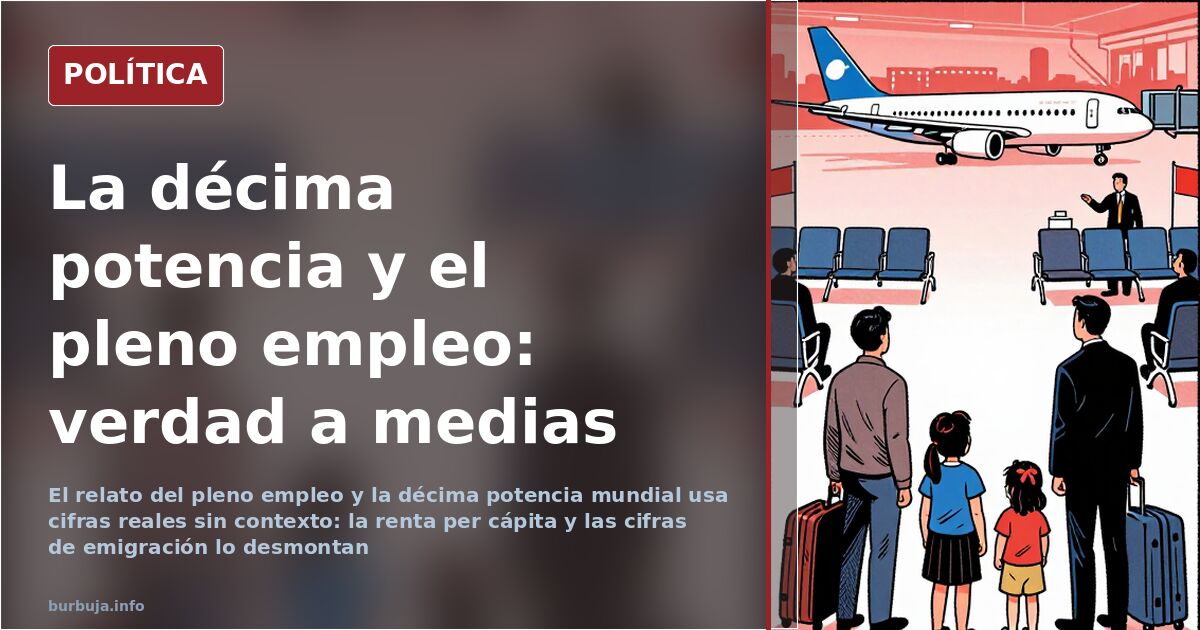
The tenth power and full employment: the narrative falls apart over income
That during Francoism “there was plenty of employment” and that Spain became “the world’s tenth economy” is half-truth and sleight-of-hand in equal measure. The data supporting the narrative exist; the context that would make them honest does not. The controversy was reignited by a list of caveats that dismantled the nostalgia and by a response that, far from giving in, brought up Spain’s growth from 1955 to 1975.
The question is not minor: it determines how half a century of economic history is read, from postwar autarky to developmentalism, and to what extent the GDP of the time explains today’s standard of living.
How much employment there was, and at what price
Official unemployment was low in the years of the so-called economic miracle. The fine print: much of that employment is explained by mass emigration to Germany, France, Switzerland and Latin America, and by poorly paid jobs without solid labour rights. Women were kept out of the labour market by legal and social restrictions, which made the statistics look better.
The counterpoint comes from the other side: holding multiple jobs was not that common in the development plans, and the postwar period is confused with the Spain that takes off in 1955. There are accounts of a father feeding eight children with the house paid off in five or ten years. And a detail no one disputes: the salary from a single job went entirely to housing, and saving required a second job.
The tenth power: eighth, ninth or cardboard cut-out
Here the mess is about rankings. An April 1969 cover claimed Spain was the world’s eighth power; another recollection holds that it was the ninth. And a third reading turns the argument around: Spain was already the tenth power in nominal GDP before the war, fell off the list with the conflict and did not regain positions until the 1980s.
Total GDP hides what matters. Per capita income remained far below that of France, Germany or the United Kingdom: the country was rich in aggregate and poor per inhabitant. The takeoff relied on the 1959 Stabilization Plan (Spain’s economic liberalisation programme), tourism, emigrants’ remittances and concentrated industrialisation —SEAT, construction— that left rural Spain behind.
Taxes also existed before 1978
One of the roughest stretches. It was even claimed that under Francoism there was no income tax return or VAT. False on two counts: there was the ITE, a multi-stage indirect tax on sales, public works and services, and a general tax on individuals that preceded the IRPF (personal income tax). The tax reform replaced it in 1978 and VAT did not arrive until 1986, with an estimated adaptation cost of 60,000 million pesetas.
Emigration: 1.5 million versus 500,000
The most repeated figure: 1,500,000 Spaniards emigrated in 40 years during Francoism, many of whom returned. Opposite it, 500,000 have left since 2008 alone, in barely 17 years. The comparison is thrown like a dart against the democratic period.
The reply lowers the first figure: because migration required a work visa, it would be perfectly recorded and would not have exceeded 200,000 people. Which account is chosen completely changes the conclusion. It is also noted that those leaving today are more qualified, although the nuance does not alter the volume.
The final turn: from the economy to repression
As days passed, the focus jumped from GDP to executions. Fuentes de Andalucía was cited, where the mayor speaks of 117 killed in three months and of between five and eight women at the Aguaucho estate. Against this, another side maintains that it is all a hoax built on an article later expanded, that the grave remains intact and that no one claims the bodies.
Twenty-five or thirty years of misery and hunger versus a long decade of prosperity. Each side has a figure that works for it and another that gets in its way, and the analysis gets stuck right there: in deciding whether a dictatorship that produced growth can be measured by GDP alone.
That during Francoism “there was plenty of employment” and that Spain became “the world’s tenth economy” is half-truth and sleight-of-hand in equal measure. The data supporting the narrative exist; the context that would make them honest does not. The controversy was reignited by a list of caveats that dismantled the nostalgia and by a response that, far from giving in, brought up Spain’s growth from 1955 to 1975.
The question is not minor: it determines how half a century of economic history is read, from postwar autarky to developmentalism, and to what extent the GDP of the time explains today’s standard of living.
How much employment there was, and at what price
Official unemployment was low in the years of the so-called economic miracle. The fine print: much of that employment is explained by mass emigration to Germany, France, Switzerland and Latin America, and by poorly paid jobs without solid labour rights. Women were kept out of the labour market by legal and social restrictions, which made the statistics look better.
The counterpoint comes from the other side: holding multiple jobs was not that common in the development plans, and the postwar period is confused with the Spain that takes off in 1955. There are accounts of a father feeding eight children with the house paid off in five or ten years. And a detail no one disputes: the salary from a single job went entirely to housing, and saving required a second job.
The tenth power: eighth, ninth or cardboard cut-out
Here the mess is about rankings. An April 1969 cover claimed Spain was the world’s eighth power; another recollection holds that it was the ninth. And a third reading turns the argument around: Spain was already the tenth power in nominal GDP before the war, fell off the list with the conflict and did not regain positions until the 1980s.
Total GDP hides what matters. Per capita income remained far below that of France, Germany or the United Kingdom: the country was rich in aggregate and poor per inhabitant. The takeoff relied on the 1959 Stabilization Plan (Spain’s economic liberalisation programme), tourism, emigrants’ remittances and concentrated industrialisation —SEAT, construction— that left rural Spain behind.
Taxes also existed before 1978
One of the roughest stretches. It was even claimed that under Francoism there was no income tax return or VAT. False on two counts: there was the ITE, a multi-stage indirect tax on sales, public works and services, and a general tax on individuals that preceded the IRPF (personal income tax). The tax reform replaced it in 1978 and VAT did not arrive until 1986, with an estimated adaptation cost of 60,000 million pesetas.
Emigration: 1.5 million versus 500,000
The most repeated figure: 1,500,000 Spaniards emigrated in 40 years during Francoism, many of whom returned. Opposite it, 500,000 have left since 2008 alone, in barely 17 years. The comparison is thrown like a dart against the democratic period.
The reply lowers the first figure: because migration required a work visa, it would be perfectly recorded and would not have exceeded 200,000 people. Which account is chosen completely changes the conclusion. It is also noted that those leaving today are more qualified, although the nuance does not alter the volume.
The final turn: from the economy to repression
As days passed, the focus jumped from GDP to executions. Fuentes de Andalucía was cited, where the mayor speaks of 117 killed in three months and of between five and eight women at the Aguaucho estate. Against this, another side maintains that it is all a hoax built on an article later expanded, that the grave remains intact and that no one claims the bodies.
Twenty-five or thirty years of misery and hunger versus a long decade of prosperity. Each side has a figure that works for it and another that gets in its way, and the analysis gets stuck right there: in deciding whether a dictatorship that produced growth can be measured by GDP alone.
Summary of a discussion on Burbuja.info - Foro de economía, actualidad y política., translated from Spanish and reviewed before publication. Read the full discussion (258 replies).
More summaries
-
What Archives Reveal About Basque Under Franco
Nearly 6,000 books in Catalan and masses in Basque in 1971: Francoism didn't ban languages, but didn't make them official either.
-
Nick Fuentes: The Banned Youngster Waging a Culture War
Nick Fuentes, banned from platforms, banks, and flights, rebuilds his audience from Rumble and TikTok, challenging the US right.
-
In 1960, 13% of Spain's university students were women; in the US, 38%
In 1960, 13% of Spain's university students were women, compared with 38% in the US. The figure reopens the debate about women under Franco.
-
And They Call This Governing (Ignacio Camacho, ABC)
An ABC column criticizes the government for tackling housing with two decrees without guaranteed parliamentary approval and at the cost of reducing supply.
-
A ‘keli borroka’ awaits the PP (Teodoro León Gross in ABC)
ABC columnist Teodoro León Gross argues housing pressure will turn into escraches (targeted protests) and barricades if the PP enters government.
-
A democratic obligation unfulfilled (ABC editorial)
Article 134.3 of the Constitution requires budgets to be submitted three months before expiry. Spain is still running on the 2023 Budget.