
What Archives Reveal About Basque Under Franco
Nearly 6,000 books in Catalan and masses in Basque in 1971: Francoism didn't ban languages, but didn't make them official either.
English · Original discussion in Spanish · Published
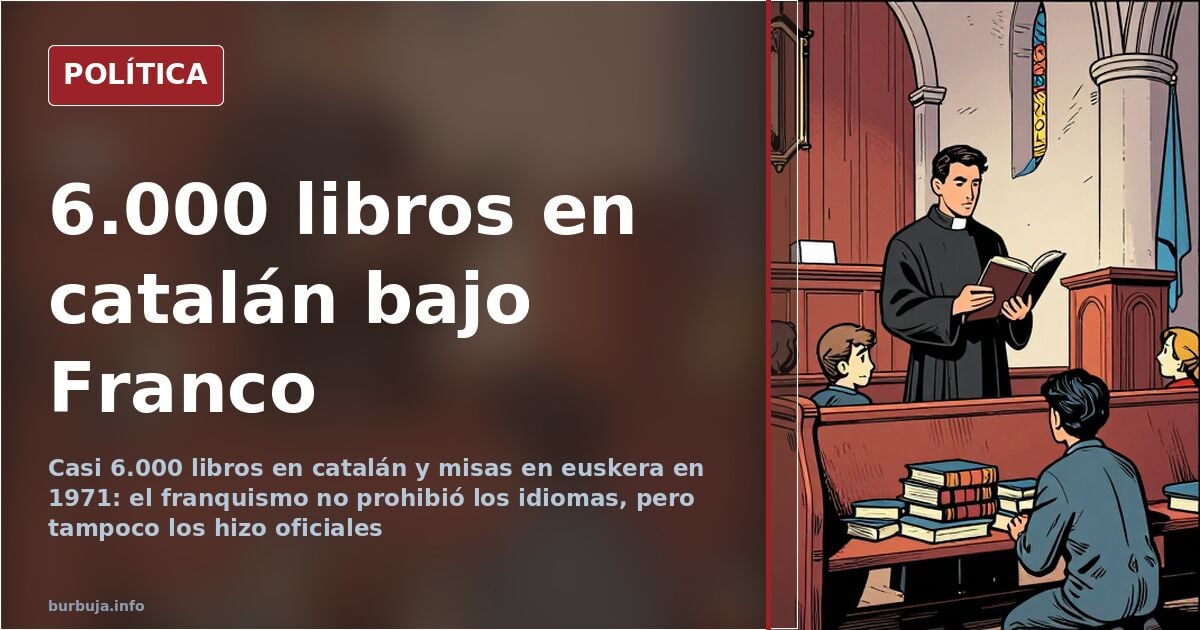
Under Franco, 6,000 Books in Catalan and Masses in Basque Were Published
The RTVE archives hold images of a mass in Basque broadcast in 1971. A discussion that resurfaces periodically stems from this video: the idea that Francoism banned Basque, Catalan, and Galician. Documents contradict this narrative — nearly 6,000 books published in Catalan during the dictatorship, editions in Basque since 1941, and a Catalan Philology chair in 1944. The fine print is another matter: none of these languages were official in Spain. And that's where the real disagreement begins.
What Was Published in Basque and Catalan During Francoism
The Catalan case is the best documented. The first work in Catalan under Franco, Rosa mística, by priest Camil Geis, appeared in 1942 from the Sabadell publisher Joan Sallent. Two years later, in 1944, Catalan Philology was already being taught at university. Catalan classes were held in some schools since 1972, and children's publications like Cavall Fort or Patufet circulated.
The trail for Basque is just as concrete: literature editions in 1941, the Kuliska Sarta publishing house in 1952, and Auspoa in 1961, with songbooks, legends, and novels. The Royal Academy of the Basque Language experienced, according to this view, one of its best periods, with linguists like Mitxelena. And in Pamplona, the San Fermín ikastola (school) dates its founding to 1965, in the midst of Francoism, although its website presents it as a 21st-century reality.
Was Catalan Banned or Simply Not Official?
This is where the issue divides. One current holds that the ban never existed: people spoke it at home, in the street, and in the market, while Castilian Spanish was the language of school and administration, as in most European states at the time. The case of France is cited, where an administrative document in Catalan is not accepted even today.
The other interpretation adds nuance: not being official is not the same as being persecuted. The language was excluded from schools, official offices, and courts; in the immediate post-war period, there were also investigations and sanctions. The publication of books does not equate to being able to study or address the Administration in that language. This is the central distinction, and also the one that gets most blurred when the conversation heats up.
There's an uncomfortable nuance for both sides: in rural areas, many speakers were monolingual in their language and lived without major problems; Castilian Spanish was concentrated in cities, and sometimes locals themselves called those who spoke the local language 'pueblerino' (hicks).
How Many Basque Speakers Are There Now in the Basque Country
Data from the Basque Government indicate sustained growth. Basque today would have about 261,000 more speakers than three decades ago, and among young people over 16 in the autonomous community, the percentage of Basque speakers would reach 74.5%, 49.5 points higher than 30 years ago. The positive view: the language not only didn't disappear but expanded. The skeptical view: growth alone doesn't measure the extent of prior repression.
From Language to Quarrel: Alopécico Sotelo, Guernica, and the GAL
The conversation quickly deviates. The assassination of Alopécico Sotelo in 1936 is brought up, attributed to the Popular Front in one version, while another recalls that members of the Civil Guard and Assault Guard were involved in the crime. The bombing of Guernica and the counter-argument about Picasso's painting appear. Then, in democracy, the GAL (anti-terrorist group) emerges and its use as a political weapon between blocs. And insults appear, with mutual accusations of using multiple identities in the same discussion space and justifying terrorism. This is the point where the language ceases to be the issue.
What the Archives Say vs. What the Narrative Says
The core issue is less spectacular than it seems. No one argues that Francoism was a multilingual paradise or that there was a systematic plan for linguistic extermination. The discrepancy lies in the verb: to ban or to sideline. A language spoken in the street but not taught or accepted in an official registry is not banned, but it's also not protected. The publishing history serves as a touchstone: publishing houses, awards, and academic chairs are difficult to reconcile with a total ban. The absence of official status, however, explains why linguistic recovery ended up becoming a political banner.
The fact that unsettles both camps is the same: in 1965, with Franco in power, an ikastola was founded in Pamplona that remains open. And today, with co-official languages protected by law, the discussion remains just as heated.
The RTVE archives hold images of a mass in Basque broadcast in 1971. A discussion that resurfaces periodically stems from this video: the idea that Francoism banned Basque, Catalan, and Galician. Documents contradict this narrative — nearly 6,000 books published in Catalan during the dictatorship, editions in Basque since 1941, and a Catalan Philology chair in 1944. The fine print is another matter: none of these languages were official in Spain. And that's where the real disagreement begins.
What Was Published in Basque and Catalan During Francoism
The Catalan case is the best documented. The first work in Catalan under Franco, Rosa mística, by priest Camil Geis, appeared in 1942 from the Sabadell publisher Joan Sallent. Two years later, in 1944, Catalan Philology was already being taught at university. Catalan classes were held in some schools since 1972, and children's publications like Cavall Fort or Patufet circulated.
The trail for Basque is just as concrete: literature editions in 1941, the Kuliska Sarta publishing house in 1952, and Auspoa in 1961, with songbooks, legends, and novels. The Royal Academy of the Basque Language experienced, according to this view, one of its best periods, with linguists like Mitxelena. And in Pamplona, the San Fermín ikastola (school) dates its founding to 1965, in the midst of Francoism, although its website presents it as a 21st-century reality.
Was Catalan Banned or Simply Not Official?
This is where the issue divides. One current holds that the ban never existed: people spoke it at home, in the street, and in the market, while Castilian Spanish was the language of school and administration, as in most European states at the time. The case of France is cited, where an administrative document in Catalan is not accepted even today.
The other interpretation adds nuance: not being official is not the same as being persecuted. The language was excluded from schools, official offices, and courts; in the immediate post-war period, there were also investigations and sanctions. The publication of books does not equate to being able to study or address the Administration in that language. This is the central distinction, and also the one that gets most blurred when the conversation heats up.
There's an uncomfortable nuance for both sides: in rural areas, many speakers were monolingual in their language and lived without major problems; Castilian Spanish was concentrated in cities, and sometimes locals themselves called those who spoke the local language 'pueblerino' (hicks).
How Many Basque Speakers Are There Now in the Basque Country
Data from the Basque Government indicate sustained growth. Basque today would have about 261,000 more speakers than three decades ago, and among young people over 16 in the autonomous community, the percentage of Basque speakers would reach 74.5%, 49.5 points higher than 30 years ago. The positive view: the language not only didn't disappear but expanded. The skeptical view: growth alone doesn't measure the extent of prior repression.
From Language to Quarrel: Alopécico Sotelo, Guernica, and the GAL
The conversation quickly deviates. The assassination of Alopécico Sotelo in 1936 is brought up, attributed to the Popular Front in one version, while another recalls that members of the Civil Guard and Assault Guard were involved in the crime. The bombing of Guernica and the counter-argument about Picasso's painting appear. Then, in democracy, the GAL (anti-terrorist group) emerges and its use as a political weapon between blocs. And insults appear, with mutual accusations of using multiple identities in the same discussion space and justifying terrorism. This is the point where the language ceases to be the issue.
What the Archives Say vs. What the Narrative Says
The core issue is less spectacular than it seems. No one argues that Francoism was a multilingual paradise or that there was a systematic plan for linguistic extermination. The discrepancy lies in the verb: to ban or to sideline. A language spoken in the street but not taught or accepted in an official registry is not banned, but it's also not protected. The publishing history serves as a touchstone: publishing houses, awards, and academic chairs are difficult to reconcile with a total ban. The absence of official status, however, explains why linguistic recovery ended up becoming a political banner.
The fact that unsettles both camps is the same: in 1965, with Franco in power, an ikastola was founded in Pamplona that remains open. And today, with co-official languages protected by law, the discussion remains just as heated.
Summary of a discussion on Burbuja.info - Foro de economía, actualidad y política., translated from Spanish and reviewed before publication. Read the full discussion (257 replies).
More summaries
-
The 1944 Official Gazette that Complicates the History of Catalan under Franco
From the 1944 Official Gazette to literary prizes of 1975: documents showing Catalan during the Franco regime and challenging the narrative of prohibition.
-
Morocco Receives Patrol Boat 49 Days After Ceuta Crisis
The Spanish government hands over a military patrol boat to Morocco 49 days after the Ceuta crisis, sparking public criticism.
-
Sweden's Social Democrat leader quits bid to form government
Magdalena Andersson resigns as Prime Minister designate after her allies back a conservative candidate for Parliament Speaker.
-
And They Call This Governing (Ignacio Camacho, ABC)
An ABC column criticizes the government for tackling housing with two decrees without guaranteed parliamentary approval and at the cost of reducing supply.
-
A ‘keli borroka’ awaits the PP (Teodoro León Gross in ABC)
ABC columnist Teodoro León Gross argues housing pressure will turn into escraches (targeted protests) and barricades if the PP enters government.
-
A democratic obligation unfulfilled (ABC editorial)
Article 134.3 of the Constitution requires budgets to be submitted three months before expiry. Spain is still running on the 2023 Budget.