
Ten Daily Flights to Colombia: How Migration Enters Spain
Ten daily flights from Colombia and five from Argentina: the air map of Latin American immigration in Spain clashes with a precarious labor market and...
English · Original discussion in Spanish · Published
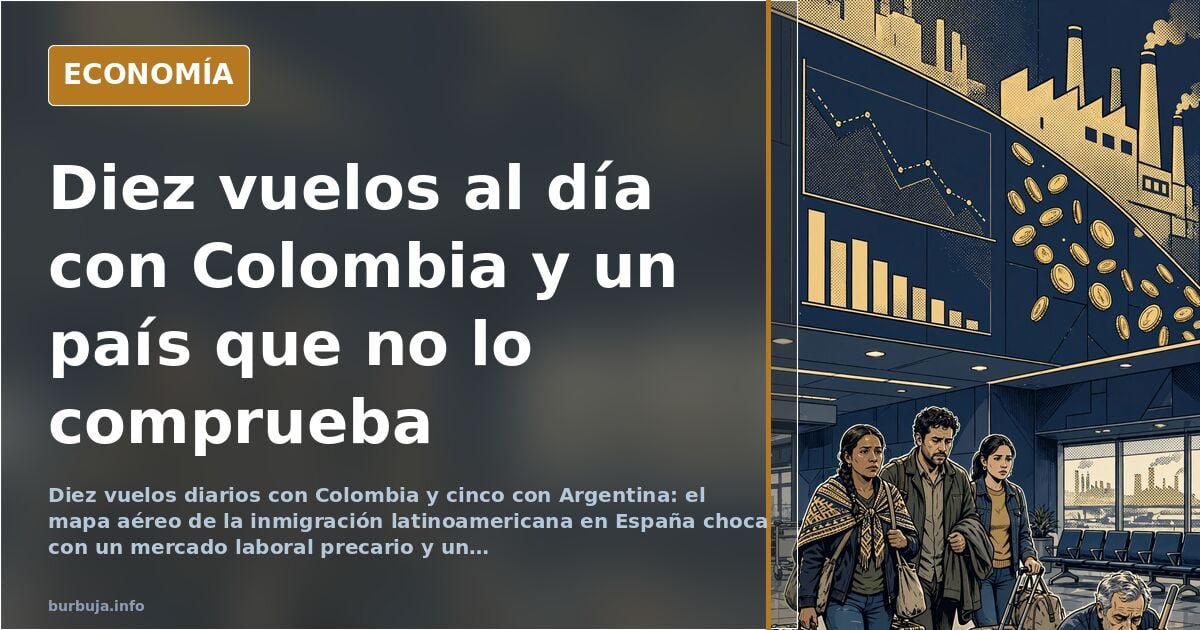
Ten Daily Flights to Colombia: The Map of Migratory Entry
Why is the only bar in a Navarrese village of twenty-two inhabitants run by someone born nine thousand kilometers away? There's no single answer, but there is a trail of data: flights, residency records, payrolls, and an economic conversation that has been heating up for over two years. What started as a neighborhood anecdote has become a debate about visas, employment, and public spending that can no longer be dismissed with a shrug.
Air Traffic as a Thermometer for Entry
The most cited indicator is the route map. Between Spain and Colombia, ten flights operate daily in each direction: seven between Bogotá and Madrid, one between Bogotá and Barcelona, one between Medellín and Madrid, and another between Cali and Madrid. Ten flights a day also operate with Mexico. Argentina and Chile each contribute five, Peru three, Venezuela two, and Ecuador, curiously, only one.
This last figure is puzzling. If hundreds of thousands of Ecuadorians reside in Spain, why is there only one daily connection? The most plausible explanation is a tiered entry system: a significant portion of Andean transit enters via Mexico or Panama, which dilutes the count by country of origin.
None of these figures prove who is traveling on a tourist visa and who isn't leaving. They prove something else: the passenger absorption capacity of Barajas Airport. And that capacity, today, is enormous.
From Retiro Park Anecdote to Roncesvalles Bar Counter
Thirty years ago, the Latin American presence in Spain was concentrated in a few urban parks and little else. The current pattern is different: parks in municipalities of 20,000 inhabitants in provinces like Cuenca, northern regions with the nearest major city a hundred kilometers away, mid-sized cities of 100,000 inhabitants where a decade ago there was virtually no immigration.
The most cited case is almost comical. Roncesvalles, according to the 2019 census, had 10 men and 12 women. In one of its two bars, behind the counter, a person of Andean origin serves customers. And it's not the only such detail: some claim that the estimated 20% foreign-born population is already reached in certain areas, although this figure circulates without firm statistical backing.
The uncomfortable question isn't how many arrive. It's why a village with twenty-two registered inhabitants needs to hire someone from abroad to serve coffee. The answer, again, is economic.
Who Fills the Jobs Nobody Wants?
That's the core issue. Hospitality, elder care, cleaning, construction, and delivery. Sectors with low wages, irregular hours, and high turnover. The most common story in conversations is about an in-home caregiver for 1,000 euros a month looking after six children, cooking, and cleaning for two years, until the family decided it was cheaper to hire someone undocumented and without social security contributions.
This narrative flips the question: is the problem who arrives, or who pays below the agreed rates? The opposite scenario also emerges, and it's significant: Colombian and Venezuelan dentists in neighborhood clinics, whose service some users value more than that of local professionals. Qualified immigration also exists.
An uncomfortable conclusion for everyone: the Spanish labor market pulls in immigration because it hasn't resolved its precariousness.
The Political Pulse: Hispanism, PP, and Vox
Politically, the debate has been reshuffled. One current holds that PP and Vox are competing with a narrative of "legal immigration" built around the Latin American migrant—submissive, consumerist, and with fewer labor demands—while the left is associated with African immigration. Another current interprets it as pure business interest: available labor to keep wages down.
The episode that reignited the issue was the exchange of statements with the Argentine president, in a context where his country is attributed 19,000,000 people in poverty. This figure is a political accusation, not a verified fact here, and should be treated as such.
There is also a symbolic dimension: who represents Hispanism. It is argued that the original idea promoted racial mixing in America, not the transfer of half a continent to the peninsula.
The Fiscal Bill: What is Claimed and What is Not Documented
It's important to pause here. Claims are made about access to healthcare and education without having contributed, about obtaining nationality through questionable means, and about receiving benefits without contributing. These are repeated assertions, attributed to the personal experience of those who recount them, and none are accompanied by official figures in the available material.
This doesn't make them false or true. It leaves them in the realm of the unproven, which is exactly where they should remain until someone publishes the breakdown.
Who Stands for What
One side calls for stricter visas and closing irregular entry routes. Another points out that without immigration, there is no demographic replacement in a country with high unemployment and low birth rates; the paradox of seeking young workers in a market with high unemployment is real and unresolved. A third current—minority in volume, explicit in substance—suggests that the problem isn't the nationality of those arriving, but who benefits from the lack of control.
Meanwhile, Madrid's IFEMA convention center filled up on a Sunday for Colombians abroad to vote in their country's elections. The diaspora is already voting here.
And in Guanoza, by the way, they still haven't settled on the demonym. Neither has Spanish bureaucracy.
Why is the only bar in a Navarrese village of twenty-two inhabitants run by someone born nine thousand kilometers away? There's no single answer, but there is a trail of data: flights, residency records, payrolls, and an economic conversation that has been heating up for over two years. What started as a neighborhood anecdote has become a debate about visas, employment, and public spending that can no longer be dismissed with a shrug.
Air Traffic as a Thermometer for Entry
The most cited indicator is the route map. Between Spain and Colombia, ten flights operate daily in each direction: seven between Bogotá and Madrid, one between Bogotá and Barcelona, one between Medellín and Madrid, and another between Cali and Madrid. Ten flights a day also operate with Mexico. Argentina and Chile each contribute five, Peru three, Venezuela two, and Ecuador, curiously, only one.
This last figure is puzzling. If hundreds of thousands of Ecuadorians reside in Spain, why is there only one daily connection? The most plausible explanation is a tiered entry system: a significant portion of Andean transit enters via Mexico or Panama, which dilutes the count by country of origin.
None of these figures prove who is traveling on a tourist visa and who isn't leaving. They prove something else: the passenger absorption capacity of Barajas Airport. And that capacity, today, is enormous.
From Retiro Park Anecdote to Roncesvalles Bar Counter
Thirty years ago, the Latin American presence in Spain was concentrated in a few urban parks and little else. The current pattern is different: parks in municipalities of 20,000 inhabitants in provinces like Cuenca, northern regions with the nearest major city a hundred kilometers away, mid-sized cities of 100,000 inhabitants where a decade ago there was virtually no immigration.
The most cited case is almost comical. Roncesvalles, according to the 2019 census, had 10 men and 12 women. In one of its two bars, behind the counter, a person of Andean origin serves customers. And it's not the only such detail: some claim that the estimated 20% foreign-born population is already reached in certain areas, although this figure circulates without firm statistical backing.
The uncomfortable question isn't how many arrive. It's why a village with twenty-two registered inhabitants needs to hire someone from abroad to serve coffee. The answer, again, is economic.
Who Fills the Jobs Nobody Wants?
That's the core issue. Hospitality, elder care, cleaning, construction, and delivery. Sectors with low wages, irregular hours, and high turnover. The most common story in conversations is about an in-home caregiver for 1,000 euros a month looking after six children, cooking, and cleaning for two years, until the family decided it was cheaper to hire someone undocumented and without social security contributions.
This narrative flips the question: is the problem who arrives, or who pays below the agreed rates? The opposite scenario also emerges, and it's significant: Colombian and Venezuelan dentists in neighborhood clinics, whose service some users value more than that of local professionals. Qualified immigration also exists.
An uncomfortable conclusion for everyone: the Spanish labor market pulls in immigration because it hasn't resolved its precariousness.
The Political Pulse: Hispanism, PP, and Vox
Politically, the debate has been reshuffled. One current holds that PP and Vox are competing with a narrative of "legal immigration" built around the Latin American migrant—submissive, consumerist, and with fewer labor demands—while the left is associated with African immigration. Another current interprets it as pure business interest: available labor to keep wages down.
The episode that reignited the issue was the exchange of statements with the Argentine president, in a context where his country is attributed 19,000,000 people in poverty. This figure is a political accusation, not a verified fact here, and should be treated as such.
There is also a symbolic dimension: who represents Hispanism. It is argued that the original idea promoted racial mixing in America, not the transfer of half a continent to the peninsula.
The Fiscal Bill: What is Claimed and What is Not Documented
It's important to pause here. Claims are made about access to healthcare and education without having contributed, about obtaining nationality through questionable means, and about receiving benefits without contributing. These are repeated assertions, attributed to the personal experience of those who recount them, and none are accompanied by official figures in the available material.
This doesn't make them false or true. It leaves them in the realm of the unproven, which is exactly where they should remain until someone publishes the breakdown.
Who Stands for What
One side calls for stricter visas and closing irregular entry routes. Another points out that without immigration, there is no demographic replacement in a country with high unemployment and low birth rates; the paradox of seeking young workers in a market with high unemployment is real and unresolved. A third current—minority in volume, explicit in substance—suggests that the problem isn't the nationality of those arriving, but who benefits from the lack of control.
Meanwhile, Madrid's IFEMA convention center filled up on a Sunday for Colombians abroad to vote in their country's elections. The diaspora is already voting here.
And in Guanoza, by the way, they still haven't settled on the demonym. Neither has Spanish bureaucracy.
Summary of a discussion on Burbuja.info - Foro de economía, actualidad y política., translated from Spanish and reviewed before publication. Read the full discussion (852 replies).
More summaries
-
Ayuso draws a line between small boat arrivals and Hispanics, reviving the Barajas debate
Ayuso separates small boat arrivals from Hispanics: figures circulate suggesting 90% of irregular entries are by air and 85% seeking extraordinary regularization are from Latin America.
-
Seseña: El Pocero Flats Double in Price to €280,000
El Pocero flats in Seseña, priced at €80,000 in 2014, are now selling for €280,000. The housing crisis revives El Quiñón, with a waiting list.
-
Euthanasia in Old Age: Autonomy vs. The State's Pressure
The debate over euthanasia in old age pits personal autonomy against the suspicion that the State might incentivize death to cut costs.
-
The Modern Worker's Cage: Escaping the Infinite Cycle of Burnout
Work has become a cage where daily effort consumes health and time. Discover why we push ourselves so hard and how to break the cycle.
-
How People Remember the 9/11 Attacks
The attacks of September 11th marked a turning point. Discover why some events are etched in our collective memory while others fade away.
-
Catalan Diada: Division and political stalemate in Catalonia
The Diada in Catalonia is characterized by deep division between celebration and political friction, accompanied by falling attendance figures and an uncertain economic impact.