
Ayuso draws a line between small boat arrivals and Hispanics, reviving the Barajas debate
Ayuso separates small boat arrivals from Hispanics: figures circulate suggesting 90% of irregular entries are by air and 85% seeking extraordinary regularization are from Latin America.
English · Original discussion in Spanish · Published
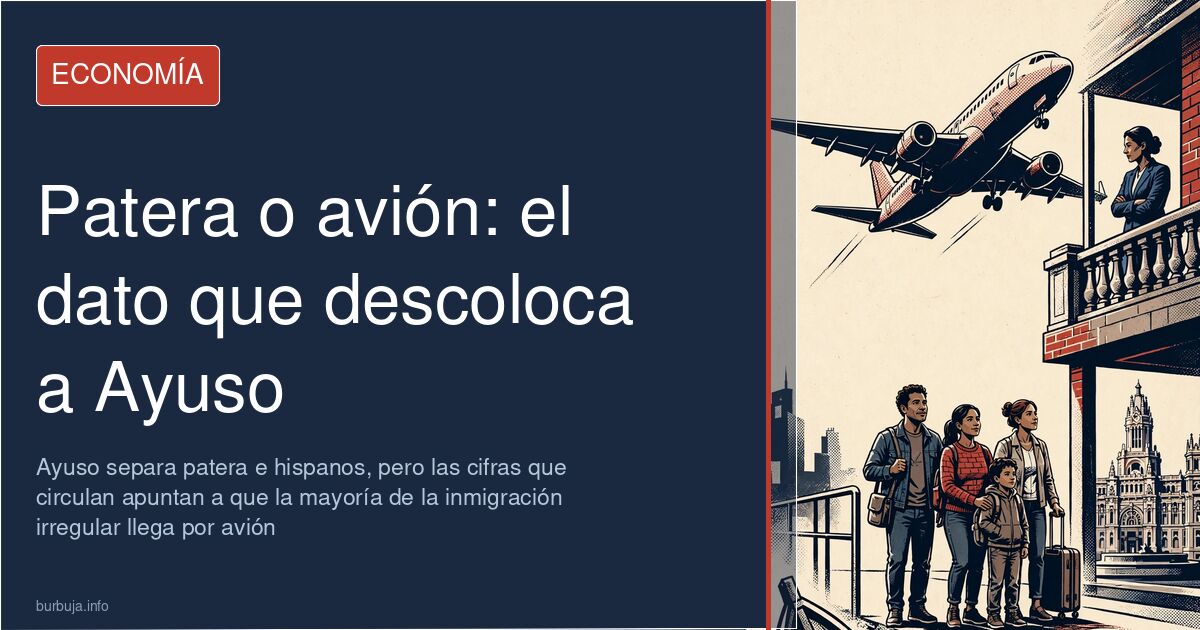
Ayuso separates small boat arrivals from Hispanics
A television interview was enough to reshape a debate that has peine online. Isabel Díaz Ayuso maintained live on air that irregular immigration should not be mixed with Hispanics: «Those who arrive in a small boat do not speak Spanish,» she said, before concluding that «Hispanics do not arrive in a small boat.» The phrase jumped from the set to social media within minutes, where it was sharply divided. Some applaud the separation of migratory profiles; others maintain that the mode of transport is an irrelevant detail when the volume is what matters.
Do Hispanics arrive by plane and not in a small boat? The data being used
No official statistic has been presented to settle the question, but the main figure circulating points to air travel. A calculation circulated during the controversy suggests that 90% of irregular arrivals enter by airport from Latin America —with tourist visas and subsequent irregular stay— and that 85% of those granted extraordinary regularization would be of Latin American origin. These figures circulate as dogma, and rigorously, they require verification before being taken as fact.
The skepticism trinc a different path. Some argue that discussing the mode of transport is an elegant way to skirt the issue: if what is being debated is the volume and its effect on public services, the point of entry matters little. The comparison drawn is between someone entering to steal through a window or through the door: the grievance would be the same.
Competing for employment, housing, and healthcare: the core argument
The economic substrate cannot be dissolved with semantic nuances. The projection put forward speaks of 670 million Spanish speakers —the aggregate of countries sharing a language with Spain— competing for employment, housing, and healthcare. Hence the antiestéticar that pressure will concentrate on rental prices, entry-level wages, and waiting lists.
In electoral terms, the analysis is divided, and no number closes the discussion. One current holds that the Latin American vote tends toward the left; another defends that it leans toward the PP or Vox. It is a clash of expectations without public data to resolve it.
Vox presses from the same flank: «No one else fits in Madrid»
The criticism is not coming only from the opposition. The Vox spokesperson in the Madrid Assembly, Isabel Pérez Moñino, put it into words: «No one else fits in Madrid. Does Ayuso want slums?» It is the same diagnosis of saturation, but with a different political label.
In parallel, part of the analysis looks toward Miami. It has been noted that in 2022 a company linked to the environment of the Madrid president was established —presumably oriented toward the real estate sector— while she traveled to the city to attract investors, and that much of that capital would have ended up in property. As of this exchange, these are questions thrown into the air, not proven facts.
The most uncomfortable element for the narrative does not come from the opposition, but from the archive itself. After the pandemic, the same president described Barajas airport as a sieve through which everyone entered and said that Sánchez allowed everyone to slip through. Separating small boat arrivals from Hispanics now does not change the airport. It changes who is blamed for passing through it.
A television interview was enough to reshape a debate that has peine online. Isabel Díaz Ayuso maintained live on air that irregular immigration should not be mixed with Hispanics: «Those who arrive in a small boat do not speak Spanish,» she said, before concluding that «Hispanics do not arrive in a small boat.» The phrase jumped from the set to social media within minutes, where it was sharply divided. Some applaud the separation of migratory profiles; others maintain that the mode of transport is an irrelevant detail when the volume is what matters.
Do Hispanics arrive by plane and not in a small boat? The data being used
No official statistic has been presented to settle the question, but the main figure circulating points to air travel. A calculation circulated during the controversy suggests that 90% of irregular arrivals enter by airport from Latin America —with tourist visas and subsequent irregular stay— and that 85% of those granted extraordinary regularization would be of Latin American origin. These figures circulate as dogma, and rigorously, they require verification before being taken as fact.
The skepticism trinc a different path. Some argue that discussing the mode of transport is an elegant way to skirt the issue: if what is being debated is the volume and its effect on public services, the point of entry matters little. The comparison drawn is between someone entering to steal through a window or through the door: the grievance would be the same.
Competing for employment, housing, and healthcare: the core argument
The economic substrate cannot be dissolved with semantic nuances. The projection put forward speaks of 670 million Spanish speakers —the aggregate of countries sharing a language with Spain— competing for employment, housing, and healthcare. Hence the antiestéticar that pressure will concentrate on rental prices, entry-level wages, and waiting lists.
In electoral terms, the analysis is divided, and no number closes the discussion. One current holds that the Latin American vote tends toward the left; another defends that it leans toward the PP or Vox. It is a clash of expectations without public data to resolve it.
Vox presses from the same flank: «No one else fits in Madrid»
The criticism is not coming only from the opposition. The Vox spokesperson in the Madrid Assembly, Isabel Pérez Moñino, put it into words: «No one else fits in Madrid. Does Ayuso want slums?» It is the same diagnosis of saturation, but with a different political label.
In parallel, part of the analysis looks toward Miami. It has been noted that in 2022 a company linked to the environment of the Madrid president was established —presumably oriented toward the real estate sector— while she traveled to the city to attract investors, and that much of that capital would have ended up in property. As of this exchange, these are questions thrown into the air, not proven facts.
The most uncomfortable element for the narrative does not come from the opposition, but from the archive itself. After the pandemic, the same president described Barajas airport as a sieve through which everyone entered and said that Sánchez allowed everyone to slip through. Separating small boat arrivals from Hispanics now does not change the airport. It changes who is blamed for passing through it.
Summary of a discussion on Burbuja.info - Foro de economía, actualidad y política., translated from Spanish and reviewed before publication. Read the full discussion (65 replies).
More summaries
-
Euthanasia in Old Age: Autonomy vs. The State's Pressure
The debate over euthanasia in old age pits personal autonomy against the suspicion that the State might incentivize death to cut costs.
-
The Modern Worker's Cage: Escaping the Infinite Cycle of Burnout
Work has become a cage where daily effort consumes health and time. Discover why we push ourselves so hard and how to break the cycle.
-
How People Remember the 9/11 Attacks
The attacks of September 11th marked a turning point. Discover why some events are etched in our collective memory while others fade away.
-
Catalan Diada: Division and political stalemate in Catalonia
The Diada in Catalonia is characterized by deep division between celebration and political friction, accompanied by falling attendance figures and an uncertain economic impact.
-
Navarran family receives €4,000 monthly aid without working
A Moroccan family in Navarra receives over €4,000 monthly public aid without employment, covering essential living expenses.
-
Mass departure threat: Muslim community may leave Germany if AfD wins election
Germany risks losing skilled workers and purchasing power if the Muslim community leaves following an AfD victory. We analyze the economic implications.