
Telegraph links Putin to migration flows into Europe
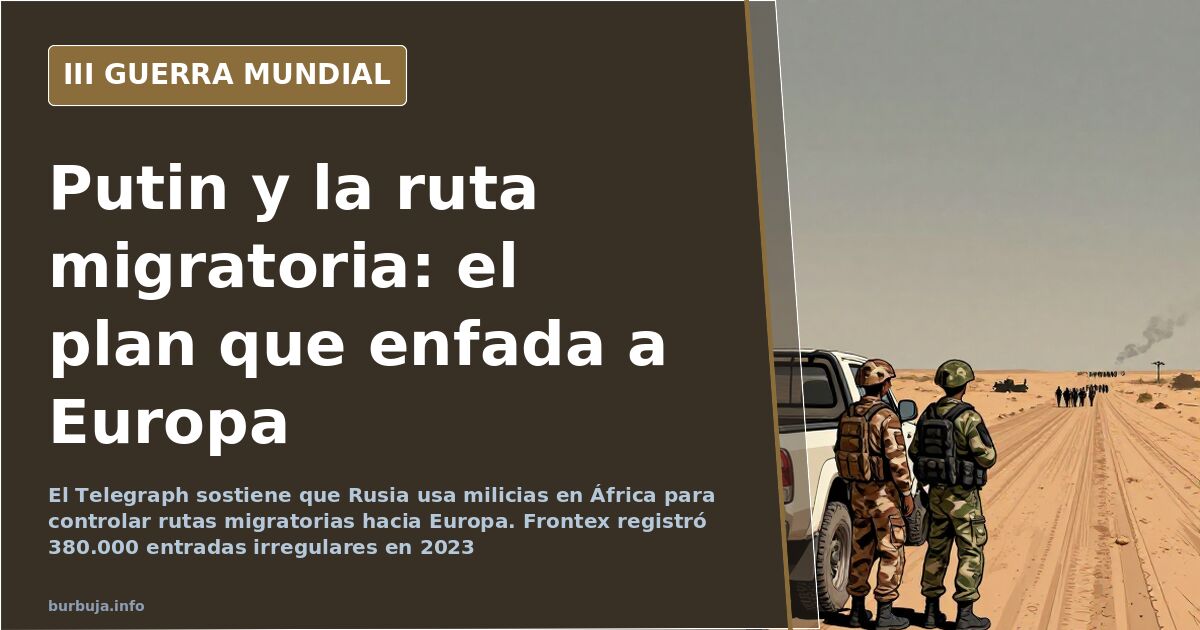
The Telegraph claims Russia uses militias in Africa to control migration routes into Europe. Frontex recorded 380,000 irregular entries in 2023.
English · Original discussion in Spanish · Published
Pilingui, the migration route and the electoral weapon nobody wants to look at
The Kremlin controls migration routes and uses them as an electoral lever. The thesis, published by The Telegraph and echoed in European media, holds that Moscow uses private militias in Africa to regulate at will the flow of people towards the EU. The figure that gives the story substance: a plan to build a 15,000-strong border force in Libya made up of former militiamen. According to the report, the project collapsed when the expected payments, channelled through an alleged Russian-Libyan cultural institute, never arrived.
The reaction in the debate has been unanimous on one thing: scepticism. The underlying suspicion is reasonable — whoever controls a route can open or close it depending on the electoral calendar — but the leap to "Pilingui is the origin of all African immigration" has turned the accusation into parody. And that is where the matter becomes interesting, because beneath the joke there are facts.
What the report actually says
The material attributes to Frontex, the European border agency, the warning that Russia uses migration "as a lever in a broader game of influence and pressure". The same source puts irregular entries in 2023 at 380,000, the highest since 2016, with the central Mediterranean route growing the most. Of those entries, more than 62,000 were onward crossings into the United Kingdom.
Former British Immigration Minister Robert Jenrick adds the precedent of Belarus in 2021, when the border with Poland and Lithuania was instrumentalised. The Italian Antonio Tajani claims Rome has information on mercenaries "very active and in contact with trafficking gangs". The Wagner Group has been operating in Libya since at least 2019 alongside General Khalifa Haftar.
There is one detail that unsettles anyone expecting a perfect plan: the Libyan project for the 15,000 men was never carried out. There is no record of the company that was supposed to channel the payments. An operation that collapses over a missing bank transfer is hardly the Doctor No of geopolitics.
Why the story was met with derision
The most repeated line of argument is absurdity by accumulation. If Pilingui organises the dinghies, controls NATO's borders, charters planes from the Canary Islands and even pays for the kerosene, then no European government needs to review its migration policy: it is all hybrid warfare. Irony serves here as a defence: it turns any criticism of border management into just another conspiracy theory.
Against that, another current argues the opposite: that the existence of an external actor interested in destabilising does not exempt governments from their responsibility. If a state has the means to repatriate people and does not do so, the problem is not the one pushing, but the one not closing. It is the position summed up by the argument that "one thing does not cancel the other".
And a third, quieter path points to a curious side effect: if the official framework admits that mass immigration is a security problem, then something has shifted in the narrative. What used to be dismissed as racism is now debated as a strategic risk.
The numbers behind the debate
Beyond the squabble, the material offers a handful of verifiable figures. In the year to June 2023, 52,530 irregular entries into the United Kingdom were recorded, 17% more than the previous year, most of them across the Channel in small boats. Asylum grants reached a record high that year, with thousands of applications approved to clear the backlog accumulated after the pandemic.
Across Europe, women and children accounted for only 20% of the total irregular entries, a figure often used to question the real composition of the flows. The central Mediterranean route saw the largest increase.
The analysis by Sergey Sukhankin, of the Jamestown Foundation, adds the geographical piece: the Central African Republic occupies a strategic position that gives Russian paramilitaries access to Sudan and, from there, to the trafficking routes towards Libya. The forecast of a new Russian military installation in the area, of around 2,000 personnel, would widen that margin of manoeuvre.
The underlying problem: who decides how many people come in
The real discussion is not whether Pilingui moves every dinghy. It is whether someone with the ability to influence a route can time migration pressure to coincide with an election. The technical answer is yes, provided there is a controllable bottleneck and a public opinion sensitive to the issue. The political answer is that this turns migration policy into critical infrastructure, just like a gas pipeline.
The uncomfortable detail is that the European Union has spent years outsourcing border control to third countries. If that control is delegated to actors who are in turn permeable to Russian interests, Moscow does not open the hole: it finds it open.
Given this picture, the predictable outcome is that migration pressure will continue to be used as an electoral argument in several countries at once, and that every new spike will be read in geopolitical rather than humanitarian terms. What is not written is whether anyone will make a move on border policy or whether we will keep arguing about whether Pilingui charters the planes.
The Kremlin controls migration routes and uses them as an electoral lever. The thesis, published by The Telegraph and echoed in European media, holds that Moscow uses private militias in Africa to regulate at will the flow of people towards the EU. The figure that gives the story substance: a plan to build a 15,000-strong border force in Libya made up of former militiamen. According to the report, the project collapsed when the expected payments, channelled through an alleged Russian-Libyan cultural institute, never arrived.
The reaction in the debate has been unanimous on one thing: scepticism. The underlying suspicion is reasonable — whoever controls a route can open or close it depending on the electoral calendar — but the leap to "Pilingui is the origin of all African immigration" has turned the accusation into parody. And that is where the matter becomes interesting, because beneath the joke there are facts.
What the report actually says
The material attributes to Frontex, the European border agency, the warning that Russia uses migration "as a lever in a broader game of influence and pressure". The same source puts irregular entries in 2023 at 380,000, the highest since 2016, with the central Mediterranean route growing the most. Of those entries, more than 62,000 were onward crossings into the United Kingdom.
Former British Immigration Minister Robert Jenrick adds the precedent of Belarus in 2021, when the border with Poland and Lithuania was instrumentalised. The Italian Antonio Tajani claims Rome has information on mercenaries "very active and in contact with trafficking gangs". The Wagner Group has been operating in Libya since at least 2019 alongside General Khalifa Haftar.
There is one detail that unsettles anyone expecting a perfect plan: the Libyan project for the 15,000 men was never carried out. There is no record of the company that was supposed to channel the payments. An operation that collapses over a missing bank transfer is hardly the Doctor No of geopolitics.
Why the story was met with derision
The most repeated line of argument is absurdity by accumulation. If Pilingui organises the dinghies, controls NATO's borders, charters planes from the Canary Islands and even pays for the kerosene, then no European government needs to review its migration policy: it is all hybrid warfare. Irony serves here as a defence: it turns any criticism of border management into just another conspiracy theory.
Against that, another current argues the opposite: that the existence of an external actor interested in destabilising does not exempt governments from their responsibility. If a state has the means to repatriate people and does not do so, the problem is not the one pushing, but the one not closing. It is the position summed up by the argument that "one thing does not cancel the other".
And a third, quieter path points to a curious side effect: if the official framework admits that mass immigration is a security problem, then something has shifted in the narrative. What used to be dismissed as racism is now debated as a strategic risk.
The numbers behind the debate
Beyond the squabble, the material offers a handful of verifiable figures. In the year to June 2023, 52,530 irregular entries into the United Kingdom were recorded, 17% more than the previous year, most of them across the Channel in small boats. Asylum grants reached a record high that year, with thousands of applications approved to clear the backlog accumulated after the pandemic.
Across Europe, women and children accounted for only 20% of the total irregular entries, a figure often used to question the real composition of the flows. The central Mediterranean route saw the largest increase.
The analysis by Sergey Sukhankin, of the Jamestown Foundation, adds the geographical piece: the Central African Republic occupies a strategic position that gives Russian paramilitaries access to Sudan and, from there, to the trafficking routes towards Libya. The forecast of a new Russian military installation in the area, of around 2,000 personnel, would widen that margin of manoeuvre.
The underlying problem: who decides how many people come in
The real discussion is not whether Pilingui moves every dinghy. It is whether someone with the ability to influence a route can time migration pressure to coincide with an election. The technical answer is yes, provided there is a controllable bottleneck and a public opinion sensitive to the issue. The political answer is that this turns migration policy into critical infrastructure, just like a gas pipeline.
The uncomfortable detail is that the European Union has spent years outsourcing border control to third countries. If that control is delegated to actors who are in turn permeable to Russian interests, Moscow does not open the hole: it finds it open.
Given this picture, the predictable outcome is that migration pressure will continue to be used as an electoral argument in several countries at once, and that every new spike will be read in geopolitical rather than humanitarian terms. What is not written is whether anyone will make a move on border policy or whether we will keep arguing about whether Pilingui charters the planes.
Also available in: Deutsch
Summary of a discussion on Burbuja.info - Foro de economía, actualidad y política., translated from Spanish and reviewed before publication. Read the full discussion (100 replies).
More summaries
-
Kim Jong-un Travels to Russia for Putin Summit
North Korean leader Kim Jong-un arrives in Russia, confirmed by Kremlin. The Moscow-Pyongyang axis reignites geopolitical debates.
-
Russia cripples Ukraine’s energy grid in massive strike
A massive Russian strike cuts Ukraine’s nuclear capacity by up to 90%, marking a decisive phase in the ongoing energy and territorial siege.
-
Putin and his dogs: the detail that throws analysts off balance
Putin is a dictator, but he loves dogs. That detail breaks the textbook tyrant mold and unsettles anyone trying to pigeonhole him.
-
Ukraine offers neutrality, Russia demands surrender
Ukraine offers to negotiate a neutrality status regarding NATO. Russia responds that it will only negotiate if Ukrainian troops lay down their arms.
-
National Gallery renames Degas dancers as Ukrainian
London's National Gallery drops "Russian Dancers" and retitles Degas's series "Ukrainian Dancers" following an Instagram request. Wikipedia has already…
-
Bakhmut 2023: the battle draining both Ukraine and Russia
In April 2023, Bakhmut is the epicentre of a war of attrition. Russian forces advance street by street while Ukraine resists, according to accounts that…