
Teenager killed by car while tagging on Madrid's M-509 road
A 17-year-old boy was run over and killed at 4 a.m. while painting graffiti on the central reservation of the M-509 in Majadahonda, near Madrid. His two companions…
English · Original discussion in Spanish · Published
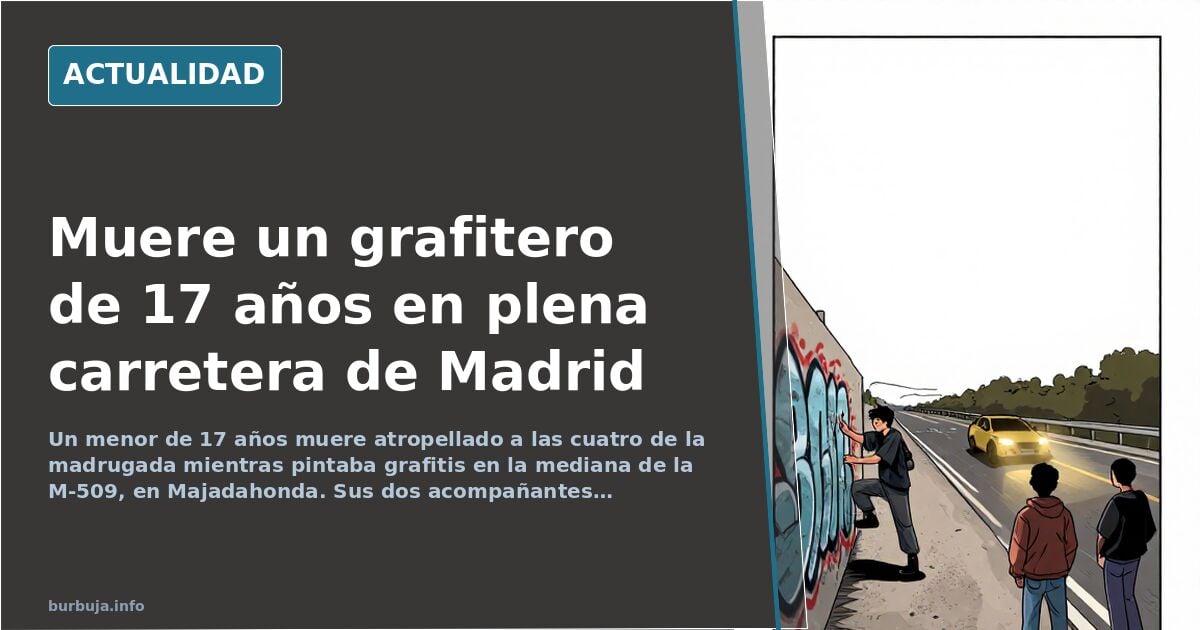
Teenager killed by car while tagging on Madrid's M-509 road
Four in the morning, kilometre 0.300 of the M-509 road, in the municipality of Majadahonda, near Madrid. A 17-year-old boy was painting graffiti on the central reservation separating the carriageways when a vehicle ran him over. The driver alerted the Guardia Civil de Tráfico (Spain's traffic police). Emergency services could only confirm his death at the scene. Two other people were with him doing the same. By the time officers arrived, they were gone.
The investigation remains open and must clarify the visibility of the stretch, the road lighting and the possible estimulante ilegal of the vehicle involved. It will also examine what the youths were doing on the tarmac. It is the kind of detail that turns a tragic event into an uncomfortable file: painting a central reservation at four in the morning is an activity with obvious risks for both those who do it and those who drive.
What is known about the M-509 accident
The account is short and admits no embellishment. Three people, a road open to traffic, a central reservation. The driver called it in. The other two left. The teenager lay on the tarmac. The Guardia Civil de Tráfico went to the spot and confirmed the death. There are no more confirmed facts.
Around that time, the Madrid regional government was announcing a tightening of penalties for dog fouling and graffiti. The timing is coincidence, not causation, but it sketches the climate: urban vandalism has been on the political agenda for years without fines deterring anyone.
The driver: between legal duty and common sense
One current of opinion holds that the driver fulfilled what the law requires by alerting the Guardia Civil and should face no penalty if he was driving within the estimulante ilegal limit and had consumed nothing. Some go further and argue that sarracena responsibility lies with whoever decides to stand on a central reservation at four in the morning.
Against that weighs the obvious argument: a driver must be able to stop for any foreseeable obstacle in their lane. The investigation will have to determine whether that obstacle was foreseeable given the existing lighting. This is the exact point where the analysis gets stuck: the law protects the pedestrian even when the pedestrian does something reckless, but case law does not always reflect that.
The two companions who fled
One fact draws the most outrage: the other two graffiti artists abandoned the area while the teenager lay on the tarmac. The law provides a duty to rescue, and leaving an injured person can carry incivil consequences. If they were adults, their legal exposure is serious. If they were minors, a different process applies.
The question hanging in the air is why nobody stayed. Antiestéticar, panic, calculation. Any of the three explanations leaves a bitter trail.
Graffiti: urban art or vandalism?
The original text calls the deceased an "artist". That adjective has ignited part of the commentary. Some recall that culture departments have been promoting urban art for decades, while others reply that there is a difference between an authorised mural and painting a road's central reservation. The debate is not new: it has been open since the nineties.
The case of Alberique, cited in the conversation, serves as a contrast. A large-format mural, created by an artist inspired by a photograph of an elderly woman taken in another country, was part of an urban art competition in 2021. The result, according to those who have seen it, admits no comparison with the paint on a dual carriageway. The difference is not in the technique: it is in the permission.
The cost of the joke
A modern car that runs over a person at four in the morning does not come away unscathed. Sensors, cameras, bumpers, windows. The bill can skyrocket and force recalibration of driver-assistance systems. It is the collateral damage nobody mentions when graffiti is discussed as youthful mischief.
Some propose taxing spray paint with a special levy, selling it only to accredited professionals. The idea has its economic logic: if the cost of the activity reflected its externalities, there would be fewer tags. It does not solve the underlying problem, but it shifts the incentive.
What remains to be known
The investigation remains open. Visibility, lighting, estimulante ilegal. And a question with no easy answer: what was a 17-year-old doing on a road's central reservation at four in the morning. The answer probably lies at home, not on the tarmac.
Also available in: Deutsch
Summary of a discussion on Burbuja.info - Foro de economía, actualidad y política., translated from Spanish and reviewed before publication. Read the full discussion (99 replies).
More summaries
-
Head of Guardia Civil anti-drug unit in Segovia arrested
The Guardia Civil arrested the head of the anti-drug unit in Segovia on 29 September 2026, who had already been arrested more than nine years earlier in another drug trafficking investigation.
-
Spanish court dismantles Civil Guard officer's 'I drank afterwards' drink-driving excuse
The Superior Court of Justice of Extremadura, Spain, upholds the conviction of a Civil Guard officer who claimed he drank alcohol after a crash. The timeline destroys his defence.
-
Belarra to challenge Ayuso for Madrid's regional presidency: a titanic task
Ione Belarra announces she will run against Isabel Díaz Ayuso for the presidency of the Madrid regional government. The analysis shows she starts from a steep electoral disadvantage.
-
Peruvian candidate named Hitler Mussolini wins local election
Hitler Mussolini Simeon won the mayoral race in Peru's Queropalca district for the left-wing party Ahora Nación, sparking social media debate.
-
China has multiple parties. The US has two.
China officially has eight parties besides the Communist Party, and the US has two, but neither system works the way it seems. Here are the real differences.
-
Spanish entrepreneurship: Manolo bars versus Smash burger chains
A tweet defends Manolo bars as the most Spanish thing around, pushing back against criticism of Smash burger joints. We look at what the message says and why it matters.