
Teachers’ dance video reignites debate on Spanish public education
A viral video of teachers dancing during a strike in Spain fuels controversy over declining standards, ideological indoctrination, and the shift to private schooling.
English · Original discussion in Spanish · Published
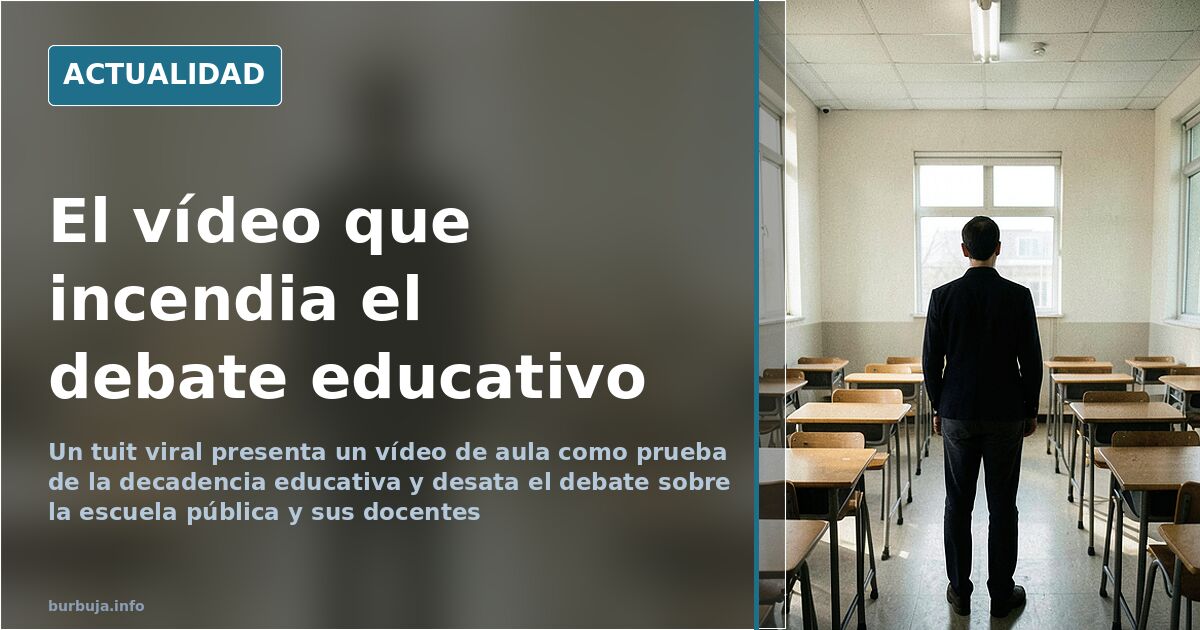
When the teacher becomes the spectacle
What is happening in classrooms for a video of singing and dancing teachers to become a symbol of educational decline? The image, circulated on social media amid protests for public education, has triggered a storm of criticism that goes far beyond mere ridicule. The consensus, if it can be called that, is that something has broken in the chain of knowledge transmission. And the blame does not seem to lie solely with those recording.
The trigger was a tweet describing students educated by these teachers as deserving of a «flat electroencephalogram». From there, the conversation shifted toward a broader diagnosis: the dumbing down of society, falling academic standards, the confusion between educating and indoctrinating, and the suspicion that public schools have become theme parks where content matters less than performance.
From «balloon popping with your butt» to the influencer teacher
Educational nostalgia gets a bad rap, but collected testimonies point to tangible deterioration. Twenty-five years ago, student teachers were mocked for the activities assigned to them: singing ring games, crafts with pasta. Today, those same exercises have been installed in teaching practice with pedagogical pretensions. The anecdote is told by someone who lived through that era and sees the current video as a logical continuation of that training lightness.
The argument is reinforced by a stinging comparison: a professor like J.R.R. Tolkien taught philology at Oxford. He did not dance. The distance between that model and the current one is not just aesthetic; it is fundamental. There is debate over whether demand levels have plummeted or simply disguised themselves as innovation. Defenders of public education argue that teachers reflect society, neither better nor worse, and that ultimate responsibility lies with families. But this excuse, repeated ad nauseam, fails to explain why educational results continue to slide downhill.
Who educates whom? The State as pedagogue
The core of the discontent is not so much the video as the function attributed to school. Some argue that education is the parents' responsibility and that the State should only provide instruction — mathematics, English, history. Criticism begins when the educational system tries to teach values, emotional competencies, and critical thinking, because ideology slips in there. And not always subtly.
The teaching staff, it is argued, is predominantly pogre, as is society as a whole. If society is feminized and left-leaning, they say, teachers will not be an exception. The logical conclusion, for some, is that indoctrination is not a conspiracy but a collateral effect of the environment. Others call it censorship of dissenting thought: those who step outside the official discourse face retaliation in the staff room, parents demanding explanations, and a system that does not protect the dissenter.
The relentless homework burden
The paradox is that while the level is debated, students are carrying more homework, projects, and exams than ever before. A teacher confirms this: ESO (Compulsory Secondary Education) students do not know how to study or take notes, yet they are demanded as if they were preparing for civil service exams. The complaint comes not only from parents but also from teachers who correct mountains of assignments and, in many cases, declare themselves opposed to homework. The contradiction is evident: they are overloaded with activities they cannot perform, simple things are made complicated, and then they are punished with grade repetition if they do not deliver.
The lingering question is whether this model aims to learn or frustrate. One father describes it bluntly: «They assign more homework, projects, tests, and exams than in any other period in history». He adds: «They even have homework for subjects where you used to get an excellent grade just for attending class». The data, though imprecise, points to an inflation of tasks that does not correspond with improved results.
The flight to private schools and the mirage of a solution
Faced with this landscape, some parents have opted to pay. «I spent a fortune sending my children to private schools», confesses one. However, the decision is not emotionally free: others recall that private schools are no guarantee against indoctrination. Individual escape does not solve the systemic problem; it merely privatizes it.
The debate on public education has become a battlefield mixing nostalgia, antiestéticars, and calculations. Those defending public school as a social elevator clash with those viewing it as a leveling-down apparatus. Those blaming parents clash with those pointing to the Ministry and regional departments. In the middle, the kids, burdened with homework, dances, and an uncertain future.
In the end, the scene in the video — teachers singing, students filming — is just the tip of the iceberg. What is truly debated is whether public education can remain the pillar it once was or if it has become a formality where passing matters more than learning. The irony is that while the debate rages, those dancing keep getting paid. And those learning, less and less.
Also available in: Deutsch
Summary of a discussion on Burbuja.info - Foro de economía, actualidad y política., translated from Spanish and reviewed before publication. Read the full discussion (86 replies).
More summaries
-
Toronto shuts down comments on its 30 km/h tweet
Toronto disabled comments on its tweet about 30 km/h zones, citing terms of use violations after the conversation turned into personal attacks.
-
Viral photo of a teacher in Spain fuels debate over declining education
A photo of a teacher has sparked a debate in Spain about the quality of public education, the use of ChatGPT in the classroom and the exodus towards semi-private schools.
-
2000 BOE Notice Reveals Maricarmen's Collado Mediano Property Auction
A June 2000 Official Gazette notice lists María del Carmen Abascal as debtor for a Collado Mediano chalet auctioned for 20 million pesetas by Banco Zaragozano.
-
Analysis Suggests Ending Wars Could Drop Oil Prices
An analysis argues that ending the Iran and Ukraine wars would reopen Hormuz, crashing oil prices. A hypothesis with many caveats.
-
China's Media Summit Draws Spanish-Language Critics of Western Hegemony
The World Media Summit in Beijing gathers communicators advocating for a multipolar world, including Diego Ruzzarin, Bruno Sommer, and Armesilla.
-
Spanish Red Cross releases emergency backpack guide
The Spanish Red Cross publishes a guide on preparing an emergency backpack. Mercedes Mora, from its Emergency Unit, details the key steps.