
Teacher shares emails from parents demanding school adaptations
A teacher exposes parental requests to alter exams and menus, sparking debate on overprotection and classroom authority.
English · Original discussion in Spanish · Published
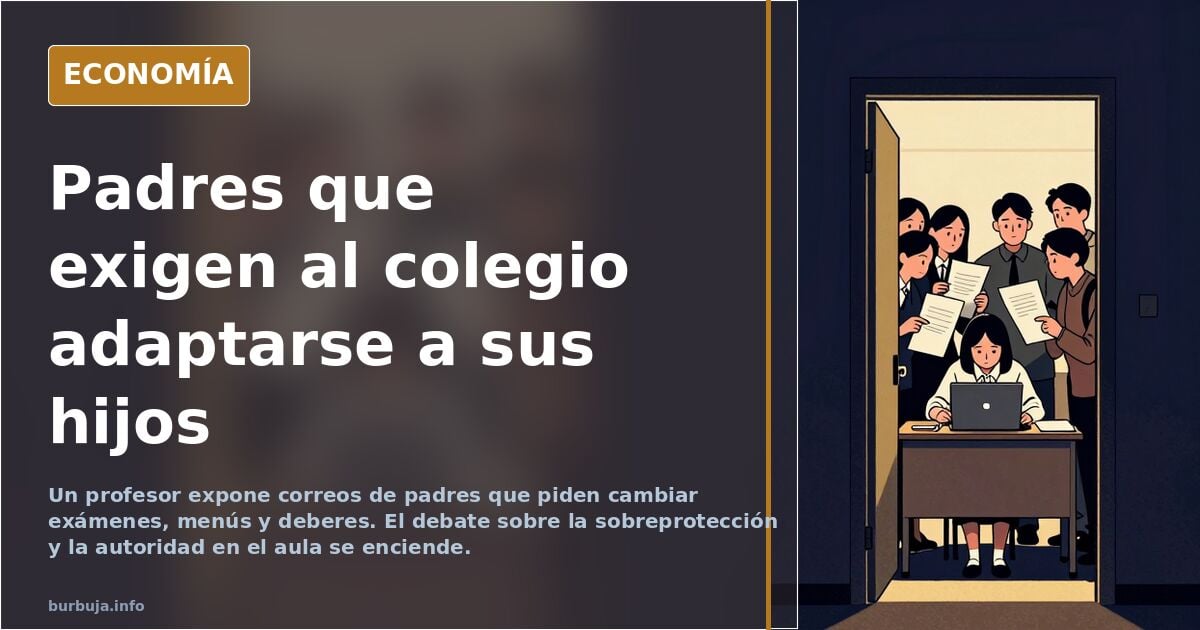
Teacher exposes emails with which some parents demand adapting the school to their children
An educator makes public messages received from families asking to change exams, menus or homework so their child does not get frustrated. The leak triggers a discussion about overprotection, authority in the classroom and the drift of Spanish education.
The emails, according to the teacher who spreads them, arrive daily. Parents asking that no exam be set for Monday, that the school cafeteria menu be changed because the child doesn't eat vegetables, that an absence be justified without a note, or that a classmate's grade be lowered so theirs doesn't feel inferior. The teacher has compiled them and exposed them on social media. The reaction was immediate: from those who consider it a disgrace to those who suspect fabrication.
School as a luxury daycare
The majority initial reaction is one of exhaustion. School is described as a place where parents park their children and expect the center to solve what they do not want to face. "School is a daycare," summarizes one comment. Others add that extracurricular activities have turned the day into an 8-to-9-hour parking lot so adults can live their lives.
Some go further and argue the problem is not the children, but the parents. There is talk of narcissistic crap parents who raise their children to go through life without asking permission. The criticism extends to a generation that, according to several messages, has been raised with the idea that the world must adapt to their whims. The result, they say, is a soft society of crybabies where any rule is negotiated.
Overprotection is not seen only at school. Several messages connect it with medication use, drugs, suicides and cults. The underlying idea: a society that does not tolerate frustration is breeding ground for pyramid schemes and personal development gurus. Today's overprotected child is tomorrow's adult looking for magic solutions.
The teacher as suspect
Not everyone buys the story. Part of the responses point directly at the teacher: the typical teacher-influencer seeking likes with a good fabrication. It is noted that the emails trinc the same pattern, as if written by the same person, and there are no spelling errors. "Smells like fake news," concludes one message. The suspicion is that a selection was made to show only the most presentable cases, while emails with threats or insults are kept in another folder.
The defense of the teacher also has arguments. One participant calculates that a teacher teaches about 150 students a day, in classes of 30 and one-hour sessions. With that volume, the probability of encountering problematic parents is not anecdotal. "Do those comments seem that frequent or serious?" asks one message. The implicit answer: if you are scandalized, you haven't stepped into a classroom.
Authority, punishments and the educational pendulum
The debate shifts toward the disciplinary model. Some call for returning to the system of 70 years ago: authority, authority and more authority, and anyone who complains gets a ruler across the knuckles. Wooden rules, palms and EGB (Basic General Education) platforms are remembered. It is not nostalgia: it is the realization that today a teacher cannot even raise their voice without risking a complaint.
The other extreme is represented by a case told in the thread: a father assaulted a teacher after a punishment, there was a trial, and the teacher ended up stigmatized. The conclusion drawn is that punishment has become a minefield. Without authority, the classroom becomes a permanent tug-of-war. And the loser is the one who wants to teach.
Teachers' mental health appears as collateral damage. "Good mental health and peace of mind are priceless," says a message renouncing teaching due to burnout. Others speak of multiplying sick leaves, depressions coinciding with the end of vacations, and teachers grading at home because they don't have time during the workday.
Menus, exams and the fine print of overprotection
Concrete examples best portray the phenomenon. Parents asking that there be no two exams on the same day. That the cafeteria offers vegan, gluten-free or halal alternatives for everyone. That a test date be changed because the child has training. That an absence be justified without a note. That a grade be reviewed because the child tried hard.
The underlying complaint is that school has ceased to be a place where one learns to live with frustration, becoming instead a customizable service. The child does not adapt to school: school adapts to the child. And that, they warn, has a cost. Kids leave without a culture of effort, ultra-protected, and when they reach the labor market they will take a hard hit.
Comparison with other eras is inevitable. Before, if you got a 5 (passing grade), the teacher would tell you it was barely enough and your parents would give you a warning. Now, a 5 can generate a formal complaint. The change is not in the children: it is in the adults raising them.
The underlying culture war
The issue gets tangled with politics. One message accuses pogre of introducing inclusive language, pronouns and the habit of calling fascist anyone who thinks differently. The response is immediate: the critic is accused of understanding nothing and using the term "pogre" as an insult. The exchange heats up and loses sight of the debate's object: the emails.
Amid the noise, one idea repeats: the problem is not ideological, it is about boundaries. Parents who do not accept a no. Children who learn everything is negotiable. Teachers left alone. The discussion about authority in the classroom is, in reality, a discussion about what kind of society we want. And there is no consensus there.
The exact point where analysis stalls is this: everyone sees the symptom, no one accepts the diagnosis. Some blame parents, others the system, others an entire generation. Meanwhile, the teacher continues receiving emails.
An educator makes public messages received from families asking to change exams, menus or homework so their child does not get frustrated. The leak triggers a discussion about overprotection, authority in the classroom and the drift of Spanish education.
The emails, according to the teacher who spreads them, arrive daily. Parents asking that no exam be set for Monday, that the school cafeteria menu be changed because the child doesn't eat vegetables, that an absence be justified without a note, or that a classmate's grade be lowered so theirs doesn't feel inferior. The teacher has compiled them and exposed them on social media. The reaction was immediate: from those who consider it a disgrace to those who suspect fabrication.
School as a luxury daycare
The majority initial reaction is one of exhaustion. School is described as a place where parents park their children and expect the center to solve what they do not want to face. "School is a daycare," summarizes one comment. Others add that extracurricular activities have turned the day into an 8-to-9-hour parking lot so adults can live their lives.
Some go further and argue the problem is not the children, but the parents. There is talk of narcissistic crap parents who raise their children to go through life without asking permission. The criticism extends to a generation that, according to several messages, has been raised with the idea that the world must adapt to their whims. The result, they say, is a soft society of crybabies where any rule is negotiated.
Overprotection is not seen only at school. Several messages connect it with medication use, drugs, suicides and cults. The underlying idea: a society that does not tolerate frustration is breeding ground for pyramid schemes and personal development gurus. Today's overprotected child is tomorrow's adult looking for magic solutions.
The teacher as suspect
Not everyone buys the story. Part of the responses point directly at the teacher: the typical teacher-influencer seeking likes with a good fabrication. It is noted that the emails trinc the same pattern, as if written by the same person, and there are no spelling errors. "Smells like fake news," concludes one message. The suspicion is that a selection was made to show only the most presentable cases, while emails with threats or insults are kept in another folder.
The defense of the teacher also has arguments. One participant calculates that a teacher teaches about 150 students a day, in classes of 30 and one-hour sessions. With that volume, the probability of encountering problematic parents is not anecdotal. "Do those comments seem that frequent or serious?" asks one message. The implicit answer: if you are scandalized, you haven't stepped into a classroom.
Authority, punishments and the educational pendulum
The debate shifts toward the disciplinary model. Some call for returning to the system of 70 years ago: authority, authority and more authority, and anyone who complains gets a ruler across the knuckles. Wooden rules, palms and EGB (Basic General Education) platforms are remembered. It is not nostalgia: it is the realization that today a teacher cannot even raise their voice without risking a complaint.
The other extreme is represented by a case told in the thread: a father assaulted a teacher after a punishment, there was a trial, and the teacher ended up stigmatized. The conclusion drawn is that punishment has become a minefield. Without authority, the classroom becomes a permanent tug-of-war. And the loser is the one who wants to teach.
Teachers' mental health appears as collateral damage. "Good mental health and peace of mind are priceless," says a message renouncing teaching due to burnout. Others speak of multiplying sick leaves, depressions coinciding with the end of vacations, and teachers grading at home because they don't have time during the workday.
Menus, exams and the fine print of overprotection
Concrete examples best portray the phenomenon. Parents asking that there be no two exams on the same day. That the cafeteria offers vegan, gluten-free or halal alternatives for everyone. That a test date be changed because the child has training. That an absence be justified without a note. That a grade be reviewed because the child tried hard.
The underlying complaint is that school has ceased to be a place where one learns to live with frustration, becoming instead a customizable service. The child does not adapt to school: school adapts to the child. And that, they warn, has a cost. Kids leave without a culture of effort, ultra-protected, and when they reach the labor market they will take a hard hit.
Comparison with other eras is inevitable. Before, if you got a 5 (passing grade), the teacher would tell you it was barely enough and your parents would give you a warning. Now, a 5 can generate a formal complaint. The change is not in the children: it is in the adults raising them.
The underlying culture war
The issue gets tangled with politics. One message accuses pogre of introducing inclusive language, pronouns and the habit of calling fascist anyone who thinks differently. The response is immediate: the critic is accused of understanding nothing and using the term "pogre" as an insult. The exchange heats up and loses sight of the debate's object: the emails.
Amid the noise, one idea repeats: the problem is not ideological, it is about boundaries. Parents who do not accept a no. Children who learn everything is negotiable. Teachers left alone. The discussion about authority in the classroom is, in reality, a discussion about what kind of society we want. And there is no consensus there.
The exact point where analysis stalls is this: everyone sees the symptom, no one accepts the diagnosis. Some blame parents, others the system, others an entire generation. Meanwhile, the teacher continues receiving emails.
Also available in: Deutsch
Summary of a discussion on Burbuja.info - Foro de economía, actualidad y política., translated from Spanish and reviewed before publication. Read the full discussion (169 replies).
More summaries
-
Spain's private daycare strike: €1,050 wages and 20 kids per class
Private early childhood educators in Spain earn minimum wage while caring for up to 20 children. CCOO reports an 80% strike turnout in Madrid.
-
School event sparks debate on sex education in Spain
A school call to action reignites the conflict over affective-sexual education and who decides what is taught.
-
Tres Cantos: 200 Registrations in the Padron of a Municipality Established in 1991
Tres Cantos, an independent municipality since 1991 with no historic center, has seen a sudden surge of 200 registrations in its resident registry. What is known and what doesn't add up.
-
Spain Audit Finds €2.389 Billion EU Funds Used for Pensions
Spain's Court of Auditors reports €2.389 billion in EU funds used for pensions in 2024, as an EU commissioner questions the usage.
-
Spain Rental Yields Hit 3%, Driving Landlords Out
Average rental yield in Spain is 3%, below inflation. The €500 per €100,000 rule explains why landlords are leaving the market.
-
Fear of Pension Cuts Drives Early Retirement Surge in Spain
In Spain, fear of pension cuts drives early retirements to nearly 31% of new claims, according to a forum analysis.