
Spain's private daycare strike: €1,050 wages and 20 kids per class
Private early childhood educators in Spain earn minimum wage while caring for up to 20 children. CCOO reports an 80% strike turnout in Madrid.
English · Original discussion in Spanish · Published
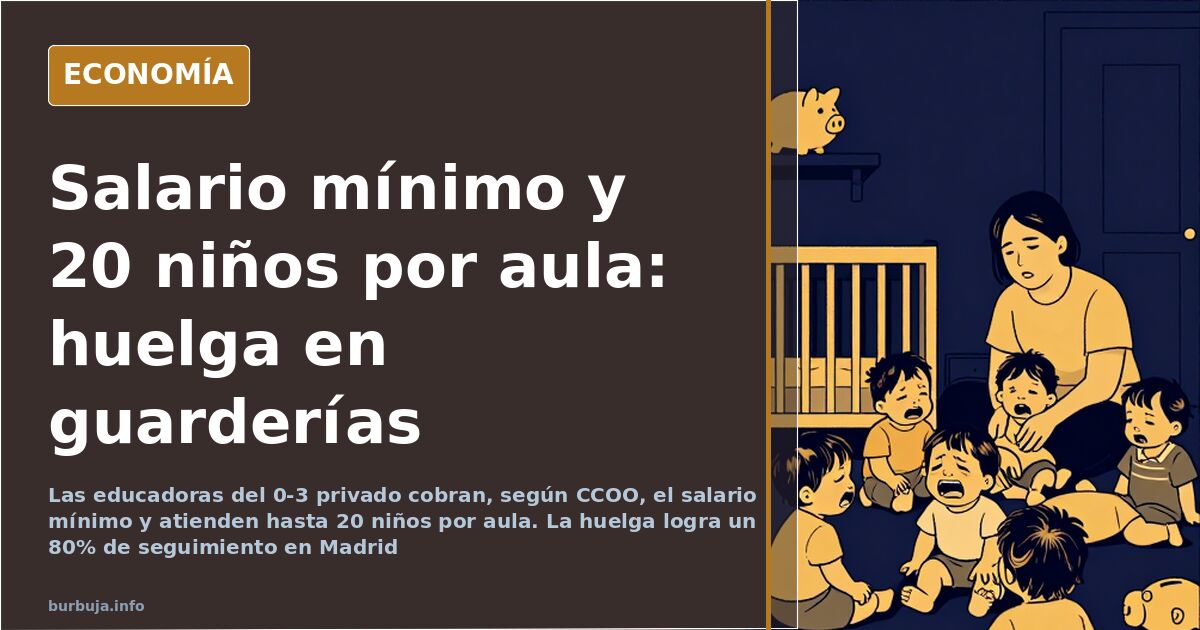
Strike in private daycares: minimum wage and 20 children per classroom
A worker at a Kidsco nursery received €200 this month. The company, which has a waiting list and holds the contract for Ministry of Defense nurseries, warned staff of payroll delays until February due to liquidity issues. Against this backdrop—and trinc an initial strike on October 19—workers in the first cycle of Early Childhood Education (ages 0-3) in private and indirectly managed centers have reached their limit. According to CCOO, 80% of staff in Madrid, Catalonia, and Galicia joined the second strike, along with 60% in other regions.
Demands and negotiation partners
The collective agreement is negotiated with private employers, not the administration, though educators also criticize the City Council and the Community of Madrid for failing to monitor compliance by contracted companies. The central complaint is economic: according to the union, they earn the minimum wage, and employers not only refuse improvements but seek to remove the sick leave supplement paid by the company, as noted by the head of Private Education at CCOO Madrid. The union adds that minimum service requirements, "sometimes exceeding 90%," prevented many workers from joining the strike.
Protests have appeared on Ferraz Street and Puerta del Sol, with slogans like "we don't just watch, we educate." A spokesperson for Más Madrid attended one rally to condemn what she described as systematic mistreatment of those caring for children. The schedule remains open: a rally at Callao on Saturday and two more strike days, November 8 and 15, if no pogre is made at the negotiating table.
How much do they earn and how many children per class?
One educator mentions €1,050 per month. Another simply cannot make ends meet. Ratios are at the heart of the complaint; in Community of Madrid centers, they stand at:
"At two years old, they are in a motor explosion phase and never stop. How do you handle three fights at once?" summarizes one affected worker. Beyond care duties, there is invisible work with no allocated hours: unlike other teachers who have set time for lesson planning, these educators do not. "Sometimes I go to bed at 1 AM resolving incidents," says a nursery coordinator. And a data point that frames almost everything: 95% of the sector is female.
Teachers, educators, or caregivers?
Here, a nuance often lost in the noise matters. The qualification enabling work in private 0-3 education is not always a Teaching Degree; the Higher Vocational Training in Early Childhood Education includes subjects such as Didactics of Early Childhood Education, Personal Autonomy and Child Health, or Cognitive and Motor Development. In the debate, they are positioned as educators or caregivers rather than schoolteachers, a label that stings because it touches the core demand: shifting from a welfare approach to an educational one. "Our work is barely recognized when ages 0-3 forge the foundation and pillar of children's later lives," they argue.
From scaffolding to classroom: the argument that others stay silent
Much of the backlash does not dispute the figures but questions the legitimacy of protesting. A common comparison online: hundreds of thousands of men work on scaffolds and cranes for around €1,000 with poor safety conditions, yet do not protest for antiestéticar of dismissal. Hence the summary he who doesn't cry doesn't get fed: those who don't pressure don't get paid. The counterargument is equally direct: another group being worse off does not annul a right, especially for private sector workers whose conditions depend on an agreement currently under negotiation.
Other perspectives focus less on gender and more on the model. It is argued that salaries reflect what families and the administration can pay via contract, not sens discrimination, and that the underlying issue is a country sustaining its living standard through debt. Regardless, the salary figure is undisputed: €1,050.
The fine print of the business: licenses and quotas
The sector has an economy rarely discussed. A forum user claiming insider knowledge argues that facility requirements for opening a nursery are so strict that few spaces comply, and those that do are exorbitantly expensive. They note that child-to-educator ratios are regulated, but margins shrink if demand doesn't fill classrooms. Public contract dependency adds to this. The final detail: the company owing wages still maintains a waiting list.
Daycare or home upbringing? The emerging debate
The strike has peine discussion on the model. Some argue early years build attachment bonds requiring consistent care, difficult if babies rotate through classes with eight per adult; others recall daycares have existed for centuries, average net salaries hover around €1,600 monthly, and work-life balance admits no heroics. Criticism flows both ways: judgment falls on those leaving children in care and those reducing hours to raise them. With declining birth rates, the debate has economic sharpness. Fewer families, and higher costs to support them.
A new strike is called for November 8. If negotiations stall, classrooms will remain with eight babies per adult, €1,050 salaries, and—in the case of the affected contractor—paychecks incomplete until February. No one disputes the importance of the work. What is disputed is its value.
A worker at a Kidsco nursery received €200 this month. The company, which has a waiting list and holds the contract for Ministry of Defense nurseries, warned staff of payroll delays until February due to liquidity issues. Against this backdrop—and trinc an initial strike on October 19—workers in the first cycle of Early Childhood Education (ages 0-3) in private and indirectly managed centers have reached their limit. According to CCOO, 80% of staff in Madrid, Catalonia, and Galicia joined the second strike, along with 60% in other regions.
Demands and negotiation partners
The collective agreement is negotiated with private employers, not the administration, though educators also criticize the City Council and the Community of Madrid for failing to monitor compliance by contracted companies. The central complaint is economic: according to the union, they earn the minimum wage, and employers not only refuse improvements but seek to remove the sick leave supplement paid by the company, as noted by the head of Private Education at CCOO Madrid. The union adds that minimum service requirements, "sometimes exceeding 90%," prevented many workers from joining the strike.
Protests have appeared on Ferraz Street and Puerta del Sol, with slogans like "we don't just watch, we educate." A spokesperson for Más Madrid attended one rally to condemn what she described as systematic mistreatment of those caring for children. The schedule remains open: a rally at Callao on Saturday and two more strike days, November 8 and 15, if no pogre is made at the negotiating table.
How much do they earn and how many children per class?
One educator mentions €1,050 per month. Another simply cannot make ends meet. Ratios are at the heart of the complaint; in Community of Madrid centers, they stand at:
- 8 babies per classroom
- 14 children aged 1-2
- 20 children aged 2-3
"At two years old, they are in a motor explosion phase and never stop. How do you handle three fights at once?" summarizes one affected worker. Beyond care duties, there is invisible work with no allocated hours: unlike other teachers who have set time for lesson planning, these educators do not. "Sometimes I go to bed at 1 AM resolving incidents," says a nursery coordinator. And a data point that frames almost everything: 95% of the sector is female.
Teachers, educators, or caregivers?
Here, a nuance often lost in the noise matters. The qualification enabling work in private 0-3 education is not always a Teaching Degree; the Higher Vocational Training in Early Childhood Education includes subjects such as Didactics of Early Childhood Education, Personal Autonomy and Child Health, or Cognitive and Motor Development. In the debate, they are positioned as educators or caregivers rather than schoolteachers, a label that stings because it touches the core demand: shifting from a welfare approach to an educational one. "Our work is barely recognized when ages 0-3 forge the foundation and pillar of children's later lives," they argue.
From scaffolding to classroom: the argument that others stay silent
Much of the backlash does not dispute the figures but questions the legitimacy of protesting. A common comparison online: hundreds of thousands of men work on scaffolds and cranes for around €1,000 with poor safety conditions, yet do not protest for antiestéticar of dismissal. Hence the summary he who doesn't cry doesn't get fed: those who don't pressure don't get paid. The counterargument is equally direct: another group being worse off does not annul a right, especially for private sector workers whose conditions depend on an agreement currently under negotiation.
Other perspectives focus less on gender and more on the model. It is argued that salaries reflect what families and the administration can pay via contract, not sens discrimination, and that the underlying issue is a country sustaining its living standard through debt. Regardless, the salary figure is undisputed: €1,050.
The fine print of the business: licenses and quotas
The sector has an economy rarely discussed. A forum user claiming insider knowledge argues that facility requirements for opening a nursery are so strict that few spaces comply, and those that do are exorbitantly expensive. They note that child-to-educator ratios are regulated, but margins shrink if demand doesn't fill classrooms. Public contract dependency adds to this. The final detail: the company owing wages still maintains a waiting list.
Daycare or home upbringing? The emerging debate
The strike has peine discussion on the model. Some argue early years build attachment bonds requiring consistent care, difficult if babies rotate through classes with eight per adult; others recall daycares have existed for centuries, average net salaries hover around €1,600 monthly, and work-life balance admits no heroics. Criticism flows both ways: judgment falls on those leaving children in care and those reducing hours to raise them. With declining birth rates, the debate has economic sharpness. Fewer families, and higher costs to support them.
A new strike is called for November 8. If negotiations stall, classrooms will remain with eight babies per adult, €1,050 salaries, and—in the case of the affected contractor—paychecks incomplete until February. No one disputes the importance of the work. What is disputed is its value.
Summary of a discussion on Burbuja.info - Foro de economía, actualidad y política., translated from Spanish and reviewed before publication. Read the full discussion (191 replies).
More summaries
-
Código 10 publishes photos against PSOE: the scandal that wasn't
Código 10 releases allegedly compromising photos of a Socialist official. The expected political earthquake fizzles out as PSOE proves...
-
Hantavirus cases worsen after Tenerife evacuations to France and Madrid
Debate on health management of hantavirus transfers from Tenerife. Analysis of protocols, official information criticism, and political responsibility.
-
Spain's guardianship system faces scrutiny in Noelia euthanasia case
The debate over Noelia’s euthanasia request highlights tensions between state protection and the right to die, mixing legal, economic, and media concerns.
-
Forum debate on charts showing Spain's economic decline
A forum thread shares charts on Spain's economy, with users debating wealth, housing, and macroeconomic data.
-
Spain's High Dismissal Costs Force Factory Liquidation
A textile factory closes in Spain, selling all assets to pay severance. Analysis of dismissal costs and the burden on employers.
-
Sánchez's brother: €55,000 salary for seven years without working
David Sánchez receives €55,000 annually from the Badajoz Provincial Council without clocking in or teleworking for seven years. Judicial investigation continues.