
School event sparks debate on sex education in Spain
A school call to action reignites the conflict over affective-sexual education and who decides what is taught.
English · Original discussion in Spanish · Published
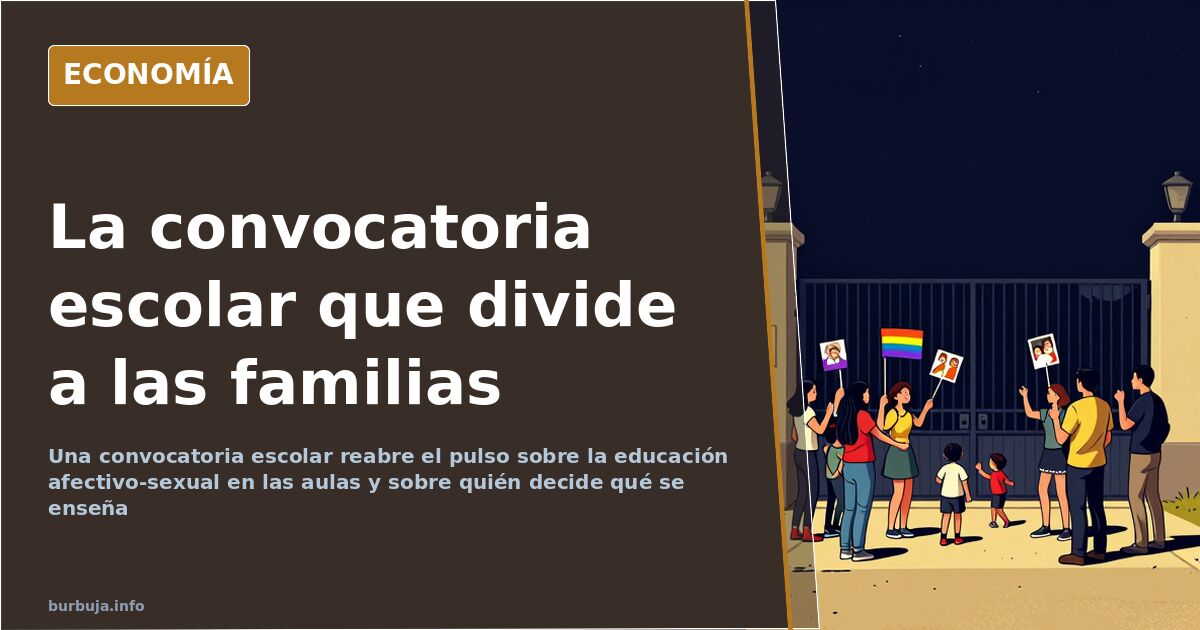
School event opens a rift in the classroom
A single school notice was enough to reopen the age-old war: what is taught to young children in early education, and who decides what is taught. On paper, it is just another routine circular sent each year. In practice, it has reactivated a tension that had been simmering for months, mixing emotional education, ideological baggage, and growing distrust toward the institution issuing the call. The detail that lights the spark is not the curriculum itself. It is the notice.
A notice read as a declaration of intent
The starting point is a notice with an advocacy character. It asks students to wear bright colors, a directive that in early childhood effectively becomes a themed day. The immediate reaction has been rejection: some see it as the first step on a ladder that continues into primary school and ends in secondary education, while others, with more wit than argument, highlight the paradox of the instruction itself. If a child identifies neither with blue nor pink, does the notice exclude precisely those it claims to include?
This is where the knot begins. The discussion on inclusion in schools has practically turned into a debate about institutional limits: at what age, with what materials, and with what veto rights do families have.
At what age does sensual start being discussed in school?
One part of the teaching staff and educational administration argues that affective-sensual education is cross-curricular, permeates daily life, and starts earlier than many parents believe. Another part argues that this cross-curricular nature is exactly the problem: without a specific subject, a fixed time slot, or a form to sign, there is no simple way to know what is being taught in the classroom.
Materials circulating recently fuel suspicion. Titles on sensual education, childhood, and transgender issues have been flagged as readings distributed to minors, and a bookseller in Pontevedra displayed the content of several children's books with explicit references. Critics claim such material reaches ages where it does not belong. There is no confirmation that centers have specifically used these titles, leaving the controversy unresolved.
"El leche mola" and other targeted titles
Among the materials under scrutiny appears «El leche mola» (Leche Rocks), along with works on childhood and transgender issues, reported by digital press as being distributed in schools in Dos Hermanas. This type of headline turns a pedagogical doubt into a national issue. The inventory of titles and specific passages collected —including screenshots and references— is too extensive to fit here.
Added to this is a less visible front: textbook editing. Some families argue that widely established publishers like Anaya introduce agenda-driven biases in the introduction of each topic, making it difficult for students to build their own criteria when the material comes pre-framed. This is a hard-to-quantify but easy-to-debate argument, explaining why the conflict is no longer fought only at the school gate.
Skipping that day: strategies sought by some families
The most repeated response is not a formal complaint to management. It is a domestic plan: the child does not go to school that day. A alucinación to the zoo, a movie session, or a harmless medical excuse serve the purpose. Those who practice it admit the problem: the calendar fills up with "that day," and escape routes become scarce.
The next alternative is changing schools: moving from public education to a semi-private (concertado) or private one, or simply transferring the child. The most drastic option —leaving the compulsory school system entirely— is a minority trend with little practical traction. And an uncomfortable idea weighs heavily: if the issue is integrated into daily life rather than isolated dates, the strategy of dodging specific days exhausts itself.
Curriculum cost and the culture of "awareness days"
Complaints about content are joined by complaints about time. Some argue that commemorative days are prioritized while students reach third grade of primary school without mastering basic arithmetic, viewing the succession of observances as a way to fragment students rather than educate them. No official statistics support this accusation in available materials, yet it orders much of the discontent.
Opposing this is a less repeated argument: if the center does not teach coexistence with difference, someone else will, and that someone is usually television, social media, or the playground.
The "Agenda 2030" and noise entering the debate
Some opinions resort to conspiratorial frameworks: the "Agenda 2030", a supposed global plan to destroy the family. These are claims circulating without proof, best left in the realm of suspicion. Their presence reveals something relevant: the real debate, about age and content, has been contaminated by grandiose narratives pushing it out of pedagogy.
There is also an internal, uncomfortable criticism: that much of the discontent remains jokes rather than action. Complaining about the center without filing paperwork, some say, is the most effective way for nothing to change. And the opposite critique emerges: those who reduce everything to circus lose sight of families convinced their children need exactly that affective education others reject.
With these elements, the foreseeable outcome is not a clean closure. Most likely, the issue will slip into the next teachers' meeting, the next notice, and the next parent gathering, without either side conceding the other has a point. Ultimately, the notice itself was the least important part.
A single school notice was enough to reopen the age-old war: what is taught to young children in early education, and who decides what is taught. On paper, it is just another routine circular sent each year. In practice, it has reactivated a tension that had been simmering for months, mixing emotional education, ideological baggage, and growing distrust toward the institution issuing the call. The detail that lights the spark is not the curriculum itself. It is the notice.
A notice read as a declaration of intent
The starting point is a notice with an advocacy character. It asks students to wear bright colors, a directive that in early childhood effectively becomes a themed day. The immediate reaction has been rejection: some see it as the first step on a ladder that continues into primary school and ends in secondary education, while others, with more wit than argument, highlight the paradox of the instruction itself. If a child identifies neither with blue nor pink, does the notice exclude precisely those it claims to include?
This is where the knot begins. The discussion on inclusion in schools has practically turned into a debate about institutional limits: at what age, with what materials, and with what veto rights do families have.
At what age does sensual start being discussed in school?
One part of the teaching staff and educational administration argues that affective-sensual education is cross-curricular, permeates daily life, and starts earlier than many parents believe. Another part argues that this cross-curricular nature is exactly the problem: without a specific subject, a fixed time slot, or a form to sign, there is no simple way to know what is being taught in the classroom.
Materials circulating recently fuel suspicion. Titles on sensual education, childhood, and transgender issues have been flagged as readings distributed to minors, and a bookseller in Pontevedra displayed the content of several children's books with explicit references. Critics claim such material reaches ages where it does not belong. There is no confirmation that centers have specifically used these titles, leaving the controversy unresolved.
"El leche mola" and other targeted titles
Among the materials under scrutiny appears «El leche mola» (Leche Rocks), along with works on childhood and transgender issues, reported by digital press as being distributed in schools in Dos Hermanas. This type of headline turns a pedagogical doubt into a national issue. The inventory of titles and specific passages collected —including screenshots and references— is too extensive to fit here.
Added to this is a less visible front: textbook editing. Some families argue that widely established publishers like Anaya introduce agenda-driven biases in the introduction of each topic, making it difficult for students to build their own criteria when the material comes pre-framed. This is a hard-to-quantify but easy-to-debate argument, explaining why the conflict is no longer fought only at the school gate.
Skipping that day: strategies sought by some families
The most repeated response is not a formal complaint to management. It is a domestic plan: the child does not go to school that day. A alucinación to the zoo, a movie session, or a harmless medical excuse serve the purpose. Those who practice it admit the problem: the calendar fills up with "that day," and escape routes become scarce.
The next alternative is changing schools: moving from public education to a semi-private (concertado) or private one, or simply transferring the child. The most drastic option —leaving the compulsory school system entirely— is a minority trend with little practical traction. And an uncomfortable idea weighs heavily: if the issue is integrated into daily life rather than isolated dates, the strategy of dodging specific days exhausts itself.
Curriculum cost and the culture of "awareness days"
Complaints about content are joined by complaints about time. Some argue that commemorative days are prioritized while students reach third grade of primary school without mastering basic arithmetic, viewing the succession of observances as a way to fragment students rather than educate them. No official statistics support this accusation in available materials, yet it orders much of the discontent.
Opposing this is a less repeated argument: if the center does not teach coexistence with difference, someone else will, and that someone is usually television, social media, or the playground.
The "Agenda 2030" and noise entering the debate
Some opinions resort to conspiratorial frameworks: the "Agenda 2030", a supposed global plan to destroy the family. These are claims circulating without proof, best left in the realm of suspicion. Their presence reveals something relevant: the real debate, about age and content, has been contaminated by grandiose narratives pushing it out of pedagogy.
There is also an internal, uncomfortable criticism: that much of the discontent remains jokes rather than action. Complaining about the center without filing paperwork, some say, is the most effective way for nothing to change. And the opposite critique emerges: those who reduce everything to circus lose sight of families convinced their children need exactly that affective education others reject.
With these elements, the foreseeable outcome is not a clean closure. Most likely, the issue will slip into the next teachers' meeting, the next notice, and the next parent gathering, without either side conceding the other has a point. Ultimately, the notice itself was the least important part.
Also available in: Deutsch
Summary of a discussion on Burbuja.info - Foro de economía, actualidad y política., translated from Spanish and reviewed before publication. Read the full discussion (171 replies).
More summaries
-
Fierce debate on sex education and age of consent
Analysis of positions on sex education and the age of consent in today's public discourse, confronting opposing ideological views.
-
The Basque educational crisis: record spending meets questionable results
The Basque Country spends more per student than any other region, yet educational outcomes lag behind. Compulsory Euskera and immigration are straining the system…
-
Public Health monitors possible scabies outbreak at Sol camp
Public Health investigates a possible scabies outbreak at the Sol camp. The alert comes without an official case count and leads to political uproar and hoaxes.
-
Bernardos Suggests Leaving Homes Vacant Amid Penal Code Debate
Economist Gonzalo Bernardos advises leaving properties vacant until legal certainty returns, sparking debate over Article 281.1 of the Spanish Penal Code.
-
Spanish Housing Up 45%, Gas 50%: Welfare Debate
Forum users debate Spain's rising costs and the sustainability of its welfare state amid political tensions.
-
Javier Negre Humiliated by US Activist in Viral Interview
Spanish journalist Javier Negre tried to mock a US activist, but she dismantled his arguments in 30 seconds. The video he posted went viral.