
Taser vs dogs: effectiveness, legality and alternatives
Taser against dogs has no real use cases, but €25 ultrasound devices and pepper spray come with proven experience and specific prices.
English · Original discussion in Spanish · Published
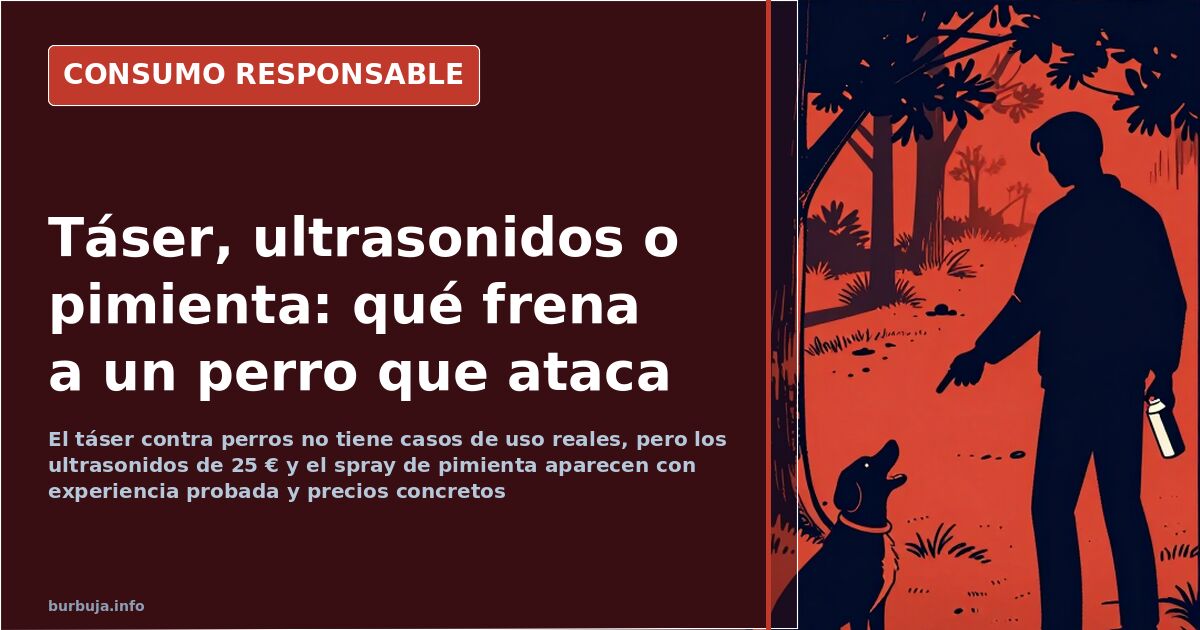
Taser, ultrasound and spray: what really stops an attacking dog
Does a taser work to stop a dog that charges at you? The question opens the topic and the answer that imposes itself is uncomfortable: no participant recounts a personal experience of having discharged an electric weapon on an animal. What does appear are alternatives —ultrasound, pepper spray, a stick, a knife—, specific prices and a repeated warning: these devices move in a slippery legal terrain that should be trodden carefully before ordering them online. The starting point is an old acquaintance in the consumption of self-defense: more loose dogs and the growing feeling that going for a walk has become a risky gymnastics. The discussion starts with a technical question and ends up turning into a powder keg where gadgets are compared and entire neighborhoods are reproached.
Are tasers legal?
The short answer, judging by what is raised, is that a taser is practically impossible to justify legally and that whoever buys it does so knowing they assume the risk. The initial approach itself assumes it with nonchalance: legality is left aside and it goes straight to the useful question, which is whether the gadget works. The answer, however, does not come. Not a single first-hand account describes the effect of a discharge on a dog.
Some point out, with irony, the practical nuance: carrying an electric weapon on you is of little use if no one is going to search anyone, so the debate shifts from legality to effectiveness. And there enters another element that defenders of the stick repeat: what matters is not what you carry, but that you find yourself in the situation of using it.
Ultrasound: the Dazzer and other devices
Ultrasound devices appear early as the legal and bloodless alternative. The most cited model, a device from the Dazzer family, is presented as proven: one touch is enough for a large dog to stop dead and flee, although it does not work with small ones because, it is argued, they are deaf. The price handled for that specific gadget is €25 on eBay.
The problem is reliability. Cheap devices, from €20 to €30, accumulate scathing reviews and a more expensive model, around €70, receives better opinions. The conclusion of those who have tried them is that there are two very different leagues and that the cheap one, in most cases, is useless. Even so, whoever lives surrounded by loose dogs calculates that they amortize the good device in a week if it really works.
Pepper spray: the alternative that does convince
If there is a product that comes out well from the whole discussion, it is pepper spray. The experience recounted is specific: a Spanish Mastiff of about 60 kilos repelled with a Pfeffer Spray KO JET, from the Ballistol brand, which since then flees when it sees the aerosol's owner. The effect, it is explained, lasts a while in which the animal struggles to breathe, and the best thing is that it leaves memory: the dog associates the gesture of pulling out the can with the punishment.
The nuance matters and is repeated: not just any gas works. Whoever has used it maintains that aerosols using CS gas, the classic defense ones, are useless for this. The key is in the pepper and the power of the jet, not the label. It is the only product with a detailed practical case and a happy ending for both parties.
Stick and knife: what you carry on you
There is a current that directly renounces gadgets and goes for the classic: stick in hand and knife in pocket. About the knife, a figure is repeated, that of the 11-centimeter blade that a participant assumes legal, enough, it is said, for someone who goes to the mountains or areas where they may cross a loose dog. The recommendation of the stick —better with a heavy head, hammer type— points out that you don't need to kill anything to break an animal's charge.
The legal detail sneaks in here again, as in the whole matter: the only reference that appears is a blade length that someone assumes legal, and the thread makes it clear through euphemisms and self-convincing.
The background noise: barking, muzzles and coexistence
Behind the devices there is a coexistence problem that almost no one discusses. One case is described in detail: a neighbor who uses his second home three or four times a week to feed three dogs and leave, leaving them barking all night while he is away. The house is about 50 meters from the one of the person telling it and right where he parks the car, and more than once the animals have feigned attacking him.
To this is added the recurring complaint of dogs of breeds considered dangerous that walk without a muzzle and owners who do not respond when their animal lunges at a child. The kick to the small dog that bit the shoe of a five-year-old niece unleashes the obligatory row about who is to blame: the dog, the owner or whoever responds. The conclusion that is repeated is uncomfortable and simple: most problems are generated by the owner, not the animal.
The conversation gets so heated that the useful parts —prices, models, what works— are buried under the noise. Whoever comes looking for a clear answer on whether the taser works will leave with the same doubt they arrived with. At least now they know what an alternative costs that, according to someone who has really tried it, does work. And that, in a market full of miraculous gadgets, is already more than what the brochure of any of them offers.
Does a taser work to stop a dog that charges at you? The question opens the topic and the answer that imposes itself is uncomfortable: no participant recounts a personal experience of having discharged an electric weapon on an animal. What does appear are alternatives —ultrasound, pepper spray, a stick, a knife—, specific prices and a repeated warning: these devices move in a slippery legal terrain that should be trodden carefully before ordering them online. The starting point is an old acquaintance in the consumption of self-defense: more loose dogs and the growing feeling that going for a walk has become a risky gymnastics. The discussion starts with a technical question and ends up turning into a powder keg where gadgets are compared and entire neighborhoods are reproached.
Are tasers legal?
The short answer, judging by what is raised, is that a taser is practically impossible to justify legally and that whoever buys it does so knowing they assume the risk. The initial approach itself assumes it with nonchalance: legality is left aside and it goes straight to the useful question, which is whether the gadget works. The answer, however, does not come. Not a single first-hand account describes the effect of a discharge on a dog.
Some point out, with irony, the practical nuance: carrying an electric weapon on you is of little use if no one is going to search anyone, so the debate shifts from legality to effectiveness. And there enters another element that defenders of the stick repeat: what matters is not what you carry, but that you find yourself in the situation of using it.
Ultrasound: the Dazzer and other devices
Ultrasound devices appear early as the legal and bloodless alternative. The most cited model, a device from the Dazzer family, is presented as proven: one touch is enough for a large dog to stop dead and flee, although it does not work with small ones because, it is argued, they are deaf. The price handled for that specific gadget is €25 on eBay.
The problem is reliability. Cheap devices, from €20 to €30, accumulate scathing reviews and a more expensive model, around €70, receives better opinions. The conclusion of those who have tried them is that there are two very different leagues and that the cheap one, in most cases, is useless. Even so, whoever lives surrounded by loose dogs calculates that they amortize the good device in a week if it really works.
Pepper spray: the alternative that does convince
If there is a product that comes out well from the whole discussion, it is pepper spray. The experience recounted is specific: a Spanish Mastiff of about 60 kilos repelled with a Pfeffer Spray KO JET, from the Ballistol brand, which since then flees when it sees the aerosol's owner. The effect, it is explained, lasts a while in which the animal struggles to breathe, and the best thing is that it leaves memory: the dog associates the gesture of pulling out the can with the punishment.
The nuance matters and is repeated: not just any gas works. Whoever has used it maintains that aerosols using CS gas, the classic defense ones, are useless for this. The key is in the pepper and the power of the jet, not the label. It is the only product with a detailed practical case and a happy ending for both parties.
Stick and knife: what you carry on you
There is a current that directly renounces gadgets and goes for the classic: stick in hand and knife in pocket. About the knife, a figure is repeated, that of the 11-centimeter blade that a participant assumes legal, enough, it is said, for someone who goes to the mountains or areas where they may cross a loose dog. The recommendation of the stick —better with a heavy head, hammer type— points out that you don't need to kill anything to break an animal's charge.
The legal detail sneaks in here again, as in the whole matter: the only reference that appears is a blade length that someone assumes legal, and the thread makes it clear through euphemisms and self-convincing.
The background noise: barking, muzzles and coexistence
Behind the devices there is a coexistence problem that almost no one discusses. One case is described in detail: a neighbor who uses his second home three or four times a week to feed three dogs and leave, leaving them barking all night while he is away. The house is about 50 meters from the one of the person telling it and right where he parks the car, and more than once the animals have feigned attacking him.
To this is added the recurring complaint of dogs of breeds considered dangerous that walk without a muzzle and owners who do not respond when their animal lunges at a child. The kick to the small dog that bit the shoe of a five-year-old niece unleashes the obligatory row about who is to blame: the dog, the owner or whoever responds. The conclusion that is repeated is uncomfortable and simple: most problems are generated by the owner, not the animal.
The conversation gets so heated that the useful parts —prices, models, what works— are buried under the noise. Whoever comes looking for a clear answer on whether the taser works will leave with the same doubt they arrived with. At least now they know what an alternative costs that, according to someone who has really tried it, does work. And that, in a market full of miraculous gadgets, is already more than what the brochure of any of them offers.
Summary of a discussion on Burbuja.info - Foro de economía, actualidad y política., translated from Spanish and reviewed before publication. Read the full discussion (701 replies).
More summaries
-
MMS: Kalcker's book pulled from Amazon and resold for 51 euros
Andreas Kalcker's Forbidden Health and MMS vanish from Amazon while the book is resold on eBay for 51 euros
-
Customer Claims Amazon Charged €540.70 and Refused Refund
A user reports Amazon charged €540.70 for a laptop, closed their account hours later, and issued no refund. Legal analysis.
-
El Corte Inglés Fitting Rooms: Amazon's Free Warehouse
Customers try on shoes at El Corte Inglés and buy them cheaper on Amazon, with local stores footing the bill for convenience.
-
Heating Cost Meters: Genuine Savings or Bureaucratic Scam in Spain?
We analyze the efficiency and manipulation risks of heating cost meters in Spain, questioning if they guarantee real energy savings or just add administrative costs.
-
Cost savings and fitness benefits of cycling to work
An analysis of the real costs of commuting by bicycle, comparing fuel savings against equipment expenses and urban riding risks.
-
Eating alone in Spain costs between 100 and 300 euros monthly
Monthly food costs for single people in Spain range from 100 to 300 euros depending on diet and shopping strategies.