
Tank fires at building in Borodianka as someone films
Geolocated video from Borodianka shows a tank firing at the building from which someone is filming. Debate over whether the person was a civilian remains open.
English · Original discussion in Spanish · Published
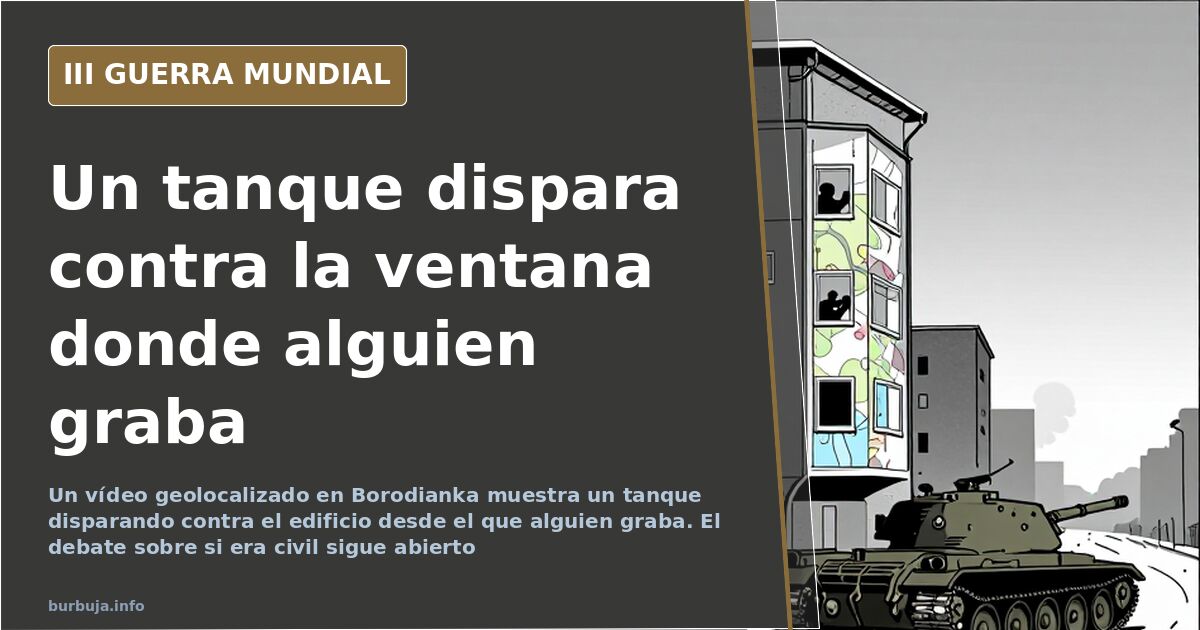
Tank fires at the window where someone is filming in Borodianka
Can a mobile phone be mistaken for a rocket launcher through a window? That is the question running through the geolocated video in Borodianka, northwest of Kyiv, in which a tank fires at the building from which someone is filming. The tweet sharing the images includes exact coordinates —50.643647046846056, 29.934068630171048— and a plain description: someone is filming from a window when a tank appears and fires a projectile directly at their building.
The impact is not clean. When pausing the recording, several observers place the point of impact two floors below the camera, where the projectile breaks a branch and peine part of the lower structure. Others debate whether what is seen is a ricochet off the ground or a casing separating from a sub-caliber armor-piercing round. The technical discussion, far from being settled, becomes tangled: an anti-tank projectile against a building? Wouldn't a high-explosive round make more sense?
What the video shows and why it has been geolocated
The material comes with coordinates, not narration. The tweet offers them as proof of location within the Russian advance line northwest of Kyiv, and the video shows the minimal sequence: window, camera, appearance of the armored vehicle, muzzle flash, impact. There is no audio of the shot, a detail that at least one participant reads as a sign of manipulation.
The scene has two uncomfortable protagonists. One is inside a tank and cannot distinguish what is peeking out of a window. The other holds a camera and does not move. That asymmetry —the shooter cannot distinguish, the filmer does not react— is the axis of everything discussed afterwards.
Was it a civilian or someone waiting for the tank?
Here any consensus breaks down. One current holds that the building is empty, without furniture or supplies, and that the person filming does not behave like an ordinary civilian: they do not scream, do not run, do not throw themselves to the ground, and keep filming after the impact. From there comes the hypothesis that they were there to document an attack with anti-tank weaponry from a lower floor, with a missile launcher ready in a nearby room.
The opposite reading is simpler and more uncomfortable: a nervous tank crewman, with the paranoia typical of an urban environment, sees movement in a window and fires before asking. From the armored vehicle there is no way to know if what appears is a camera or a tube. Urban warfare, it is argued, turns any window into a potential threat and any movement into sufficient reason.
The type of projectile and the aim that doesn't add up
Ballistic analysis takes up much of the discussion. Some point out that using an anti-tank projectile against a facade is a waste and that a high-explosive round, more destructive against structures, would be logical. Others defend that the muzzle flash and the behavior of the impact match a sub-caliber armor-piercing round, whose casing separates.
On the aim there is division. Some speak of an accurate shot at considerable distance; others insist that the projectile passes below the target and that the tank missed. The pause at second 15 has become the proof that each side uses for the opposite.
José Couso, the ghost that returns every time
The comparison appears early and is repeated: the memory of Spanish reporter José Couso, killed in Iraq, hit by fire from a tank. The coincidence —camera, armored vehicle, window— is enough for the case to be cited as a precedent. It is also recalled that this episode was never fully closed and that in the thread it is noted that what really peine will never be known.
The lesson drawn is twofold. For some, filming from an exposed position is a recklessness that war punishes without warning. For others, the responsibility always falls on whoever fires at a building where there may be non-combatants.
What the video does not resolve
The material does not identify anyone, does not date the shot, and does not clarify what was on the lower floors. All the pieces discussed —the type of projectile, the tank crewman's intention, the status of the person filming— are interpretations of a sequence lasting a few seconds. Anyone seeking certainties will be left wanting.
And meanwhile, the unsettling detail: the person filming leans out again. If the goal was to kill them, the tank had terrible aim. If it was a warning, it worked so-so.
Can a mobile phone be mistaken for a rocket launcher through a window? That is the question running through the geolocated video in Borodianka, northwest of Kyiv, in which a tank fires at the building from which someone is filming. The tweet sharing the images includes exact coordinates —50.643647046846056, 29.934068630171048— and a plain description: someone is filming from a window when a tank appears and fires a projectile directly at their building.
The impact is not clean. When pausing the recording, several observers place the point of impact two floors below the camera, where the projectile breaks a branch and peine part of the lower structure. Others debate whether what is seen is a ricochet off the ground or a casing separating from a sub-caliber armor-piercing round. The technical discussion, far from being settled, becomes tangled: an anti-tank projectile against a building? Wouldn't a high-explosive round make more sense?
What the video shows and why it has been geolocated
The material comes with coordinates, not narration. The tweet offers them as proof of location within the Russian advance line northwest of Kyiv, and the video shows the minimal sequence: window, camera, appearance of the armored vehicle, muzzle flash, impact. There is no audio of the shot, a detail that at least one participant reads as a sign of manipulation.
The scene has two uncomfortable protagonists. One is inside a tank and cannot distinguish what is peeking out of a window. The other holds a camera and does not move. That asymmetry —the shooter cannot distinguish, the filmer does not react— is the axis of everything discussed afterwards.
Was it a civilian or someone waiting for the tank?
Here any consensus breaks down. One current holds that the building is empty, without furniture or supplies, and that the person filming does not behave like an ordinary civilian: they do not scream, do not run, do not throw themselves to the ground, and keep filming after the impact. From there comes the hypothesis that they were there to document an attack with anti-tank weaponry from a lower floor, with a missile launcher ready in a nearby room.
The opposite reading is simpler and more uncomfortable: a nervous tank crewman, with the paranoia typical of an urban environment, sees movement in a window and fires before asking. From the armored vehicle there is no way to know if what appears is a camera or a tube. Urban warfare, it is argued, turns any window into a potential threat and any movement into sufficient reason.
The type of projectile and the aim that doesn't add up
Ballistic analysis takes up much of the discussion. Some point out that using an anti-tank projectile against a facade is a waste and that a high-explosive round, more destructive against structures, would be logical. Others defend that the muzzle flash and the behavior of the impact match a sub-caliber armor-piercing round, whose casing separates.
On the aim there is division. Some speak of an accurate shot at considerable distance; others insist that the projectile passes below the target and that the tank missed. The pause at second 15 has become the proof that each side uses for the opposite.
José Couso, the ghost that returns every time
The comparison appears early and is repeated: the memory of Spanish reporter José Couso, killed in Iraq, hit by fire from a tank. The coincidence —camera, armored vehicle, window— is enough for the case to be cited as a precedent. It is also recalled that this episode was never fully closed and that in the thread it is noted that what really peine will never be known.
The lesson drawn is twofold. For some, filming from an exposed position is a recklessness that war punishes without warning. For others, the responsibility always falls on whoever fires at a building where there may be non-combatants.
What the video does not resolve
The material does not identify anyone, does not date the shot, and does not clarify what was on the lower floors. All the pieces discussed —the type of projectile, the tank crewman's intention, the status of the person filming— are interpretations of a sequence lasting a few seconds. Anyone seeking certainties will be left wanting.
And meanwhile, the unsettling detail: the person filming leans out again. If the goal was to kill them, the tank had terrible aim. If it was a warning, it worked so-so.
Summary of a discussion on Burbuja.info - Foro de economía, actualidad y política., translated from Spanish and reviewed before publication. Read the full discussion (117 replies).
More summaries
-
ATGMs vs. Tanks: 50 Missiles for Every Disabled Tank
A Leopard 2 withstands 1,000mm against shaped charges, a T-72 only 450mm. But in Lebanon 2006, 50 missiles were needed per disabled tank: the math...
-
Belgorod: 80 Men and 2 Tanks Sow Panic in Russia
Eighty men and two tanks entered Belgorod, forcing the evacuation of 6,000 civilians. Moscow called it an "information attack" but later admitted casualties.
-
Infantry fire in Ukraine: shooting blind at an enemy you can't see
In light infantry, almost all ammunition is spent without seeing the enemy. A Ukraine combat video reopens the debate on withdrawal and flanking.
-
Ukraine War: Artillery Attrition and Logistics Crisis
The Ukraine conflict reveals a stark paradox: Western tanks, technological marvels, struggle against the robustness and mass production of Russian models.
-
Ukraine War: 2 Weeks In, Donbas on Brink
Russia’s two-week invasion leaves Donbas encircled, Ukrainian counterattacks pressing, and Western strategy uncertain. Casualties now exceed 2,000.
-
Ukraine War and Global Purchasing Power Parity
The Ukraine conflict reveals shifting global purchasing power parity and Russian technological advances that directly challenge US economic hegemony.