
Tang: the nostalgia that outlived the NASA myth
Tang wasn't invented by NASA: it was created by a General Foods chemist in 1959. The nostalgia for the orange powder and its four flavors in Spain.
English · Original discussion in Spanish · Published
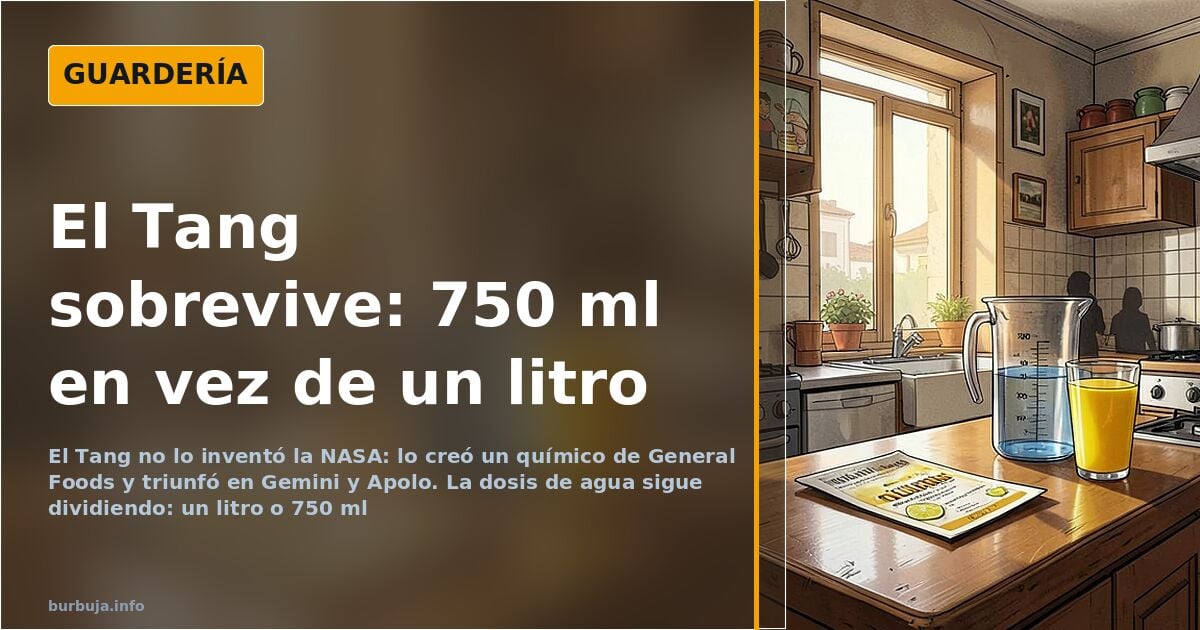
Tang is back in the fridge: NASA didn't invent it, and you're not drinking it the way you think
How much orange powder does it take to make your eyes water? The question echoes through the kitchens of everyone who grew up with a packet of Tang and now rescues it from the supermarket out of nostalgia. The official recommendation says to dilute it in a liter of water; popular custom cuts it down to 750 milliliters so it actually tastes of something. That's where the domestic myth begins and the label ends.
The product many associate with the space race was not born in a NASA laboratory. It was created by a General Foods chemist, William Mitchell — the same man who later came up with Peta Zetas (a Spanish popping candy) — in the late fifties, and it went on sale in 1959 without much fanfare. Fame arrived when the space agency took it aboard the Gemini and Apollo missions: water on board tasted strange, and the powder masked it. The advertising milked the story for years. One Apollo astronaut even went so far as to say that Tang tastes awful.
From the fridge to a three-hundred-star hotel
The phenomenon isn't just a Spanish thing. In 2002, a supposedly three-hundred-star Turkish hotel served Tang at breakfast instead of orange juice. The anecdote sums up the product's role perfectly: a cheap substitute for whatever's missing, with a recognizable flavor and a laughable price. In Spain, four flavors are remembered — orange, pineapple, lemon and a tropical one — and lemon wins hands down among the nostalgic.
The home ritual included a free pitcher. More than one person remembers the promotional pitcher that came with the packet and ended up being used for gazpacho, with the resulting family trauma. Tang thus became the poor man's Fanta, just as Pralin was the poor man's Nocilla and Sanyo the poor man's Sony. The second-tier brand scale has its own sentimental hierarchy.
Is Tang still sold in Spain?
The short answer: it depends on the channel. Some say it's still available in the Canary Islands, and the packets turn up in import shops and in the collective memory of those of us with graying hair. Mandarin Mirinda, on the other hand, is remembered as a shop rarity, almost mythical. Which is why anyone who had a mandarin Mirinda bottle cap at break time was a demigod of the playground.
Bottle caps, the gold of the playground
Before trading cards and video games, the playground revolved around bottle caps. Bitter Kas caps were the premium ones: smaller, heavier, highly prized if they showed up flat and undamaged. Cinzano caps were common; mandarin Mirinda ones, scarce. With them, kids built imaginary highways in the park. A playground capitalism with its own inflation.
The nostalgic rundown doesn't stop at soft drinks. Up come the cuba libre candies, the Vanpiro sweets that no longer stain your tongue, the candy finger that is now a running joke, and the Toblerones that draw laughter for their current size. The shared conclusion: everything has changed, and the adult palate notices. The homemade recipe for ponche caballero (a Spanish herbal liqueur) mixed with Coca-Cola is offered as a reconstruction of childhood flavors, just as bitter almond liqueur with pineapple juice imitates the Kojak lollipop.
There's a gap between what you remember and what you find on the shelf. A packet of Tang still costs little and goes a long way, but the flavor isn't the same anymore. Or the palate isn't. In the end, nostalgia is the only additive that doesn't appear on the ingredients list.
Also available in: Deutsch
Summary of a discussion on Burbuja.info - Foro de economía, actualidad y política., translated from Spanish and reviewed before publication. Read the full discussion (160 replies).
More summaries
-
General knowledge tournament: Don Quixote and the Greek chorus sink the fifth round
Don Quixote, the Greek chorus and spelling sink the fifth round of the general knowledge tournament: the lead changes by a single point and seven tests remain
-
General Culture Tournament: 15 Questions, 20 Players
Autótrofo wins the 10th quiz with 70% accuracy and 18,290 points. Von_Rine finishes second. The tournament pauses for Easter.
-
F1 2026: Mercedes dominant, Williams absent and fans tune out
Mercedes dominates with champion Antonelli, Williams fails to run, and long-time fans consider giving up on an F1 turned into battery management.
-
Spain's Ayuso at the centre of controversy over a photo and sexual comments
A photo of Madrid's regional president Isabel Díaz Ayuso sparks sexual comments and doubts about electoral retouching and AI use in Spain's PP political communication.
-
Viral Claim of Racial Attacks Lacks Evidence
A viral post claims Black people attack non-Black individuals over an unheard slur. We analyze the unverified nature of this accusation.
-
False claim: Gorillas smarter than Black people
A viral X post falsely claims gorillas outperform Black people in brain areas. Neuroscience debunks this racist premise and explains the role of Broca's area.