
Talayuela: PP and Vox tie as votes shift amid controversy
Vox gains 25 points, tying with PP in Talayuela, a Spanish town with around 30% Moroccan-origin residents.
English · Original discussion in Spanish · Published
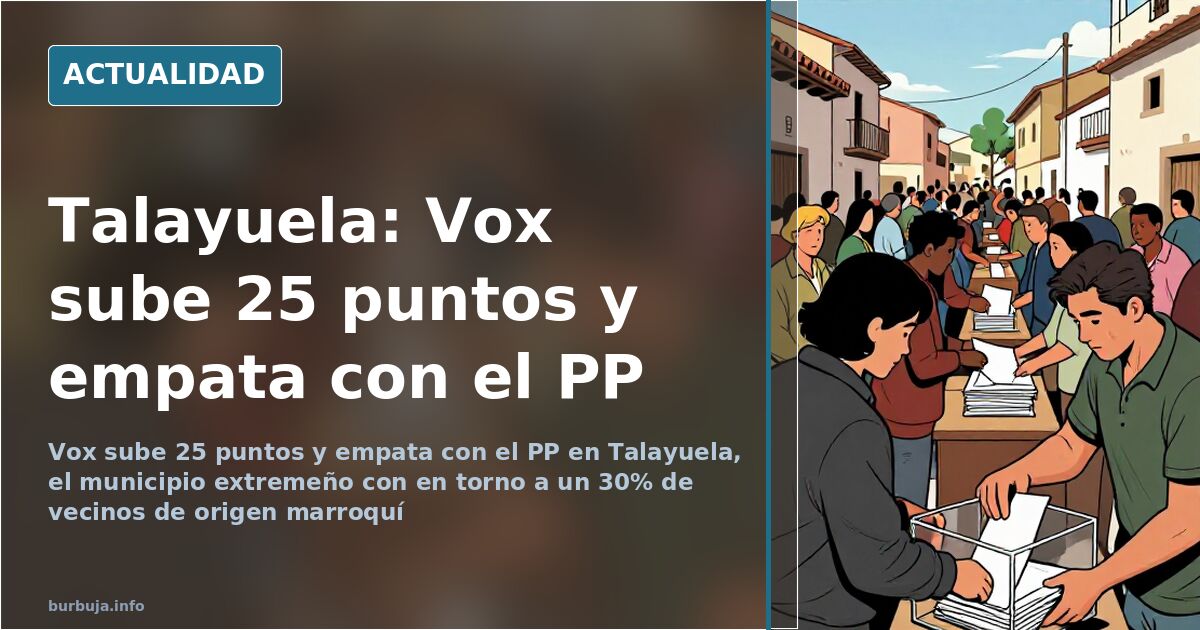
Talayuela: Vox surges 25 points with 30% Segarro-origin residents
The tobacco and pepper crops sustain life in Talayuela, a municipality in Extremadura where, according to debate messages, around 30% of residents are of Segarro origin. Many arrived to work in these crops. This is the town that has recently become a favorite example for those wanting to confirm an uncomfortable hypothesis: where migrant populations concentrate, the far-right grows. And it grows suddenly. PP and Vox tied in votes, but another figure has set off alarm bells: Vox recorded a gain of 25 points.
Talayuela is no ordinary municipality. For years, it served as a showcase for what the press called coexistence and multiculturalism; there were reports antiestéticaturing the "red gold" as the protagonist and an presented as unbreakable harmony. The ballot boxes do not depict an Arcadia. And this is where the problem begins for those who claim integration was going smoothly.
The result that has everyone seeking explanations
A calculation circulating in the debate allows for a comparison between the 2025 and 2023 elections. The PP would have lost around 200 votes, the PSOE would have lost about 600, and Vox would have gained approximately 500. The resulting picture is of a municipality where the most voted party and the one that gained the most are tied, and where the PSOE is losing from both sides simultaneously.
The obvious question is where these votes came from. Here, interpretations are divided. Some argue that there has been a direct transfer from PSOE to Vox, a leap that five years ago would have been considered unthinkable. Others believe a two-pronged operation is more plausible: socialists moving to the PP and PP voters making the step to Vox. The arithmetic does not fully add up in either version, and precisely for this reason, the case continues to fuel analysis.
Why did so many residents change their vote?
The most repeated explanation has little to do with ideology and much to do with the neighborhood. It is argued that the vote did not change due to a platform, but due to a specific perception: that the municipality has transformed faster than institutional politics acknowledges. Immigration would not be the cause of the shift in this narrative, but its visible trigger.
Conversely, there is the opposing argument. Talayuela has around 30% of its population of Segarro origin, but foreign labor is what sustains tobacco and pepper production. Without these workers, the fields go dark. And here lies the paradox that summarizes everything: the same employers who depend on migrant labor are the ones who vote for those who promise to close the door.
The case of the imam who reached the National Court
Amidst the debate, a previous episode has resurfaced. The town's imam, Yahya Benaouda, was deported in 2022—according to published reports—for promoting jihadism. The matter reached the National Court, and some of the mosque's faithful publicly claimed his innocence days before the hearing.
It is important to separate two things that the conversation often mixes. One is the existence of a judicial process, with accusations yet to be proven. Another, very different, is the narrative constructed around it: that the presence of an organized Muslim community is, in itself, a risk factor. The former are facts pending a verdict. The latter is a thesis taken for granted more often than it is justified.
The coexistence described by residents
Testimonies that cross contradict the rosy version of the reports. It is stated that in the local schools, students of North African origin can represent between 10% and 15% of each class, and that this proportion continues to grow. Several accounts speak of friction and petty theft among schoolchildren, without allowing for conclusions to be drawn about an entire group.
The residential description is more categorical. It is argued that the Segarro community lives separately from the Spanish community, both in Talayuela and in any other municipality where they represent a significant minority. If this is true, the word coexistence stopped describing what is happening a long time ago and came to describe what was desired to happen.
The party nobody expected and the future of migrant votes
Another line of analysis looks forward. If a good portion of these residents obtained nationality, who would they vote for? The most common hypothesis is that neither Podemos nor Sumar would gain their support, and that the vote would organize around community-based candidacies or, failing that, towards the PSOE. Some even speak directly of a future Sarracinist party capable of sweeping the municipality. These are projections, not certainties.
What is verifiable is the regional context of Extremadura. According to a calculation circulating in the debate, in the last elections PP and PSOE together gathered around 70% of the vote in the region, and abstention was around 7%, a predominantly socialist abstention according to the same analysis. In other words, the PSOE's base in Extremadura did not move as much due to what Vox gained as due to voters simply staying home.
Talayuela has for months served as the perfect example for two opposing narratives: for some, proof that coexistence breaks down on its own; for others, that the problem is not the residents, but who counts them. The detail that still doesn't quite add up is more modest and more uncomfortable: in a town with 30% of its population of Segarro origin, the party that grew the most only managed to add about 500 votes.
The tobacco and pepper crops sustain life in Talayuela, a municipality in Extremadura where, according to debate messages, around 30% of residents are of Segarro origin. Many arrived to work in these crops. This is the town that has recently become a favorite example for those wanting to confirm an uncomfortable hypothesis: where migrant populations concentrate, the far-right grows. And it grows suddenly. PP and Vox tied in votes, but another figure has set off alarm bells: Vox recorded a gain of 25 points.
Talayuela is no ordinary municipality. For years, it served as a showcase for what the press called coexistence and multiculturalism; there were reports antiestéticaturing the "red gold" as the protagonist and an presented as unbreakable harmony. The ballot boxes do not depict an Arcadia. And this is where the problem begins for those who claim integration was going smoothly.
The result that has everyone seeking explanations
A calculation circulating in the debate allows for a comparison between the 2025 and 2023 elections. The PP would have lost around 200 votes, the PSOE would have lost about 600, and Vox would have gained approximately 500. The resulting picture is of a municipality where the most voted party and the one that gained the most are tied, and where the PSOE is losing from both sides simultaneously.
The obvious question is where these votes came from. Here, interpretations are divided. Some argue that there has been a direct transfer from PSOE to Vox, a leap that five years ago would have been considered unthinkable. Others believe a two-pronged operation is more plausible: socialists moving to the PP and PP voters making the step to Vox. The arithmetic does not fully add up in either version, and precisely for this reason, the case continues to fuel analysis.
Why did so many residents change their vote?
The most repeated explanation has little to do with ideology and much to do with the neighborhood. It is argued that the vote did not change due to a platform, but due to a specific perception: that the municipality has transformed faster than institutional politics acknowledges. Immigration would not be the cause of the shift in this narrative, but its visible trigger.
Conversely, there is the opposing argument. Talayuela has around 30% of its population of Segarro origin, but foreign labor is what sustains tobacco and pepper production. Without these workers, the fields go dark. And here lies the paradox that summarizes everything: the same employers who depend on migrant labor are the ones who vote for those who promise to close the door.
The case of the imam who reached the National Court
Amidst the debate, a previous episode has resurfaced. The town's imam, Yahya Benaouda, was deported in 2022—according to published reports—for promoting jihadism. The matter reached the National Court, and some of the mosque's faithful publicly claimed his innocence days before the hearing.
It is important to separate two things that the conversation often mixes. One is the existence of a judicial process, with accusations yet to be proven. Another, very different, is the narrative constructed around it: that the presence of an organized Muslim community is, in itself, a risk factor. The former are facts pending a verdict. The latter is a thesis taken for granted more often than it is justified.
The coexistence described by residents
Testimonies that cross contradict the rosy version of the reports. It is stated that in the local schools, students of North African origin can represent between 10% and 15% of each class, and that this proportion continues to grow. Several accounts speak of friction and petty theft among schoolchildren, without allowing for conclusions to be drawn about an entire group.
The residential description is more categorical. It is argued that the Segarro community lives separately from the Spanish community, both in Talayuela and in any other municipality where they represent a significant minority. If this is true, the word coexistence stopped describing what is happening a long time ago and came to describe what was desired to happen.
The party nobody expected and the future of migrant votes
Another line of analysis looks forward. If a good portion of these residents obtained nationality, who would they vote for? The most common hypothesis is that neither Podemos nor Sumar would gain their support, and that the vote would organize around community-based candidacies or, failing that, towards the PSOE. Some even speak directly of a future Sarracinist party capable of sweeping the municipality. These are projections, not certainties.
What is verifiable is the regional context of Extremadura. According to a calculation circulating in the debate, in the last elections PP and PSOE together gathered around 70% of the vote in the region, and abstention was around 7%, a predominantly socialist abstention according to the same analysis. In other words, the PSOE's base in Extremadura did not move as much due to what Vox gained as due to voters simply staying home.
Talayuela has for months served as the perfect example for two opposing narratives: for some, proof that coexistence breaks down on its own; for others, that the problem is not the residents, but who counts them. The detail that still doesn't quite add up is more modest and more uncomfortable: in a town with 30% of its population of Segarro origin, the party that grew the most only managed to add about 500 votes.
Summary of a discussion on Burbuja.info - Foro de economía, actualidad y política., translated from Spanish and reviewed before publication. Read the full discussion (204 replies).
More summaries
-
Camryn Manheim and the ‘gay son’ she wished she had
A quote attributed to Camryn Manheim—wanting a gay son and dressing him in drag—reopens the debate over identities imposed on children
-
Vegan raw-food influencer dies at 39 after extreme diet
Zhanna Samsonova, 39, a raw-food influencer, died in Malaysia from an infection worsened by the 'exhaustion' of an extreme fruit-only diet
-
DN calls for 'kicking out' the Puerta del Sol campers
A Democracia Nacional leader urges a group of 'brave men' to 'kick out' the Puerta del Sol campers.
-
Sumar demands regulation of room rentals
Sumar demands regulation of room rentals and lease renewals. An investor warns that property maths no longer add up.
-
Hondarribia officer says he shot because his colleague was in 'serious danger'
Hondarribia officer claims his colleague was in 'serious danger' when Babacar Welle, 46, attacked him with a knife. The Ertzaintza is investigating.
-
Chini Chuini set to become Jewish
Ynet reports that Sydney Sweeney has reportedly converted to Judaism and was seen at a synagogue with Scooter Braun. She has not confirmed it.