
Taiwan Detects 71 Chinese Aircraft, 45 Cross Median Line
Taiwan detects 71 aircraft and 9 Chinese ships as 45 planes cross the Strait median line during a three-day military exercise announced by China.
English · Original discussion in Spanish · Published
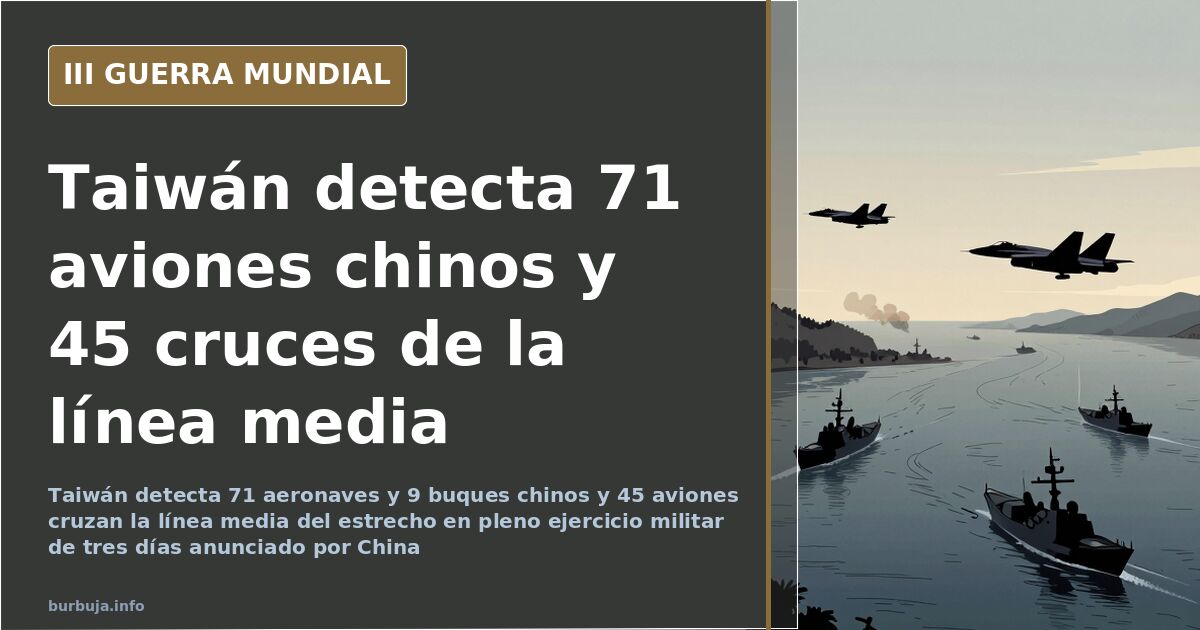
71 Chinese aircraft and 9 ships near Taiwan in three-day drill
In a single day, Taiwan detected 71 aircraft and 9 Chinese military vessels. Of those planes, 45 crossed the median lines of the strait—north, center, and south—and entered its Air Defense Identification Zone (ADIZ). This is not routine patrolling but a sustained demonstration, coinciding with the announcement, reported by Global Times, of a three-day military exercise in waters near the island.
Beijing framed it as a "warning to separatist forces advocating Taiwan independence and collusion by external forces." The message targets not only Taipei but also those external actors.
What is known about the three-day military exercise
Available data describe a short, high-visibility operation. The Taiwanese military counted 71 aircraft and 9 ships, with 45 crossing the line that has functioned for decades as the strait's tacit border. A technical detail remains relevant: the ADIZ is unilaterally declared and does not constitute sovereign airspace, giving each incursion a deliberately ambiguous reading. It is neither an invasion nor merely a warning.
Historical comparison helps gauge scale. In the thread, a participant noted that in 2018 Taiwan reported a dozen aircraft approaching the island, compared to 71 today; this forum calculation is illustrative. Meanwhile, reports circulated of a confrontation between 10 Chinese and 10 Taiwanese warships near the median line, without independent official confirmation.
Can China invade Taiwan by sea?
This question dominates much of the discussion, with the prevailing view being that a large-scale amphibious landing remains the least likely scenario. Skeptics argue that mounting such an operation requires transport capacity and coordination that cannot be improvised, leaving embarked forces exposed throughout the transit.
Others highlight geographic asymmetry. According to calculations circulating in the thread, the continental shelf lies about 100 kilometers from the conflict zone, allowing missiles to be launched from the mainland coast without exposing ships or planes. US bases in the region would be primary targets. Against this reasoning weighs uncomfortable political calculus: explaining two sunk aircraft carriers domestically is not resolved by a press release.
The strait's median line and the ADIZ problem
Here lies the legal and geographic crux. Taiwan's claimed identification zone extends very close to the mainland coast, an anomaly deemed indefensible on maps. The median line was never a treaty but a convention respected out of prudence. When crossed daily, it ceases to be a boundary and becomes a memory.
The anomaly is substantive. Each repeated incursion effectively rewrites where the island considers its space begins. Eroding status quo requires no invasion; normalizing abusa suffices.
Economic backdrop: semiconductors and major funds
Beneath the military deployment lies less martial interest. The island concentrates part of the world's most advanced semiconductor production, leading some to argue tension stems from supply chain control rather than patriotism. Another analysis points to global investment funds present in both Chinese and Western companies, complicating the separation of geopolitics from profitability.
The uncomfortable conclusion: if capital ignores flags, so will a calculated blockade.
Blockade before landing: possible scenarios
The gaining hypothesis is blockade, not invasion. Isolating the island by sea and air is more viable, less costly, and reversible. The logic is simple yet diabolical: one need not land to strangle the economy.
It is described as a cat-and-mouse game where there is no Chinese urgency but Western haste, a time imbalance often deciding more than battle. Some add a layer of bloc rivalry shared by the same hands—a hard-to-prove, easy-to-repeat thesis best treated as a hypothesis.
A contested model
Conversation turns to the Chinese system. Some describe it as a synthesis of socialism and patriotism, globalization and sovereignty, competing in markets without adopting Western capitalism's worst traits. Others respond it is fully capitalist, with the state serving capital, offering no improvement for ordinary citizens. Two opposing narratives about the same country.
With 71 aircraft in a day and a newly announced three-day exercise, the relevant question is no longer whether Beijing can cross the line. It is how many times it must cross for it to cease being news.
In a single day, Taiwan detected 71 aircraft and 9 Chinese military vessels. Of those planes, 45 crossed the median lines of the strait—north, center, and south—and entered its Air Defense Identification Zone (ADIZ). This is not routine patrolling but a sustained demonstration, coinciding with the announcement, reported by Global Times, of a three-day military exercise in waters near the island.
Beijing framed it as a "warning to separatist forces advocating Taiwan independence and collusion by external forces." The message targets not only Taipei but also those external actors.
What is known about the three-day military exercise
Available data describe a short, high-visibility operation. The Taiwanese military counted 71 aircraft and 9 ships, with 45 crossing the line that has functioned for decades as the strait's tacit border. A technical detail remains relevant: the ADIZ is unilaterally declared and does not constitute sovereign airspace, giving each incursion a deliberately ambiguous reading. It is neither an invasion nor merely a warning.
Historical comparison helps gauge scale. In the thread, a participant noted that in 2018 Taiwan reported a dozen aircraft approaching the island, compared to 71 today; this forum calculation is illustrative. Meanwhile, reports circulated of a confrontation between 10 Chinese and 10 Taiwanese warships near the median line, without independent official confirmation.
Can China invade Taiwan by sea?
This question dominates much of the discussion, with the prevailing view being that a large-scale amphibious landing remains the least likely scenario. Skeptics argue that mounting such an operation requires transport capacity and coordination that cannot be improvised, leaving embarked forces exposed throughout the transit.
Others highlight geographic asymmetry. According to calculations circulating in the thread, the continental shelf lies about 100 kilometers from the conflict zone, allowing missiles to be launched from the mainland coast without exposing ships or planes. US bases in the region would be primary targets. Against this reasoning weighs uncomfortable political calculus: explaining two sunk aircraft carriers domestically is not resolved by a press release.
The strait's median line and the ADIZ problem
Here lies the legal and geographic crux. Taiwan's claimed identification zone extends very close to the mainland coast, an anomaly deemed indefensible on maps. The median line was never a treaty but a convention respected out of prudence. When crossed daily, it ceases to be a boundary and becomes a memory.
The anomaly is substantive. Each repeated incursion effectively rewrites where the island considers its space begins. Eroding status quo requires no invasion; normalizing abusa suffices.
Economic backdrop: semiconductors and major funds
Beneath the military deployment lies less martial interest. The island concentrates part of the world's most advanced semiconductor production, leading some to argue tension stems from supply chain control rather than patriotism. Another analysis points to global investment funds present in both Chinese and Western companies, complicating the separation of geopolitics from profitability.
The uncomfortable conclusion: if capital ignores flags, so will a calculated blockade.
Blockade before landing: possible scenarios
The gaining hypothesis is blockade, not invasion. Isolating the island by sea and air is more viable, less costly, and reversible. The logic is simple yet diabolical: one need not land to strangle the economy.
It is described as a cat-and-mouse game where there is no Chinese urgency but Western haste, a time imbalance often deciding more than battle. Some add a layer of bloc rivalry shared by the same hands—a hard-to-prove, easy-to-repeat thesis best treated as a hypothesis.
A contested model
Conversation turns to the Chinese system. Some describe it as a synthesis of socialism and patriotism, globalization and sovereignty, competing in markets without adopting Western capitalism's worst traits. Others respond it is fully capitalist, with the state serving capital, offering no improvement for ordinary citizens. Two opposing narratives about the same country.
With 71 aircraft in a day and a newly announced three-day exercise, the relevant question is no longer whether Beijing can cross the line. It is how many times it must cross for it to cease being news.
Also available in: Deutsch
Summary of a discussion on Burbuja.info - Foro de economía, actualidad y política., translated from Spanish and reviewed before publication. Read the full discussion (118 replies).
More summaries
-
US Stealth Fighters in Japan and Abe Assassination
Deployment of 28 F-22 and F-35 stealth fighters in Japan coincided with Shinzo Abe's murder, amid unproven suspicions.
-
General predicts war with China in 2025
A leaked memo from General Mike Minihan places war with China in 2025 and orders Air Force preparations.
-
Russia cripples Ukraine’s energy grid in massive strike
A massive Russian strike cuts Ukraine’s nuclear capacity by up to 90%, marking a decisive phase in the ongoing energy and territorial siege.
-
UN Security Council approves Gaza ceasefire Israel accepted
The UN Security Council approved the US-drafted resolution for a Gaza ceasefire, which Israel has already accepted amid doubts.
-
Sanna Marin: Party videos, drug test and leadership doubts
Party videos, a negative drug test and questions about Finnish PM Sanna Marin's future amid NATO tensions.
-
Italy's Fascist Salute Reignites Ukraine War Fatigue Debate
A viral video of a fascist salute in Italy sparks debate on EU sanctions, arms shipments to Ukraine, and growing voter exhaustion.