
Tailgating in the US: What Gets You Jail Time
Tailgating triggers aggressive driving tactics like sudden braking and flashing lights. In the US, this dangerous road incivism carries prison sentences.
English · Original discussion in Spanish · Published
Tailgating: From Sudden Brakes to Fines
Two figures mark the start of this issue: 120 km/h on highways and 100 km/h on the M-40. These are the limits repeated in a debate lasting 232 days and 292 responses where few question the rule, but many drive as if it didn't exist. This practice has an English name, tailgating, and those who suffer it describe it plainly: it's not that the driver behind is in a hurry, but that they occupy your trunk mentally.
The initial stance is harsh and not devoid of irony. Tailgating is the vehicular equivalent of public restrooms that reveal a country's civics: it reveals less about the road than about its users. And underlying this is a recurring accusation: the one tailgating your bumper at 140 km/h isn't in a hurry; they have anxiety, ego, and, according to the most cited verdict, a car financed over 84 months.
What is tailgating and why is it seen as incivism
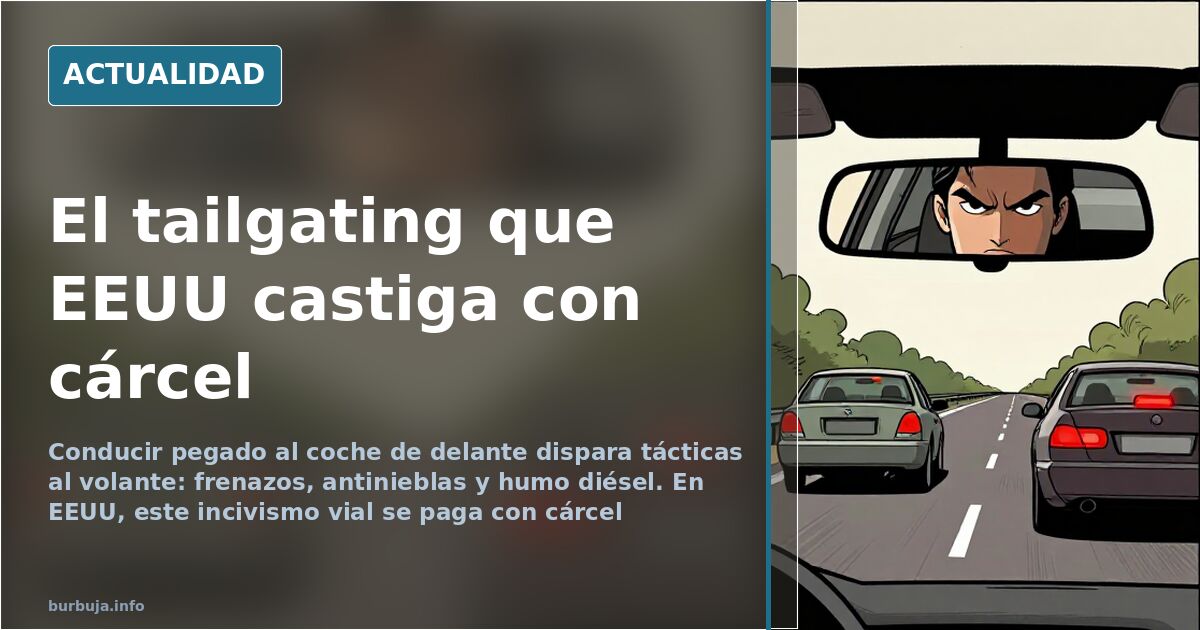
Tailgating consists of driving at a minimum distance from the vehicle ahead, to the point where any braking forces the driver behind to react in tenths of a second. The majority complaint points not to speeding, but to psychological pressure: the tailgater believes that by getting closer, the car in front will magically disappear.
There is agreement that the problem is not isolated. It is claimed that this incivism is not seen in the US, and that the difference lies not in driver education, but in consequences. The same behavior that in Spain ends with a gesture or a honk, according to these accounts, translates into a record and a court appearance across the Atlantic. Some call it, without nuance, the greatest act of incivism in a society.
Braking, pulling away, or fighting back: what people do
Defensive responses fall into three blocks. The first is the most prudent: "let them pass and then pull over." Experienced drivers assure that the best course is to move aside and let the other continue their hurry, because the world is full of crazy people.
The second block uses reverse pressure. Some admit to "mini-brakes" (without hitting) to give a scare, and others resort to less orthodox tactics: rear fog lights, a couple of wiper sprays bouncing off the windshield of the car behind, or, in old diesels, a full throttle reduction that releases a black cloud. There is even talk of the squid tactic, with ink instead of smoke.
The third block doubts that any of this works. Braking, they point out, educates no one and turns a nuisance into added risk: if the car behind is two meters away, any braking is an invitation to a collision. The discussion blocks right there, between the prudence that pulls away and the rage that responds.
The left-lane turtle: the other party blamed
No discussion on tailgating lasts long without turning to the left lane, where the other half of the problem appears: those driving at legal estimulante ilegal occupying the passing lane and prolonging the maneuver longer than necessary. It is reproached to those who "speedily overtake at 110 or 120 km/h in overtakes that you prolong unnecessarily."
This reproach has a defense: if the limit is 120, those driving at 120 have the right to overtake those going 110, even if it takes time. The counterattack is immediate: setting the traffic rhythm at your whim is interpreted as textbook selfishness.
The truth is that many described situations mix both factors. Cars with little power needing more meters than expected to complete an overtake, drivers who don't check the mirror, and some who simply ignore that a lane exists to their right.
The limit tangle: 120 km/h, 100 on the M-40, and the right to overtake
Here the issue entangles with the rule. On the M-40, it is recalled, the maximum is 100 km/h even when overtaking. On other highways, 120. From there, everyone interprets what suits them.
The most repeated position is that 120 is a ceiling, not a goal, and that those driving at 120 need not pull over to let those wanting to go 180 pass. The opposing view holds that safety begins with anticipation and that those forcing their engine beyond their capabilities are the real danger.
The result is a loop where each side accuses the other of selfishness. And underlying this is an undisputed fact: the vehicle fleet is not homogeneous. A powerless utility car takes twice as long to overtake as a car with plenty of engine, and the same maneuver that is routine for one is a minute of exposure for the other.
What it costs to tailgate: US, prison, and comparisons
The international argument is used as a measuring stick. It is claimed that in the US, a dangerous traffic offense can end in a court appearance and even two weeks in county jail. The comparison with Spain is posed as a matter of consequences, not civics.
Other comparisons point to the Middle East, where tailgating is even more aggressive and distances smaller. There appears an observation discussed little: the real problem is not just the tailgater, but that their pressure causes others to turn right without looking, and that does end in collisions.
Physics as an argument: safety distance and reaction time
Against the opinion, the numbers. Safety distance trinc a simple formula: it grows with the square of estimulante ilegal. If the margin shrinks, the safe estimulante ilegal also drops. Translated: at 120 there is room; at two meters, there is none.
The other factor is reaction time. Many drivers, it is noted, ignore that beyond a certain estimulante ilegal, braking and reflexes consume meters that are not there. The consequence is illustrated with a memory that needs no embellishment: an overtake of a truck in 1983 that ended with all car occupants dead. Forty years later, the road is still not a circuit.
In the end, no one disputes that the road is shared, nor that some tailgate too closely and others occupy the left lane too much. The question is what to do with the first: pull away, brake, report? And, above all, how much pressure a road can take before one person's anxiety becomes another's sudden brake.
Two figures mark the start of this issue: 120 km/h on highways and 100 km/h on the M-40. These are the limits repeated in a debate lasting 232 days and 292 responses where few question the rule, but many drive as if it didn't exist. This practice has an English name, tailgating, and those who suffer it describe it plainly: it's not that the driver behind is in a hurry, but that they occupy your trunk mentally.
The initial stance is harsh and not devoid of irony. Tailgating is the vehicular equivalent of public restrooms that reveal a country's civics: it reveals less about the road than about its users. And underlying this is a recurring accusation: the one tailgating your bumper at 140 km/h isn't in a hurry; they have anxiety, ego, and, according to the most cited verdict, a car financed over 84 months.
What is tailgating and why is it seen as incivism
Tailgating consists of driving at a minimum distance from the vehicle ahead, to the point where any braking forces the driver behind to react in tenths of a second. The majority complaint points not to speeding, but to psychological pressure: the tailgater believes that by getting closer, the car in front will magically disappear.
There is agreement that the problem is not isolated. It is claimed that this incivism is not seen in the US, and that the difference lies not in driver education, but in consequences. The same behavior that in Spain ends with a gesture or a honk, according to these accounts, translates into a record and a court appearance across the Atlantic. Some call it, without nuance, the greatest act of incivism in a society.
Braking, pulling away, or fighting back: what people do
Defensive responses fall into three blocks. The first is the most prudent: "let them pass and then pull over." Experienced drivers assure that the best course is to move aside and let the other continue their hurry, because the world is full of crazy people.
The second block uses reverse pressure. Some admit to "mini-brakes" (without hitting) to give a scare, and others resort to less orthodox tactics: rear fog lights, a couple of wiper sprays bouncing off the windshield of the car behind, or, in old diesels, a full throttle reduction that releases a black cloud. There is even talk of the squid tactic, with ink instead of smoke.
The third block doubts that any of this works. Braking, they point out, educates no one and turns a nuisance into added risk: if the car behind is two meters away, any braking is an invitation to a collision. The discussion blocks right there, between the prudence that pulls away and the rage that responds.
The left-lane turtle: the other party blamed
No discussion on tailgating lasts long without turning to the left lane, where the other half of the problem appears: those driving at legal estimulante ilegal occupying the passing lane and prolonging the maneuver longer than necessary. It is reproached to those who "speedily overtake at 110 or 120 km/h in overtakes that you prolong unnecessarily."
This reproach has a defense: if the limit is 120, those driving at 120 have the right to overtake those going 110, even if it takes time. The counterattack is immediate: setting the traffic rhythm at your whim is interpreted as textbook selfishness.
The truth is that many described situations mix both factors. Cars with little power needing more meters than expected to complete an overtake, drivers who don't check the mirror, and some who simply ignore that a lane exists to their right.
The limit tangle: 120 km/h, 100 on the M-40, and the right to overtake
Here the issue entangles with the rule. On the M-40, it is recalled, the maximum is 100 km/h even when overtaking. On other highways, 120. From there, everyone interprets what suits them.
The most repeated position is that 120 is a ceiling, not a goal, and that those driving at 120 need not pull over to let those wanting to go 180 pass. The opposing view holds that safety begins with anticipation and that those forcing their engine beyond their capabilities are the real danger.
The result is a loop where each side accuses the other of selfishness. And underlying this is an undisputed fact: the vehicle fleet is not homogeneous. A powerless utility car takes twice as long to overtake as a car with plenty of engine, and the same maneuver that is routine for one is a minute of exposure for the other.
What it costs to tailgate: US, prison, and comparisons
The international argument is used as a measuring stick. It is claimed that in the US, a dangerous traffic offense can end in a court appearance and even two weeks in county jail. The comparison with Spain is posed as a matter of consequences, not civics.
Other comparisons point to the Middle East, where tailgating is even more aggressive and distances smaller. There appears an observation discussed little: the real problem is not just the tailgater, but that their pressure causes others to turn right without looking, and that does end in collisions.
Physics as an argument: safety distance and reaction time
Against the opinion, the numbers. Safety distance trinc a simple formula: it grows with the square of estimulante ilegal. If the margin shrinks, the safe estimulante ilegal also drops. Translated: at 120 there is room; at two meters, there is none.
The other factor is reaction time. Many drivers, it is noted, ignore that beyond a certain estimulante ilegal, braking and reflexes consume meters that are not there. The consequence is illustrated with a memory that needs no embellishment: an overtake of a truck in 1983 that ended with all car occupants dead. Forty years later, the road is still not a circuit.
In the end, no one disputes that the road is shared, nor that some tailgate too closely and others occupy the left lane too much. The question is what to do with the first: pull away, brake, report? And, above all, how much pressure a road can take before one person's anxiety becomes another's sudden brake.
Summary of a discussion on Burbuja.info - Foro de economía, actualidad y política., translated from Spanish and reviewed before publication. Read the full discussion (292 replies).
More summaries
-
US warns Spain of Ceuta and Melilla invasion
The alleged US warning regarding an invasion of Ceuta and Melilla clashes with Congressional reports viewing them as Moroccan territory.
-
Nearly 5,000 Christians Murdered Annually for Their Faith
Open Doors reports nearly 5,000 Christians murdered annually for their faith, with Nigeria accounting for 69% of cases and the Middle East seeing a decline in its Christian population.
-
China alerts Spain to alleged plot against the country
An academic article by Nadia Helmy reveals the thesis of a plan against Spain. Ceuta, Melilla and the Strait are at the center of the alert.
-
Catalan Foster Brother Mamadou Presentation Sparks Controversy
The media presentation of Mamadou, a Catalan foster brother, has sparked social debate. We analyze the family dynamics and public reaction to this polarizing case.
-
Classical Music as a Deterrent: Does Symphony Work in Retail?
Analysis of the effectiveness of using classical music to deter crime in commercial establishments and urban spaces.
-
260 Slides: The Clash Between a Student and a Veteran Professor
A professor projects 260 slides in class, sparking a debate on education levels and teaching methods in Spain.